
US–South Korea Military Drills Cut Short: Trump’s Kim Jong Un Strategy Raises New Questions for the Alliance
US–South Korea Military Drills Cut Short: Trump’s Kim Jong Un Strategy Raises New Questions for the Alliance The United States and South Korea are abruptly scaling back their major joint military exercises, putting a spotlight on the changing security relationship between Washington, Seoul and Pyongyang. The annual Ulchi Freedom Shield exercise was originally scheduled to...
TheBusinessNow
Aug 19, 2026 · 8 min Read
Key Highlights
- 🇺🇸🇰🇷 US–South Korea military drills are being shortened from 11 days to five.
- Ulchi Freedom Shield will now end August 21, rather than August 27.
- Some live field-training activities are being reduced, canceled or shifted to simulations.
- Trump cited his relationship with North Korean leader Kim Jong Un as part of his reasoning for reducing the exercises.
- Trump has also criticized the cost of the drills and South Korea's decision not to participate in U.S. efforts related to Iran.
- South Korean officials said they were not consulted before Trump's initial directive, according to reporting.
US–South Korea Military Drills Cut Short: Trump’s Kim Jong Un Strategy Raises New Questions for the Alliance
The United States and South Korea are abruptly scaling back their major joint military exercises, putting a spotlight on the changing security relationship between Washington, Seoul and Pyongyang.
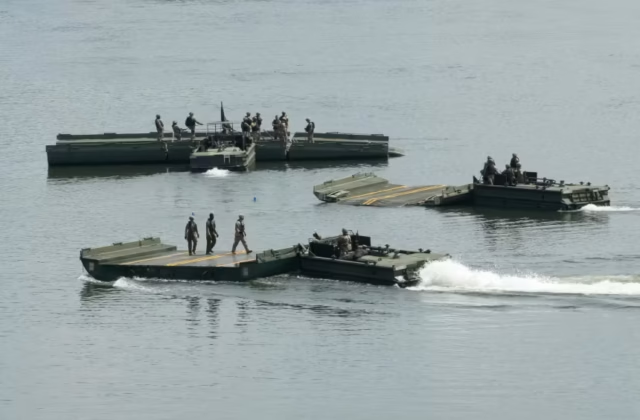
The annual Ulchi Freedom Shield exercise was originally scheduled to run for 11 days, but the two countries have now agreed to shorten it to five days, ending on August 21 instead of August 27. Some live-training activities are also being reduced, canceled or converted into simulations.
The decision follows President Donald Trump’s direction to substantially reduce U.S. participation in the drills. Trump has pointed to his relationship with North Korean leader Kim Jong Un and criticized the exercises as costly and unnecessarily provocative.
That makes the move about much more than a military exercise. It could become an important test of how Washington balances deterrence, diplomacy and its commitments to a major Asian ally.
What Happened to the US–South Korea Military Drills?
Ulchi Freedom Shield is one of the key annual exercises designed to improve the ability of U.S. and South Korean forces to operate together.
This year’s exercise began on August 17. The original schedule called for 11 days of training, but Washington subsequently requested changes to the exercise’s duration and scale.
South Korea’s Defense Ministry confirmed that the allies agreed to make adjustments following the U.S. request. Some combined field-training activities will take place on a smaller scale, while other activities have been canceled or converted into simulations.
U.S. officials have emphasized that the changes are intended to preserve essential readiness and that U.S. training objectives will not be degraded.
That distinction is important: the drills have not simply disappeared. Their scale and schedule have changed.
Why Did Trump Order the Reduction?
Trump’s explanation connects the military decision to both North Korea and Iran.
He has argued that the exercises are expensive and send an unnecessarily hostile signal toward Pyongyang. Trump has also repeatedly highlighted his relationship with Kim Jong Un and has indicated an interest in renewed engagement with the North Korean leader.
The Iran conflict adds another layer.
According to Reuters, Trump was frustrated that South Korea declined to support U.S. efforts related to Iran. That disagreement has contributed to broader questions about burden-sharing and the expectations Washington places on its allies.
The result is an unusual combination: a military decision involving North Korea that is also being influenced by Washington’s wider geopolitical priorities.
Is Trump Trying to Restart Talks With Kim Jong Un?
There are signs that renewed diplomacy with Pyongyang is part of the calculation.
Trump said August 17 that Kim Jong Un had responded to his diplomatic overtures, although he did not provide details about what Kim’s response contained.
Trump and Kim previously held high-profile meetings during Trump’s first presidency. Those talks generated international attention but ultimately failed to produce a lasting agreement over North Korea’s nuclear program.
The latest outreach therefore faces a major question:
Can personal diplomacy produce more this time than it did previously?
North Korea has continued developing its military capabilities and has strengthened relationships with Russia and China, making today’s strategic environment different from the one Trump faced during his earlier meetings with Kim.
Why South Korea Is Watching Closely
For Seoul, the military exercises are not merely symbolic.
The U.S.–South Korea alliance is a central part of South Korea’s defense strategy, particularly given North Korea’s nuclear weapons and missile programs.
South Korean President Lee Jae Myung has responded to the changing U.S. position by emphasizing the importance of strengthening South Korea’s own defense capabilities while maintaining the alliance with Washington. He has also renewed attention on South Korea’s long-standing goal of eventually regaining full wartime operational control of its forces.
That creates a complicated balancing act.
Seoul wants to preserve the credibility of the U.S. security commitment while simultaneously becoming less dependent on Washington.
Does This Mean the US–South Korea Alliance Is Breaking Down?
Not based on the current evidence.
The two militaries are still conducting the exercise, and officials say the revised format preserves essential readiness.
However, the decision could create political and strategic concerns.
Military exercises provide forces with opportunities to practice communications, command structures and coordinated operations. Reducing them repeatedly could eventually affect interoperability and readiness, even if a single shortened exercise does not produce an immediate military consequence.
The bigger issue may therefore be predictability.
Allies need to know how committed Washington will be to joint planning and training if the security environment suddenly deteriorates.
North Korea’s Response Adds Another Dimension
North Korea has historically condemned U.S.–South Korea military exercises, describing them as preparations for aggression.
Reuters reported that Pyongyang denounced the latest drills but notably did not directly attack Trump personally, something analysts viewed as potentially significant given Trump’s renewed outreach to Kim.
That could leave a narrow opening for diplomacy.
But North Korea has not abandoned its broader military strategy, meaning Washington will have to balance any diplomatic opening with continued deterrence.
What Happens Next?
Several developments could determine whether this becomes a temporary adjustment or a broader shift in U.S. policy toward the Korean Peninsula.
1. Will Trump meet Kim again?
Trump has expressed interest in renewed engagement, and reports have linked possible diplomacy to his planned travel to Asia later this year.
2. Will future military exercises also be reduced?
This may be the most important question for Seoul. A one-time change can be managed; repeated reductions could have much greater implications for alliance planning.
3. How will South Korea respond?
Seoul is already emphasizing defense independence, including greater attention to its own military capabilities.
4. What will North Korea demand?
Any meaningful negotiations would likely involve difficult questions surrounding North Korea’s nuclear weapons, sanctions, military posture and security guarantees.
Why This Matters for Markets and the Global Economy
Geopolitical developments on the Korean Peninsula can influence investor sentiment, particularly across Asian markets.
A reduction in tensions could potentially support risk appetite, while a deterioration in U.S.–South Korean relations or renewed North Korean military activity could have the opposite effect.
The situation also comes against a backdrop of heightened geopolitical pressure from the Iran conflict.
For investors, the key issue isn’t simply whether military drills are shorter this year. It is whether the change represents a temporary diplomatic tactic or a deeper restructuring of America’s security commitments in Asia.
About The Business Now
The Business Now covers breaking developments across business, markets, technology, geopolitics, finance and the global economy.
Our approach is to bring together major developments from multiple credible sources and explain what happened, why it matters and what could happen next—rather than simply repeating a breaking-news headline.
For market-focused readers, the platform also connects major geopolitical developments with the broader economic and financial picture.
Live Gold Price
Geopolitical uncertainty can influence investor demand for traditional safe-haven assets such as gold.
For the latest gold market information, readers can check GoldPriceNow.in – Live Gold Price for current gold-price data and related market tools.
Gold prices can move rapidly in response to interest rates, currencies, inflation expectations and geopolitical developments. This article is for information purposes and is not investment advice.
FAQs
Why were the US–South Korea military drills cut short?
The United States requested changes to the exercise’s duration and scale. Trump has criticized the drills as costly and provocative toward North Korea while emphasizing his relationship with Kim Jong Un.
How long will Ulchi Freedom Shield last now?
The exercise was reduced from its planned 11-day schedule to five days, with the revised exercise ending August 21.
Are the US and South Korea ending military cooperation?
No. Both countries continue to conduct joint training, although some activities have been reduced, canceled or moved to simulations. Officials say essential readiness objectives remain intact.
Why is Kim Jong Un important to Trump’s decision?
Trump has repeatedly highlighted his relationship with Kim and has signaled interest in renewed diplomacy with North Korea. He said Kim had responded to his latest outreach, although he did not disclose details.
Could this affect the US–South Korea alliance?
The immediate change does not mean the alliance is ending. However, repeated reductions in joint exercises could raise longer-term questions about military readiness, interoperability and confidence in the U.S. security commitment.
What is South Korea doing in response?
South Korean President Lee Jae Myung has emphasized maintaining the alliance while strengthening South Korea’s independent defense capabilities, including the long-standing objective of regaining full wartime operational control.
Key Resources
- Reuters – US and South Korea scale back military exercises
- Reuters – Trump orders Pentagon to reduce exercises
- Reuters – Trump says Kim responded to his outreach
- The Guardian – South Korea and military independence
- CNN – Military drills cut short
- GoldPriceNow.in – Live Gold Prices
Bottom Line
The shortening of the US–South Korea military drills is more significant than a change to a training calendar. It comes as Trump pushes for renewed engagement with Kim Jong Un, tensions remain high over Iran, and Seoul reassesses how much of its security strategy should depend on Washington.
For now, the alliance remains operational. But the real test will be whether this is a temporary diplomatic maneuver—or the beginning of a broader change in America’s military posture in East Asia.
Keep reading
Related Articles
 Commodities
Oil Nears $95: Could the Iran War Trigger a New U.S. Inflation Shock?
Oil at $95 Is Not the Real Story A crude-oil headline is easy to write: “Oil prices rise as Iran tensions escalate.” Reuters, Bloomberg, CNBC and WSJ can publish that story within minutes. But for TheBusinessNow, that isn’t enough. The bigger question is: What happens to the American economy if oil stays near $95 —...
 Economy
U.S. National Debt Hits $40 Trillion: Why Treasury Yields Are Rising Again
The $40 Trillion Number Is Not the Whole Story The United States has crossed a psychological and financial milestone. $40 trillion. But simply writing “America owes $40 trillion” misses the more important story. The real question for markets is: Who is willing to finance America’s growing debt — and at what interest rate? That question...
 Commodities
Strait of Hormuz Standoff: The Oil Shock That Could Hit the U.S. Economy Next
Strait of Hormuz Standoff: Why the Oil Market Is Getting Nervous Again The oil market is being forced to price a problem that seemed to be easing only weeks ago: the Strait of Hormuz is still not reliably functioning as a normal commercial shipping route. On August 19, Brent crude was trading around $91.20 a...
Comments (0)