
Strait of Hormuz Standoff: The Oil Shock That Could Hit the U.S. Economy Next
Strait of Hormuz Standoff: Why the Oil Market Is Getting Nervous Again The oil market is being forced to price a problem that seemed to be easing only weeks ago: the Strait of Hormuz is still not reliably functioning as a normal commercial shipping route. On August 19, Brent crude was trading around $91.20 a...
TheBusinessNow
Aug 19, 2026 · 8 min Read
Key Highlights
- Brent crude is around $91 per barrel and WTI is around $85, with oil trading near a three-week high as uncertainty over Strait of Hormuz shipping persists.
- The Strait of Hormuz normally carries an enormous share of global energy flows; EIA data put first-half 2025 oil flows at 20.9 million barrels per day, about 20% of global petroleum liquids consumption.
- Current traffic is dramatically below normal: EIA's latest outlook shows Hormuz oil flows averaging only 4.9 million barrels per day in Q2 2026, compared with 21.6 million b/d in Q4 2025.
- The immediate U.S. risk isn't simply gasoline. Diesel, freight, agriculture, manufacturing, airline costs and inflation can all be affected.
- The Federal Reserve has already highlighted the relationship between Middle East conflict, oil prices and U.S. inflation. Its July Monetary Policy Report said PCE energy prices had jumped 24% over the 12 months through May.
Strait of Hormuz Standoff: Why the Oil Market Is Getting Nervous Again
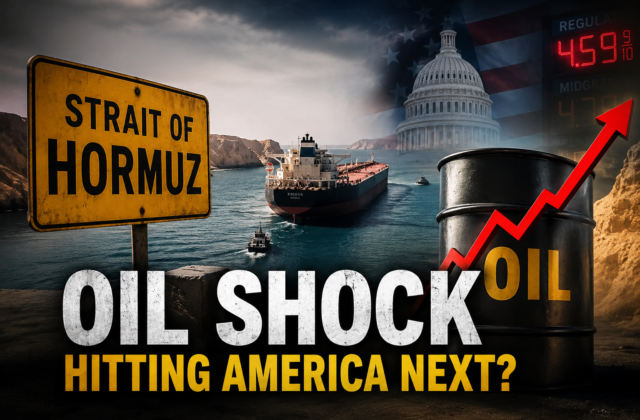
The oil market is being forced to price a problem that seemed to be easing only weeks ago: the Strait of Hormuz is still not reliably functioning as a normal commercial shipping route.
On August 19, Brent crude was trading around $91.20 a barrel, while U.S. WTI was around $85.10. Both benchmarks had earlier reached their highest levels since late July.
The immediate trigger is the continuing disagreement over the status of the waterway.
President Donald Trump has said the strait is open, while Iranian statements have indicated that it remains effectively closed. More importantly for the physical oil market, commercial shipowners are still avoiding the route.
That distinction matters.
An oil route doesn’t become economically “open” merely because a government declares it open.
Tankers have to be willing to sail through it. Insurers have to cover them. Crews have to accept the risk. Ports have to function. Buyers have to believe the cargo will arrive.
Right now, that confidence remains fragile.
Strait of Hormuz Standoff: Why the Oil Market Is Getting Nervous Again
The oil market is being forced to price a problem that seemed to be easing only weeks ago: the Strait of Hormuz is still not reliably functioning as a normal commercial shipping route.
On August 19, Brent crude was trading around $91.20 a barrel, while U.S. WTI was around $85.10. Both benchmarks had earlier reached their highest levels since late July.
The immediate trigger is the continuing disagreement over the status of the waterway.
President Donald Trump has said the strait is open, while Iranian statements have indicated that it remains effectively closed. More importantly for the physical oil market, commercial shipowners are still avoiding the route.
That distinction matters.
An oil route doesn’t become economically “open” merely because a government declares it open.
Tankers have to be willing to sail through it. Insurers have to cover them. Crews have to accept the risk. Ports have to function. Buyers have to believe the cargo will arrive.
Right now, that confidence remains fragile.
🛢️ Why Hormuz Is So Important to the Global Economy
The Strait of Hormuz is one of the world’s most important energy chokepoints.
According to the U.S. Energy Information Administration, oil flows through Hormuz averaged 20.9 million barrels per day during the first half of 2025, equivalent to roughly 20% of global petroleum liquids consumption and about a quarter of global maritime oil trade.
And oil isn’t the only commodity at stake.
EIA says roughly one-fifth of global LNG trade also passes through the strait.
That means a prolonged disruption can transmit the shock through:
Crude oil → refined fuels → transportation → food → manufacturing → inflation → interest rates → financial markets.
That’s why investors are watching Hormuz far beyond the energy sector.
📉 The Most Important Number: Actual Oil Flow
One of the biggest details missing from many basic Hormuz stories is the difference between theoretical capacity and actual physical movement.
EIA’s latest global oil-market data show Hormuz oil flows fell to an average of approximately 4.9 million barrels per day in Q2 2026, compared with 21.6 million barrels per day in Q4 2025.
That is an enormous difference.
It also explains why the market can remain nervous even when alternative pipelines, inventories and other export routes prevent an immediate global oil shortage.
The real question is:
How long can the global oil system compensate for reduced Hormuz flows?
The longer the disruption lasts, the harder it becomes to rely on temporary workarounds.
🇺🇸 What Does the Strait of Hormuz Mean for the U.S. Economy?
The United States is in a stronger position than many major oil-importing economies because domestic production provides a significant energy buffer.
But “less exposed” does not mean “immune.”
Oil is globally priced.
If the marginal barrel becomes more expensive because of a geopolitical supply shock, U.S. consumers and businesses can still feel the impact.
And the transmission mechanism goes far beyond the gasoline station.
1. Gasoline Prices
Crude oil is a major input into gasoline.
If Brent and WTI remain elevated, U.S. gasoline prices can eventually face upward pressure, although the relationship is not one-for-one and refinery margins, inventories, seasonal demand and regional supply also matter.
Higher gasoline prices reduce household purchasing power.
A family spending more on fuel has less money available for:
- restaurants
- retail
- travel
- entertainment
- discretionary purchases
That can eventually affect consumer-facing businesses.
🚛 2. Diesel Could Be the Bigger U.S. Problem
This is one of the most important angles that separates a deeper article from a generic oil story.
The U.S. economy moves on diesel.
Trucks use it.
Farm equipment uses it.
Construction equipment uses it.
Freight networks use it.
And diesel markets are already showing serious pressure.
The Financial Times reported today that U.S. diesel prices have reached around $5.47 per gallon, approaching the previous record, while disruptions in the Middle East and Europe have tightened supply.
WSJ is also reporting that U.S. refiners are supplying a global market facing tighter diesel availability while domestic inventories remain unusually low.
That creates a potentially nasty feedback loop:
Hormuz disruption
↓
Higher crude/refined-product risk
↓
Higher diesel prices
↓
Higher trucking costs
↓
Higher food + retail + manufacturing costs
↓
More inflation pressure
That’s much more important to the U.S. economy than simply asking whether Americans will pay another few cents at the gas pump.
🌾 3. Food Prices Could Feel the Shock
Food doesn’t just become expensive because farms need fertilizer.
It has to be:
grown → harvested → processed → refrigerated → transported → stocked → delivered.
Fuel is embedded throughout that chain.
Higher diesel costs can therefore raise operating expenses for:
- farmers
- trucking companies
- food processors
- warehouses
- distributors
- supermarkets
The impact may not appear immediately in inflation data, but a prolonged energy shock can eventually work its way through the supply chain.
🏭 4. Manufacturing Could Get Hit
Energy is an input into industrial production.
Higher oil and transportation costs can affect manufacturers through:
- freight
- chemicals
- plastics
- packaging
- industrial transportation
- raw-material logistics
The result is a classic economic dilemma:
Companies either absorb higher costs → margins fall
or
Companies pass costs to customers → inflation rises.
Neither outcome is particularly attractive for investors.
✈️ 5. Airlines Are Another Vulnerable Sector
Jet fuel is closely connected to petroleum markets.
If the oil shock becomes persistent, airlines could face higher operating costs.
That matters because airlines have limited ability to immediately pass every cost increase onto customers without affecting demand.
Potential pressure points include:
- ticket prices
- margins
- travel demand
- cargo costs
🏦 The Fed Problem: Oil Could Complicate Interest Rates
This may ultimately be the most important U.S. financial-market consequence.
The Federal Reserve has a difficult balancing act:
Inflation ↓
but
Energy prices ↑
The Fed’s July Monetary Policy Report explicitly linked the earlier rise in oil and gasoline prices to the Middle East conflict and disruption through Hormuz. It said PCE energy prices rose 24% over the 12 months ending in May.
That creates a potential stagflation-style risk.
Scenario A — Hormuz normalizes
Oil supply improves.
→ crude falls
→ gasoline/diesel pressure eases
→ inflation improves
→ Fed gets more room
→ bonds and rate-sensitive assets may benefit
Scenario B — Hormuz remains restricted
Oil stays elevated.
→ transportation costs rise
→ inflation remains sticky
→ Fed becomes more cautious
→ Treasury yields can remain under pressure
→ rate-sensitive stocks may struggle
Scenario C — Major escalation
A substantially larger supply disruption could produce:
→ oil shock
→ inflation shock
→ growth slowdown
→ aggressive market volatility
The third scenario is not a forecast. It is a risk scenario.
📊 What Happens to U.S. Stocks?
The stock-market impact won’t be uniform.
Potential pressure
Airlines
Higher fuel costs.
Transportation
Higher diesel costs.
Consumer discretionary
Less household spending power.
Manufacturing
Higher input costs.
Retail
Higher logistics expenses.
Potential beneficiaries
Oil producers
Higher crude prices can improve revenue and cash flow, depending on their production costs and hedging.
Refiners
A disrupted global refined-products market can create unusually strong refining margins. WSJ has reported that U.S. refiners are benefiting from tight global diesel supply.
Energy services
Higher prices can improve incentives for drilling and production investment.
But investors should distinguish between short-term commodity beneficiaries and companies with durable long-term earnings advantages.
🌍 The Geopolitical Layer: This Isn’t Just an Iran Story
The Hormuz crisis is becoming increasingly interconnected with the wider global energy system.
Russia’s western-port oil exports have also been disrupted, with Reuters reporting a 15% decline amid broader supply problems.
At the same time, the UAE has suspended financial and economic transactions with Iran after an escalation involving alleged Iranian missile launches. Iran has denied the accusation.
That matters because the global oil market isn’t dealing with a single isolated disruption.
It is dealing with multiple geopolitical risks simultaneously.
🧭 The Oil Shock Has Three Clocks
Here’s a framework investors should watch.
⏱️ Clock 1 — Shipping
Are commercial tankers actually returning to Hormuz?
This is the fastest indicator.
⏱️ Clock 2 — Inventories
How quickly are global and U.S. fuel inventories being depleted?
This tells us whether the disruption is becoming economically dangerous.
⏱️ Clock 3 — Inflation
Are higher energy prices becoming embedded in consumer prices?
This is the slowest but potentially most important clock.
If all three move in the wrong direction simultaneously, the U.S. economic risk increases substantially.
🇺🇸 What About the Strategic Petroleum Reserve?
Another factor investors should monitor is the U.S. Strategic Petroleum Reserve.
Recent reporting puts U.S. emergency oil stocks at their lowest level since the early 1980s, meaning policymakers have less inventory flexibility than they might normally prefer during a prolonged energy shock.
That doesn’t mean the United States is about to run out of oil.
It means the policy buffer is smaller.
That’s an important distinction.
🔮 What Happens Next?
The next major market move could depend less on the next headline and more on physical shipping behavior.
🟢 Bullish scenario for consumers
Hormuz traffic normalizes.
Oil risk premium falls.
Brent moves lower.
Diesel pressures ease.
Inflation expectations improve.
🟡 Base-risk scenario
Shipping remains limited but alternative routes and inventories prevent a major shortage.
Oil remains elevated.
Markets stay volatile.
🔴 High-risk scenario
The conflict escalates and physical energy flows deteriorate further.
Oil moves sharply higher.
Diesel and gasoline prices rise.
Inflation expectations increase.
The Fed faces a more difficult policy environment.
This is the scenario that could turn a geopolitical crisis into a broader U.S. economic shock.
📌 TheBusinessNow Market Watch
For readers following this story, these are the numbers that matter most:
| Indicator | Why it matters |
|---|---|
| Brent crude | Global oil benchmark |
| WTI crude | Key U.S. oil benchmark |
| U.S. diesel | Freight and industrial-cost indicator |
| Gasoline prices | Direct consumer impact |
| U.S. crude inventories | Physical supply buffer |
| Treasury yields | Inflation + Fed expectations |
| U.S. CPI/PCE | Measures inflation pressure |
| DXY / U.S. dollar | Global commodity/financial-market transmission |
| Hormuz tanker traffic | Best physical signal of normalization |
| Fed communication | Determines monetary-policy reaction |
💡 TheBusinessNow Take
The biggest mistake investors can make right now is treating the Strait of Hormuz standoff as simply an oil-price story.
It isn’t.
It is potentially:
an oil story → a diesel story → a transportation story → an inflation story → a Fed story → a bond story → a stock-market story.
The U.S. economy has significant energy resilience, but globally priced commodities mean America cannot completely isolate itself from a major disruption at one of the world’s most important energy chokepoints.
For now, $90+ Brent is a warning signal rather than proof of a full-blown U.S. energy crisis.
The bigger warning would come if elevated crude prices combine with persistently high diesel prices, falling inventories and renewed inflation pressure.
That’s the combination investors should watch next.
📈 Why This Matters for Investors
If you’re watching U.S. markets, don’t only watch the headline Brent price.
Watch the chain reaction:
Hormuz → crude → diesel → inflation → Treasury yields → Fed expectations → stocks
That is where the real market signal could emerge.
📰 Related TheBusinessNow Coverage
Continue the story through these related TheBusinessNow articles:
- [US-Iran Tensions Escalate After Military Strikes: Global Markets Brace for Rising Geopolitical Risk] — useful background on how the conflict affects oil, currencies, stocks and global markets.
- [Which Economy Is Winning in 2026? Comparing the U.S., China, India, Europe & Japan Through the Numbers] — useful macroeconomic context for comparing global growth, inflation and interest rates.
- [US Eases AI Chip Export Curbs to UAE: What Nvidia, AI Companies, and Global Investors Need to Know] — another example of how U.S. geopolitical decisions can affect companies, commodities and global investment flows.
Internal-link recommendation: On publication, link this article to the first and third articles using descriptive anchor text such as “U.S.-Iran geopolitical risk”, “global markets and geopolitical tensions”, and “U.S. geopolitical policy and global investors.”
🪙 Shoutout: GoldPriceNow.in
When geopolitical risk rises, investors often monitor gold alongside oil, the dollar and Treasury yields.
For readers who want to follow the precious-metals side of the same macro story, check out GoldPriceNow.in for gold-price coverage, market updates and analysis.
🔗 Key Resources
For this story, TheBusinessNow should cite primary data wherever possible, rather than relying entirely on other news publications.
- U.S. Energy Information Administration — World Oil Transit Chokepoints
- EIA — Global Oil Markets / Short-Term Energy Outlook
- Federal Reserve — July 2026 Monetary Policy Report
- Reuters — Oil hovers near three-week high on Hormuz uncertainty
- Reuters — Trump says no talks planned with Iran, Tehran says Hormuz still shut
- WSJ — Oil rises amid growing concerns over supply disruptions
- WSJ — U.S. refiners capitalize as buyers compete for shrinking diesel supply
- Financial Times — Soaring diesel prices rip across U.S. economy
❓ FAQs
What is the Strait of Hormuz?
The Strait of Hormuz is a narrow waterway connecting the Persian Gulf with the Gulf of Oman. It is one of the world’s most important energy transit routes.
Why does the Strait of Hormuz affect U.S. oil prices?
Oil is traded in a global market. A disruption to a major international supply route can increase the global price of crude even if U.S. domestic production remains substantial.
How much oil normally passes through the Strait of Hormuz?
EIA data show that oil flows averaged 20.9 million barrels per day in the first half of 2025, equivalent to about 20% of global petroleum liquids consumption.
Why are diesel prices important for the U.S. economy?
Diesel powers much of the trucking, agricultural, construction and industrial economy. Higher diesel costs can therefore increase transportation and production expenses.
Could the Hormuz crisis increase U.S. inflation?
Yes. A prolonged energy disruption could raise fuel and transportation costs, which can feed into broader consumer and business prices. The Federal Reserve has already identified energy prices and the Middle East conflict as important inflation factors.
Could the Federal Reserve cut interest rates if oil prices rise?
Not necessarily. Higher oil prices can create a difficult policy trade-off: they can weaken economic growth while simultaneously increasing inflation. The Fed’s response would depend on the persistence and breadth of the inflation impact.
Which U.S. industries could benefit from higher oil prices?
Oil producers and some refiners may benefit, although company-specific exposure, costs, inventories and hedging strategies matter. U.S. refiners are currently benefiting from tight global diesel markets.
Could oil reach $100?
It is possible, but not a certainty. A move toward $100 would depend on the duration and severity of the physical supply disruption, shipping conditions, inventories, alternative routes and geopolitical developments.
Is the U.S. economy protected from the Hormuz crisis?
The U.S. is relatively better positioned than many major oil-importing economies because of its domestic energy production, but it remains exposed to global crude and refined-product prices.
What should investors watch now?
The most important indicators are Brent, WTI, U.S. diesel prices, crude inventories, tanker traffic through Hormuz, Treasury yields, inflation data and Federal Reserve commentary.
Keep reading
Related Articles
 Commodities
Oil Nears $95: Could the Iran War Trigger a New U.S. Inflation Shock?
Oil at $95 Is Not the Real Story A crude-oil headline is easy to write: “Oil prices rise as Iran tensions escalate.” Reuters, Bloomberg, CNBC and WSJ can publish that story within minutes. But for TheBusinessNow, that isn’t enough. The bigger question is: What happens to the American economy if oil stays near $95 —...
 Economy
U.S. National Debt Hits $40 Trillion: Why Treasury Yields Are Rising Again
The $40 Trillion Number Is Not the Whole Story The United States has crossed a psychological and financial milestone. $40 trillion. But simply writing “America owes $40 trillion” misses the more important story. The real question for markets is: Who is willing to finance America’s growing debt — and at what interest rate? That question...
 Business
Japan’s Bond Market Is Sending a Warning: 10-Year Yields Near 3% Put the BOJ and Government Under Pressure
Japan’s Bond Market Is Sending a Warning: 10-Year Yields Near 3% Put the BOJ and Government Under Pressure Japan’s once-unthinkably low borrowing costs are disappearing. As the 10-year Japanese government bond yield approaches 3%, investors are reassessing inflation, government spending, the yen and the next move from the Bank of Japan. Japan’s bond market is...
Comments (0)