
U.S. National Debt Hits $40 Trillion: Why Treasury Yields Are Rising Again
The $40 Trillion Number Is Not the Whole Story The United States has crossed a psychological and financial milestone. $40 trillion. But simply writing “America owes $40 trillion” misses the more important story. The real question for markets is: Who is willing to finance America’s growing debt — and at what interest rate? That question...
TheBusinessNow
Aug 20, 2026 · 8 min Read

Key Highlights
- U.S. total public debt outstanding has crossed $40 trillion for the first time, according to Treasury data reported by Reuters.
- The debt milestone arrives as investors demand higher returns to hold longer-term U.S. government bonds.
- The 30-year Treasury yield recently reached 5.337%, its highest level since 2007, before falling after the Treasury announced larger long-term bond buybacks.
- The Treasury has doubled certain long-term debt buybacks from $2 billion to at least $4 billion per operation, beginning September 9.
- On August 20, the 30-year yield moved back up to around 5.22%, showing that the buyback announcement has not eliminated concerns about the long-term fiscal outlook.
- The Federal Reserve currently has a federal-funds target range of 3.50%–3.75%, while inflation remains above its 2% goal.
The $40 Trillion Number Is Not the Whole Story
The United States has crossed a psychological and financial milestone.
$40 trillion.
But simply writing “America owes $40 trillion” misses the more important story.
The real question for markets is:
Who is willing to finance America’s growing debt — and at what interest rate?
That question is suddenly becoming much more important as long-term Treasury yields rise.
Reuters reported that total U.S. debt outstanding crossed the $40 trillion threshold on August 19. The milestone comes after the debt more than doubled in less than a decade, while investors have become increasingly concerned about deficits, interest costs and the government’s long-term fiscal position.
At the same time, the Treasury has taken the unusual step of increasing certain long-duration bond buybacks.
That combination gives us the real story:
$40T debt + large deficits + higher yields + rising interest costs = a growing U.S. fiscal challenge.
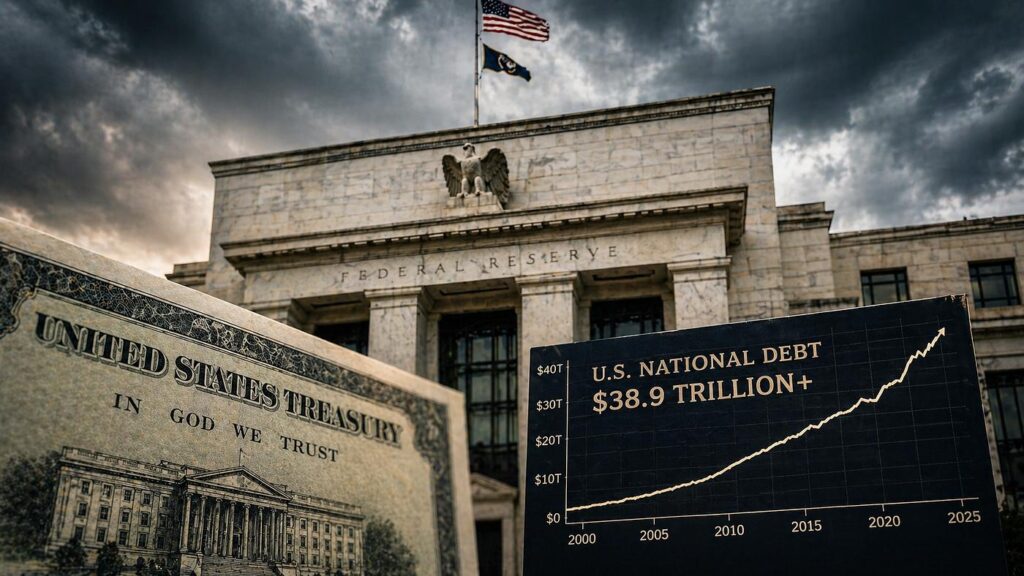
The $40 Trillion Number Is Not the Whole Story
The United States has crossed a psychological and financial milestone.
$40 trillion.
But simply writing “America owes $40 trillion” misses the more important story.
The real question for markets is:
Who is willing to finance America’s growing debt — and at what interest rate?
That question is suddenly becoming much more important as long-term Treasury yields rise.
Reuters reported that total U.S. debt outstanding crossed the $40 trillion threshold on August 19. The milestone comes after the debt more than doubled in less than a decade, while investors have become increasingly concerned about deficits, interest costs and the government’s long-term fiscal position.
At the same time, the Treasury has taken the unusual step of increasing certain long-duration bond buybacks.
That combination gives us the real story:
$40T debt + large deficits + higher yields + rising interest costs = a growing U.S. fiscal challenge.
📊 U.S. Debt at a Glance
| Indicator | Latest picture |
|---|---|
| Total U.S. debt | >$40 trillion |
| 2026 projected federal deficit | $1.9 trillion |
| 2026 debt held by public / GDP | 101% |
| 30-year Treasury recent high | 5.337% |
| 30-year yield Aug. 20 | ~5.22% |
| 10-year Treasury Aug. 20 | ~4.66% |
| Fed funds target | 3.50%–3.75% |
| 30-year mortgage average, Aug. 6 | 6.69% |
Sources: U.S. Treasury, Federal Reserve, CBO and Freddie Mac.
🧠 First: What Does “$40 Trillion Debt” Actually Mean?
The headline number refers to the federal government’s outstanding debt.
But there are two important categories:
Debt held by the public
Money the federal government owes to investors outside the federal government, including:
- households
- banks
- pension funds
- mutual funds
- foreign investors
- insurance companies
- the Federal Reserve
Intragovernmental debt
Money one part of the federal government owes another part.
For economic analysis, debt held by the public is particularly important because it represents borrowing from the broader financial system.
The Congressional Budget Office projects debt held by the public at 101% of GDP in 2026, rising to 120% of GDP by 2036 under its baseline.
You can monitor the government’s daily debt directly through the Treasury’s Debt to the Penny database.
📈 Why Are Treasury Yields Rising?
This is where the story becomes much more important for investors.
A Treasury bond has a price and a yield.
Generally:
Bond price ↓ → yield ↑
Bond price ↑ → yield ↓
When investors become less comfortable holding long-duration government debt, they can demand a higher yield.
Several forces are currently pushing in that direction.
1. Government Borrowing Is Huge
The federal government continues to run large deficits.
The CBO projects a $1.9 trillion deficit for fiscal 2026. It also projects that debt held by the public will rise from 101% of GDP in 2026 to 120% by 2036.
More borrowing means the Treasury has to keep issuing debt.
That creates a huge supply of bonds that the market must absorb.
2. Investors Want More Compensation for Long-Term Risk
This is one of the most important concepts for readers to understand.
A 30-year Treasury isn’t simply a bet on today’s Federal Reserve interest rate.
An investor holding a 30-year bond is exposed to:
- future inflation
- future deficits
- future Treasury issuance
- economic growth
- monetary policy
- fiscal policy
- political uncertainty
So investors may demand a higher term premium to hold long-duration debt.
Reuters reported that the 30-year Treasury yield climbed to 5.337%, the highest level since 2007, as investors worried about inflation and high government debt.
🏦 3. The Treasury Is Now Trying to Calm the Long End
This is the freshest part of the story.
On August 19, Treasury Secretary Scott Bessent announced that the Treasury would double the size of certain liquidity-support buyback operations for longer-dated debt.
The size of each operation will increase from $2 billion to at least $4 billion, covering parts of the 10-to-30-year maturity spectrum. The program is scheduled to run from September 9 through November 4.
Initially, the announcement helped push long-term yields lower.
The 30-year yield dropped almost 10 basis points to around 5.19% after the announcement.
But the relief didn’t last.
By August 20, the 30-year yield had climbed back toward 5.22%.
That’s the important signal.
The market may be saying:
Buybacks can improve liquidity, but they don’t solve the underlying fiscal problem.
Reuters reported that analysts questioned whether the Treasury’s intervention would provide lasting relief.
💣 Why Treasury Buybacks Don’t Solve the $40 Trillion Problem
Imagine the U.S. government has a massive mortgage.
The Treasury can improve the structure of its financing.
But that doesn’t automatically reduce:
the underlying debt
or
the annual deficit.
The buyback program is primarily a market-liquidity tool.
It can help the functioning of the Treasury market by purchasing older or less-liquid securities.
But it does not magically eliminate:
- federal deficits
- entitlement spending pressures
- interest expenses
- future borrowing needs
That’s why investors are still watching the long end of the Treasury curve.
💰 The Hidden Cost: Interest on America’s Debt
This may ultimately be the most important part of the entire story.
The government doesn’t just borrow money.
It pays interest on that borrowing.
And when interest rates are higher, refinancing maturing debt becomes more expensive.
The CBO projects federal net interest outlays of around $1.0 trillion in 2026, rising to approximately $2.1 trillion by 2036 under its baseline.
That creates a feedback loop:
Debt ↑
↓
Interest expense ↑
↓
Budget deficit ↑
↓
More borrowing
↓
Debt ↑
This doesn’t mean a U.S. default is imminent.
It means fiscal flexibility becomes increasingly constrained.
🏠 What Does $40 Trillion of U.S. Debt Mean for Mortgage Rates?
This is where the story becomes relevant to ordinary Americans.
The Federal Reserve controls the federal-funds rate, but it does not directly set the 30-year mortgage rate.
Mortgage rates are heavily influenced by longer-term market interest rates, including Treasury yields.
Freddie Mac’s latest available weekly survey before publication showed the average 30-year fixed mortgage at 6.69% on August 6, compared with 6.66% the week before.
So if long-term Treasury yields remain elevated, mortgage borrowers could continue facing a higher-rate environment even if the Fed eventually cuts short-term rates.
This is an important distinction:
Fed cuts ≠ automatically cheap mortgages.
The long-term bond market matters.
🏡 The Mortgage Connection
Think about the chain:
U.S. fiscal concerns
↓
Treasury yields rise
↓
Long-term borrowing costs remain elevated
↓
Mortgage rates face upward pressure
↓
Monthly payments remain high
↓
Housing affordability stays difficult
That makes Treasury yields one of the most important variables for the U.S. housing market.
💳 What About Credit Cards and Personal Loans?
Credit cards are generally more closely linked to short-term interest rates than 30-year mortgages.
That means the Federal Reserve’s policy rate remains particularly important.
The Fed currently maintains the federal-funds target range at 3.50%–3.75%.
But the broader bond market still matters for the financial environment.
If investors continue demanding higher yields across the Treasury curve, businesses and households can face a generally more expensive financing environment.
📉 What Does This Mean for U.S. Stocks?
This is where the debt story meets Wall Street.
Higher Treasury yields can pressure stocks because:
Investors can earn more from relatively low-risk government securities.
That can make expensive equities less attractive.
At the same time, higher discount rates reduce the present value of future corporate earnings.
This can particularly affect:
- technology stocks
- growth stocks
- speculative companies
- highly leveraged businesses
🤖 Why AI Stocks Are Particularly Sensitive
Many technology and AI companies are valued on expectations of enormous future earnings.
When long-term interest rates rise, investors typically apply a higher discount rate to those future cash flows.
That can compress valuations.
This doesn’t mean:
Treasury yields rise = AI stocks must crash.
Corporate earnings, productivity growth and AI investment can still dominate the valuation equation.
But the relationship matters.
The Federal Reserve itself has noted that productivity growth and capital investment remain strong while financial conditions are being influenced by inflation and geopolitical uncertainty.
🏦 The Fed Has a Complicated Problem
The Federal Reserve is facing a difficult environment.
At its July meeting, the FOMC maintained the federal-funds target at 3.50%–3.75%.
The Fed said economic activity was expanding at a solid pace, but inflation remained elevated relative to its 2% target.
That means the central bank can’t simply respond to high Treasury yields with aggressive rate cuts.
If inflation remains sticky, cutting rates too aggressively could create another problem.
The policy dilemma:
Cut rates
→ potentially support growth and lower short-term borrowing costs
but
→ risk keeping inflation elevated.
Keep rates higher
→ help restrain inflation
but
→ keep borrowing conditions tight.
And meanwhile, the Treasury must finance a huge amount of government debt.
🌎 The Global Problem
The U.S. isn’t operating in isolation.
Other major economies are also dealing with higher borrowing costs and fiscal pressures.
Reuters reported that long-term government bond yields have been elevated globally, including in the U.K., Germany and Japan.
That matters because U.S. Treasuries compete for global capital.
If investors can earn attractive yields elsewhere, the U.S. has to remain competitive.
This is one reason the Treasury market deserves attention far beyond Washington.
📊 What Investors Should Watch Now
Forget trying to predict the exact next move.
Watch these indicators.
| Indicator | Why it matters |
|---|---|
| 30-year Treasury yield | Long-term borrowing pressure |
| 10-year Treasury yield | Key benchmark for financial markets |
| Treasury auctions | Measures demand for new government debt |
| Federal deficit | Determines future borrowing requirements |
| Inflation expectations | Influences required bond yields |
| Fed policy | Controls short-term interest rates |
| Mortgage rates | Consumer/housing transmission |
| Oil prices | Inflation risk |
| Dollar | Global demand for U.S. assets |
| Stock valuations | Sensitivity to higher discount rates |
The U.S. Treasury publishes daily constant-maturity Treasury yields, while the Federal Reserve publishes its own H.15 interest-rate data.
🔮 Three Possible Scenarios
🟢 Scenario 1: Yields Fall
If inflation cools and investors become more comfortable with Treasury supply:
Treasury yields ↓
→ mortgage pressure ↓
→ bond prices ↑
→ growth stocks potentially benefit
→ borrowing costs improve.
🟡 Scenario 2: Yields Stay High
This could become the new normal.
5%+ long-term yields
→ expensive mortgages
→ higher corporate financing costs
→ pressure on high valuations
→ larger government interest expense.
This is arguably the most important scenario for investors right now.
🔴 Scenario 3: Fiscal Concerns Intensify
If deficits continue expanding while inflation remains elevated:
Debt ↑
Inflation ↑
Bond supply ↑
→ investors demand even higher yields.
That could create a more serious feedback loop.
Again, this is a risk scenario, not a prediction.
🇺🇸 What Does This Mean for the Average American?
The $40 trillion number won’t suddenly arrive on a household’s credit-card statement.
The transmission is indirect.
But it can still affect Americans through:
🏠 Housing
Mortgage rates and affordability.
🚗 Auto loans
Financing costs.
💳 Credit
Borrowing conditions.
📈 Retirement
Stock and bond market valuations.
🛒 Prices
If fiscal pressure contributes to inflation.
💼 Jobs
If high rates slow business investment.
🏢 Companies
Higher financing costs can affect expansion and hiring.
That’s why the debt story isn’t merely a Washington accounting story.
It is a market story.
🧭 TheBusinessNow’s Bottom Line
The $40 trillion U.S. national debt milestone is psychologically important.
But investors shouldn’t stop at the headline.
The bigger story is the interaction between:
Federal debt → deficits → Treasury issuance → bond yields → mortgage rates → corporate borrowing → stocks → economic growth
The Treasury’s decision to double some long-term buybacks may temporarily improve liquidity, but the market’s reaction on August 20 shows investors are still demanding a meaningful return for holding long-duration U.S. debt.
And that is the number to watch.
Not simply $40 trillion.
The real question is the price America pays to finance it.
📌 THE BUSINESSNOW MARKET CHECKLIST
Every morning, watch:
🇺🇸 10Y Treasury
🇺🇸 30Y Treasury
📈 S&P 500
💻 Nasdaq
💵 Dollar Index
🛢️ Brent / WTI
🏠 Mortgage rates
🏦 Fed expectations
📊 Treasury auctions
💰 Federal deficit
This is the data combination that can tell you whether the $40 trillion milestone is becoming a bigger market problem—or simply another historic number.
🔗 Read More on TheBusinessNow
These are the best internal-link opportunities I found on your existing site:
1. Wall Street / U.S. stocks
Link to:
Wall Street Rally Continues: Nasdaq Leads, S&P 500 Climbs Higher, and Dow Jones Extends Gains
🪙 TheBusinessNow × GoldPriceNow
Debt, Treasury yields, the dollar, inflation and geopolitical risk all feed into precious-metals markets.
For readers tracking that side of the macro picture:
GoldPriceNow.in — Gold prices and market analysis
Recommended placement: Near the end of the article, not above the main content.
Suggested copy:
Tracking the other side of the macro trade? When investors reassess Treasury yields, inflation and geopolitical risk, precious metals can also become a major market focus. Follow the latest gold-market data and analysis at GoldPriceNow.in.
📚 Key Resources & Primary Sources
For TheBusinessNow, use primary sources whenever possible. This is one of the biggest improvements I’d make versus simply rewriting Reuters/WSJ.
🇺🇸 U.S. Treasury
Daily federal debt data.
📊 U.S. Treasury Yield Curve
U.S. Treasury — Daily Treasury Par Yield Curve Rates
🏦 Federal Reserve
Federal Reserve — Monetary Policy
Current FOMC decisions, minutes and monetary-policy information.
📈 Federal Reserve Interest Rates
Federal Reserve — H.15 Selected Interest Rates
Daily Treasury and other benchmark interest-rate data.
🏛️ Congressional Budget Office
CBO — The Budget and Economic Outlook: 2026–2036
Deficit, debt and interest-cost projections.
🏠 Freddie Mac
Weekly U.S. mortgage-rate data.
📰 Reuters — $40T debt
Reuters — U.S. debt crosses $40 trillion
📰 Reuters — Treasury buybacks
Reuters — Treasury doubles long-bond buybacks
📰 Reuters — Bond-market reaction
Reuters — Bonds bounce on U.S. buybacks, but relief may be brief
📰 MarketWatch — JPMorgan warning
MarketWatch — Treasury buyback concerns and JPMorgan’s warning
❓ FAQs
What does the $40 trillion U.S. national debt mean?
It means total U.S. federal debt outstanding has crossed the $40 trillion threshold. The Treasury’s daily debt data track the government’s outstanding obligations.
Why are Treasury yields rising?
Investors are demanding higher returns amid concerns about inflation, government borrowing, Treasury supply and the long-term fiscal outlook. The 30-year yield recently reached its highest level since 2007.
Does $40 trillion of debt mean the U.S. is going bankrupt?
No. The debt milestone itself does not mean a U.S. default is imminent. The more important issue is the sustainability of deficits, interest costs and investor demand for Treasury securities.
How does U.S. debt affect mortgage rates?
Mortgage rates are influenced heavily by longer-term market rates. If long-term Treasury yields remain elevated, mortgage rates can face upward pressure. Freddie Mac’s 30-year mortgage average was 6.69% on August 6, 2026.
Will the Federal Reserve cut rates?
The Fed’s latest policy decision kept the federal-funds target range at 3.50%–3.75%. Future decisions will depend on inflation, employment and economic conditions.
What are Treasury bond buybacks?
Treasury buybacks involve the government purchasing certain outstanding Treasury securities. The latest increase is designed partly to support liquidity in longer-duration Treasury markets.
Can Treasury buybacks solve the U.S. debt problem?
No. Buybacks can influence liquidity and the structure of Treasury-market supply, but they do not eliminate federal deficits or the government’s outstanding debt.
Why does the 30-year Treasury yield matter?
The 30-year Treasury is a major indicator of long-term borrowing conditions and can influence mortgage rates, corporate financing and the valuation of long-duration assets.
Could high Treasury yields hurt stocks?
They can. Higher yields can increase discount rates and make bonds relatively more attractive compared with stocks. High-growth companies can be particularly sensitive to changes in long-term rates.
What should investors watch next?
Watch 10-year and 30-year Treasury yields, Treasury auctions, inflation expectations, the federal deficit, Fed policy, mortgage rates and stock-market valuations.
Keep reading
Related Articles
 Crypto
₿ Bitcoin Breaks Above $72,000: Why Trump’s Crypto Push Is Sending Crypto Stocks Higher
Bitcoin’s $72,000 Move Is Bigger Than Bitcoin A typical crypto headline would be: Bitcoin jumps above $72,000. But that misses the most important part of today’s move. The interesting part is the simultaneous rally in: Bitcoin ↓ Coinbase ↓ Strategy ↓ Circle ↓ Robinhood ↓ Bitcoin miners ↓ Crypto infrastructure That tells us investors aren’t...
 Markets
U.S. Treasury Doubles Bond Buybacks: Why Markets Are Still Worried About Rising Yields
The Treasury Just Sent Two Messages to Wall Street At first glance, this looks like a straightforward market-support operation. Treasury says: We want to improve liquidity in longer-dated Treasury securities. Investors hear: Washington is increasingly concerned about the rise in long-term borrowing costs. And that second interpretation is what makes this story important. The Treasury...
 Commodities
Oil Nears $95: Could the Iran War Trigger a New U.S. Inflation Shock?
Oil at $95 Is Not the Real Story A crude-oil headline is easy to write: “Oil prices rise as Iran tensions escalate.” Reuters, Bloomberg, CNBC and WSJ can publish that story within minutes. But for TheBusinessNow, that isn’t enough. The bigger question is: What happens to the American economy if oil stays near $95 —...
Comments (0)