
U.S. Army Operations in the Middle East Show Continued Focus on Air Defense, Mobility and Readiness
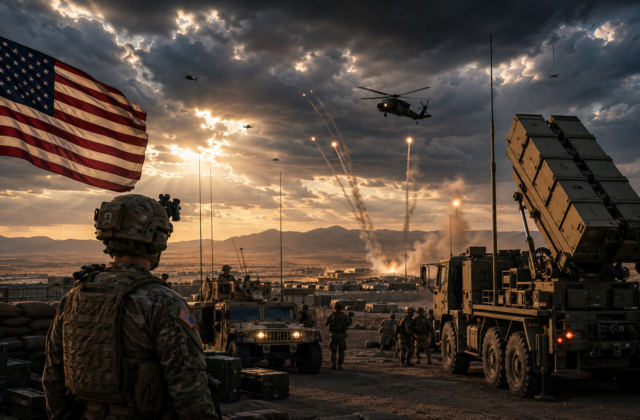
U.S. Army Operations in the Middle East Show Continued Focus on Air Defense, Mobility and Readiness The U.S. Army continues conducting a range of operations and readiness activities in the Middle East, with recent official imagery showing soldiers working with Patriot air-defense systems, THAAD equipment, helicopters, artillery, communications systems and logistics assets. The imagery was...
Ruth James
Aug 3, 2026 · 4 min Read
Key Highlights
- 🇺🇸 U.S. Army units continue operations and training activities in the Middle East.
- 🛡️ Recent imagery shows Patriot and THAAD air-defense systems being operated, maintained and positioned.
- 🚁 CH-47 Chinook helicopters have been photographed conducting routine flight and logistics operations.
- 💥 Army personnel have also conducted 155mm M777 artillery live-fire training.
- 📡 Soldiers have worked with tactical communications and counter-drone equipment.
- 📦 Logistics and ammunition resupply remain important parts of maintaining regional readiness.
- 📸 The images were released through official U.S. military channels, including U.S. Army Central and DVIDS.
U.S. Army Operations in the Middle East Show Continued Focus on Air Defense, Mobility and Readiness
The U.S. Army continues conducting a range of operations and readiness activities in the Middle East, with recent official imagery showing soldiers working with Patriot air-defense systems, THAAD equipment, helicopters, artillery, communications systems and logistics assets.
The imagery was released through official U.S. Army and Defense Department channels, including U.S. Army Central (USARCENT) and DVIDS. Importantly, the available material is primarily photographic documentation of military activities; it does not by itself establish that a new offensive operation has begun or provide details about a specific combat mission.
What Do the Recent U.S. Army Images Show?
The latest collection titled “U.S. Army Soldiers Conduct Operations in the Middle East” includes a variety of military activities.
USARCENT’s official image archive shows photographs from July 2026 featuring air-defense artillerymen working with Patriot systems, paratroopers conducting weapons training and CH-47 Chinook helicopters participating in flight operations.
The imagery provides a snapshot of the different capabilities U.S. Army units maintain in the region.
These include:
- Air defense
- Aviation
- Artillery
- Logistics
- Maintenance
- Communications
- Small-arms training
- Counter-unmanned aircraft systems
The broad range of activities illustrates the importance of readiness and sustainment for U.S. forces operating across the U.S. Central Command area of responsibility.
Patriot Air Defense Systems Remain a Major Focus
Several of the official photographs feature MIM-104 Patriot systems.
The Patriot is the Army’s primary terminal-phase air-defense system, designed to detect and engage certain incoming threats.
USARCENT imagery from June and July shows soldiers positioning, maintaining and supporting Patriot systems in the Middle East.
One June photograph shows an Army air-defense artilleryman watching spent Patriot interceptors being cross-loaded for transportation. Another shows a soldier conducting maintenance on a Patriot interceptor and launch platform.
These activities highlight an important but often overlooked part of military operations:
Keeping sophisticated defense systems operational requires continuous maintenance, logistics and trained personnel.
THAAD Adds Another Layer of Missile Defense
The official imagery also documents the presence and maintenance of Terminal High Altitude Area Defense, or THAAD, equipment.
A U.S. Army photograph shows an air-defense artilleryman inspecting a THAAD launcher in the U.S. Central Command area of responsibility. The Army describes THAAD as a system designed to intercept ballistic missiles during their terminal phase.
The presence of both Patriot and THAAD capabilities demonstrates the layered nature of U.S. missile-defense architecture.
Different systems can perform different roles depending on the type and trajectory of an incoming threat.
However, the released imagery does not provide enough information to determine the specific operational missions associated with individual systems.
Chinook Helicopters Support Regional Operations
Army aviation is another prominent feature of the imagery.
Official photographs show CH-47 Chinook helicopters conducting flight operations in the Middle East.
The Chinook is a heavy-lift helicopter used to transport personnel, equipment and supplies.
A July 15 image shows three Chinooks preparing to land during routine flight operations.
Earlier imagery also shows Army aircrews and logisticians loading ammunition onto a Chinook in the U.S. Central Command area of responsibility.
These activities demonstrate how aviation and logistics work together to support forces operating far from permanent bases in the United States.
Artillery and Weapons Training Continue
The official USARCENT image archive also documents 155mm M777 howitzer live-fire training.
A July 13 photograph shows U.S. Army paratroopers firing a 155mm round from an M777 during a field artillery live-fire exercise in the Middle East.
Other imagery shows soldiers conducting marksmanship training with the M4 carbine.
These activities are important for maintaining basic combat readiness even when an image does not indicate that the personnel are involved in active combat.
Counter-Drone Capabilities Are Also Visible
Another important capability appearing in the imagery is the Army’s Coyote counter-unmanned aircraft system.
A June 25 photograph shows a U.S. Army paratrooper working with a Coyote system in the Middle East. The Army describes the system as part of its counter-UAS capabilities.
The growing presence of unmanned aircraft has made counter-drone technology increasingly important to military forces.
Protecting personnel, equipment and installations from small unmanned aircraft is now an important component of modern force protection.
Logistics May Be the Most Important Part of the Story
Military operations depend on much more than weapons.
Fuel, ammunition, spare parts, transportation, communications and maintenance are essential for keeping units operational.
USARCENT’s imagery illustrates this repeatedly.
Photographs show soldiers conducting ammunition resupply for Patriot systems, working on launchers and handling equipment required to keep military systems functioning.
That means the recent images should not simply be viewed as photographs of weapons.
They also document the logistical infrastructure supporting U.S. military readiness in the region.
What Does This Mean for the Middle East?
The imagery confirms that U.S. Army personnel remain active across the Middle East under the U.S. Central Command area of responsibility.
But it is important not to overstate what the photographs prove.
The official material establishes that soldiers are conducting operations, training, maintenance, aviation and logistics activities.
It does not, by itself, confirm a new war, a new offensive, or a specific escalation.
That distinction matters when reporting on military developments.
Why the Images Matter
Military photographs can provide valuable information even when operational details are limited.
They can show:
Equipment → readiness → logistics → training → regional posture.
For analysts and observers, repeated imagery of particular systems can provide insight into the capabilities U.S. forces are maintaining in the region.
At the same time, official military imagery typically does not disclose sensitive operational information such as precise locations, future missions or tactical plans.
The recent USARCENT collection follows that pattern, with several photographs identifying the location only broadly as the Middle East or the U.S. Central Command area of responsibility.
The Bigger Picture
The Middle East remains a strategically important region for U.S. military planning.
The recent Army imagery demonstrates that maintaining regional readiness requires a combination of:
- Air and missile defense
- Aviation
- Artillery
- Logistics
- Communications
- Maintenance
- Counter-drone capabilities
- Individual and unit training
The photographs also demonstrate the complexity of sustaining military forces in a geographically dispersed environment.
Rather than one single capability dominating the collection, the imagery shows a network of systems and personnel working together.
Final Thoughts
The latest U.S. Army imagery from the Middle East offers a detailed look at the day-to-day military activities supporting U.S. regional readiness.
Patriot and THAAD systems, Chinook helicopters, artillery, counter-drone equipment, ammunition logistics and weapons training all appear across the official imagery released by U.S. Army Central and DVIDS.
The photographs are significant, but they should be interpreted carefully.
They demonstrate ongoing U.S. Army activity and preparedness in the Middle East — not necessarily the beginning of a new military offensive.
❓ FAQs
What are the new U.S. Army Middle East images showing?
The images show soldiers conducting air-defense operations, aviation activities, maintenance, logistics, artillery training and other readiness activities.
Are Patriot systems being used by U.S. Army forces in the Middle East?
Official Army imagery shows soldiers operating, maintaining and supporting Patriot systems in the region.
What is THAAD?
THAAD, or Terminal High Altitude Area Defense, is a U.S. missile-defense system designed to intercept ballistic missiles during their terminal phase.
What is the CH-47 Chinook used for?
The Chinook is a heavy-lift helicopter used to transport personnel, equipment and supplies. Recent Army imagery shows Chinooks conducting flight and logistics operations in the Middle East.
Does the imagery confirm a new U.S. military offensive?
No. The available official imagery documents military operations, training and readiness activities but does not by itself confirm a new offensive or provide evidence of a specific combat operation.
Who released the photographs?
The photographs are available through official U.S. military sources, including U.S. Army Central and DVIDS, the Defense Visual Information Distribution Service.
📰 About The Business Now
The Business Now delivers coverage of global politics, business, finance, technology, markets and major international developments with fact-based reporting and analysis.
🪙 Check Live Gold Prices
Track Gold, Silver, Platinum and Palladium prices, historical charts, calculators and daily market updates at:
🌐 External Resources
Keep reading
Related Articles
 Commodities
Oil Nears $95: Could the Iran War Trigger a New U.S. Inflation Shock?
Oil at $95 Is Not the Real Story A crude-oil headline is easy to write: “Oil prices rise as Iran tensions escalate.” Reuters, Bloomberg, CNBC and WSJ can publish that story within minutes. But for TheBusinessNow, that isn’t enough. The bigger question is: What happens to the American economy if oil stays near $95 —...
 Economy
U.S. National Debt Hits $40 Trillion: Why Treasury Yields Are Rising Again
The $40 Trillion Number Is Not the Whole Story The United States has crossed a psychological and financial milestone. $40 trillion. But simply writing “America owes $40 trillion” misses the more important story. The real question for markets is: Who is willing to finance America’s growing debt — and at what interest rate? That question...
 Commodities
Strait of Hormuz Standoff: The Oil Shock That Could Hit the U.S. Economy Next
Strait of Hormuz Standoff: Why the Oil Market Is Getting Nervous Again The oil market is being forced to price a problem that seemed to be easing only weeks ago: the Strait of Hormuz is still not reliably functioning as a normal commercial shipping route. On August 19, Brent crude was trading around $91.20 a...
Comments (0)