
221 Dead, 67 Boat Strikes, Yet Cocaine Keeps Flowing: Inside the U.S. Drug War Strategy Facing Tough New Questions
221 Dead, 67 Boat Strikes, Yet Cocaine Keeps Flowing: Inside the U.S. Drug War Strategy Facing Tough New Questions A Growing Debate Over America’s Maritime Drug Strategy The United States’ fight against international cocaine trafficking has entered a new phase of scrutiny after recent reporting questioned whether an intensified maritime interdiction campaign is achieving its...
TheBusinessNow
Jul 27, 2026 · 3 min Read
Key Highlights
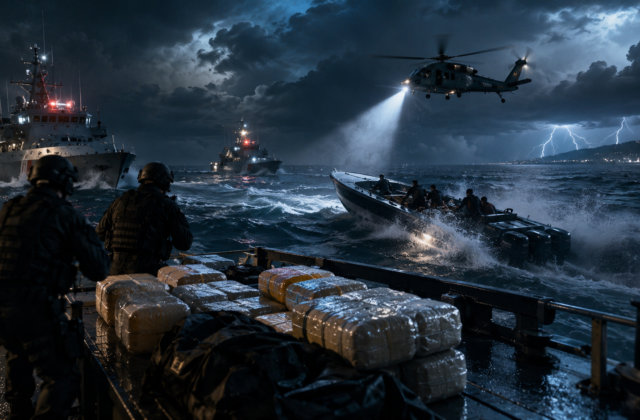
- 🚤 The Washington Post reported 67 maritime boat strikes resulting in approximately 221 reported deaths during U.S.-supported counter-narcotics operations.
- 🌎 Despite intensified enforcement, officials cited in the report said cocaine trafficking routes remain active.
- ⚖️ Human-rights organizations have raised concerns over transparency, accountability, and civilian protections.
- 🛡️ The U.S. government maintains that maritime interdictions remain a critical part of national security and anti-cartel operations.
- 📊 Experts say measuring success requires more than seizure numbers, including cartel finances, trafficking routes, and street-level drug availability.
- 🤝 International cooperation between the U.S. and Latin American partners continues to play a major role in maritime drug enforcement.
221 Dead, 67 Boat Strikes, Yet Cocaine Keeps Flowing: Inside the U.S. Drug War Strategy Facing Tough New Questions
A Growing Debate Over America’s Maritime Drug Strategy
The United States’ fight against international cocaine trafficking has entered a new phase of scrutiny after recent reporting questioned whether an intensified maritime interdiction campaign is achieving its intended objectives.
A report published by The Washington Post states that 67 U.S.-supported boat strikes have resulted in approximately 221 deaths, while officials cited by the newspaper reportedly concluded that cocaine trafficking into the United States has not slowed significantly despite the expanded operations.
At the same time, The New Republic highlighted internal assessments that it says challenge public claims of success, while the Washington Office on Latin America (WOLA) has raised human-rights concerns regarding the conduct of certain maritime operations.
The U.S. government, however, maintains that disrupting transnational criminal organizations remains a national security priority and that maritime operations continue to remove large quantities of narcotics from trafficking networks.
The discussion has evolved into a broader policy debate: Are increasingly aggressive interdiction efforts producing measurable long-term results, or is the strategy reaching its limits?
What The Washington Post Reported
According to The Washington Post, U.S.-supported maritime operations have expanded substantially in recent years.
The newspaper reported:
- Approximately 67 reported boat strike operations
- Around 221 reported fatalities
- Officials indicating that cocaine trafficking has continued despite increased enforcement efforts
The report argues that while interdiction operations may disrupt individual trafficking routes, overall cocaine supply networks remain resilient because criminal organizations rapidly adapt by shifting transportation methods and routes.
The article does not conclude that enforcement has failed but raises questions about whether tactical successes are translating into strategic outcomes.
The New Republic’s Perspective
The New Republic focused on reported internal assessments involving U.S. drug enforcement efforts.
According to its reporting, data reviewed by the publication suggests that public claims regarding the campaign’s effectiveness may not fully align with operational assessments.
Its reporting emphasizes:
- Continued cocaine movement despite intensified operations.
- Questions regarding long-term deterrence.
- Whether interdiction alone can significantly reduce drug availability.
These reports contribute to an ongoing policy discussion rather than establishing definitive conclusions.
WOLA’s Human Rights Concerns
The Washington Office on Latin America (WOLA) approached the issue from a human-rights perspective.
The organization argues that aggressive maritime enforcement raises important legal and humanitarian questions, including:
- Use of force standards.
- Civilian protections.
- Transparency in maritime operations.
- Accountability mechanisms.
WOLA has called for greater oversight and independent review where fatalities occur during interdiction efforts.
Official U.S. Government Position
U.S. officials continue to defend maritime counter-narcotics operations.
Government agencies have consistently argued that these missions are intended to:
- Disrupt transnational criminal organizations.
- Reduce the flow of narcotics.
- Protect U.S. borders.
- Improve regional security cooperation.
- Support partner nations combating organized crime.
Officials also note that success cannot be measured solely by changes in street-level drug availability because criminal networks constantly adjust their operations.
The Pentagon and partner agencies have emphasized that removing trafficking vessels, seizing narcotics, and limiting cartel logistics remain important operational objectives.
Why Cocaine Trafficking Continues
Experts frequently note that drug trafficking operates as a highly adaptive global supply chain.
When one route is disrupted, criminal organizations often:
- Open alternative maritime corridors.
- Shift toward land transportation.
- Increase use of semi-submersibles.
- Employ smaller, faster vessels.
- Expand regional distribution networks.
This flexibility makes long-term disruption difficult despite tactical interdiction successes.
Measuring Success Is More Complicated Than It Appears
Counter-narcotics experts generally evaluate several indicators rather than relying on a single statistic.
These include:
| Metric | Why It Matters |
|---|---|
| Drug seizures | Indicates interdiction activity |
| Street prices | Reflect supply changes |
| Purity levels | Shows availability |
| Cartel finances | Measures economic disruption |
| Violence | Indicates criminal adaptation |
| Trafficking routes | Shows operational shifts |
Some analysts argue that increasing seizures alone do not necessarily prove overall success if production simultaneously increases.
Economic Impact
Drug trafficking represents one of the world’s largest illicit markets.
Its effects extend beyond law enforcement.
Impacted sectors include:
- Insurance
- Shipping
- Maritime security
- International trade
- Tourism
- Border management
- Regional investment
Governments across Latin America continue investing billions of dollars annually in maritime surveillance and anti-smuggling operations.
International Cooperation
The United States works alongside multiple partner nations throughout the Caribbean and Eastern Pacific.
Joint operations often involve:
- Intelligence sharing
- Naval patrols
- Coast Guard cooperation
- Air surveillance
- Regional security agreements
Supporters argue international coordination remains essential because trafficking organizations operate across multiple jurisdictions.
Critics Say More Than Enforcement Is Needed
Many policy researchers argue that enforcement alone cannot solve global narcotics trafficking.
Suggested complementary approaches include:
- Economic development
- Anti-corruption initiatives
- Judicial reform
- Addiction treatment
- Financial investigations targeting cartel assets
- International cooperation against money laundering
Supporters of this broader approach believe demand reduction and institutional strengthening are equally important.
What Happens Next?
The recent reporting is likely to generate further congressional oversight, policy discussion, and debate over future funding priorities.
Key questions include:
- How should success be measured?
- Should operational tactics change?
- What level of transparency is appropriate?
- Can regional cooperation be strengthened?
- How should humanitarian concerns be addressed?
These questions are expected to remain central as policymakers evaluate future counter-narcotics strategy.
Final Analysis
Recent reporting by The Washington Post, The New Republic, and WOLA has intensified debate over America’s maritime counter-drug strategy. While the reporting raises questions about whether expanded interdiction efforts have significantly reduced cocaine trafficking, U.S. officials continue to defend the operations as an important component of broader national security and law enforcement efforts.
The available reporting highlights an ongoing policy discussion rather than a settled conclusion. As governments, researchers, and oversight bodies continue evaluating the effectiveness of maritime enforcement, the challenge remains balancing operational security, humanitarian concerns, international cooperation, and measurable long-term outcomes in one of the world’s most complex criminal networks.
❓ FAQs About The Business Now
1. What is The Business Now?
The Business Now is an independent digital news platform covering global business, financial markets, geopolitics, technology, personal finance, commodities, and economic policy.
2. Why should I read The Business Now?
We focus on data-driven journalism, in-depth analysis, market trends, and global developments that affect investors, businesses, and consumers.
3. Does The Business Now provide financial advice?
No. Articles are for informational and educational purposes only and should not be considered investment or financial advice.
4. How often is The Business Now updated?
The platform publishes breaking news, market updates, and detailed analysis throughout the day.
5. Can I follow live market coverage on The Business Now?
Yes. We regularly publish updates on stocks, commodities, cryptocurrencies, economic data, and global financial events.
🪙 Check Live Gold Prices
Stay updated with real-time Gold, Silver, Platinum, Palladium, and global precious metals prices along with investment guides, historical charts, calculators, and daily market analysis.
👉 Visit: https://goldpricenow.in
🌐 External Resources
- The Washington Post – https://www.washingtonpost.com/
- U.S. Department of Defense – https://www.defense.gov/
- U.S. Coast Guard – https://www.uscg.mil/
- U.S. Drug Enforcement Administration (DEA) – https://www.dea.gov/
- Washington Office on Latin America (WOLA) – https://www.wola.org/
- United Nations Office on Drugs and Crime (UNODC) – https://www.unodc.org/
Editorial Note: This analysis is based on publicly reported information from the sources listed above. As this is an evolving story, official findings, investigations, or additional reporting may provide further context or updates.
Keep reading
Related Articles
 Commodities
Oil Nears $95: Could the Iran War Trigger a New U.S. Inflation Shock?
Oil at $95 Is Not the Real Story A crude-oil headline is easy to write: “Oil prices rise as Iran tensions escalate.” Reuters, Bloomberg, CNBC and WSJ can publish that story within minutes. But for TheBusinessNow, that isn’t enough. The bigger question is: What happens to the American economy if oil stays near $95 —...
 Economy
U.S. National Debt Hits $40 Trillion: Why Treasury Yields Are Rising Again
The $40 Trillion Number Is Not the Whole Story The United States has crossed a psychological and financial milestone. $40 trillion. But simply writing “America owes $40 trillion” misses the more important story. The real question for markets is: Who is willing to finance America’s growing debt — and at what interest rate? That question...
 Commodities
Strait of Hormuz Standoff: The Oil Shock That Could Hit the U.S. Economy Next
Strait of Hormuz Standoff: Why the Oil Market Is Getting Nervous Again The oil market is being forced to price a problem that seemed to be easing only weeks ago: the Strait of Hormuz is still not reliably functioning as a normal commercial shipping route. On August 19, Brent crude was trading around $91.20 a...
Comments (0)