
Trump Takes White House Ballroom Fight to Supreme Court as Emergency Docket Heats Up
Trump Takes White House Ballroom Fight to Supreme Court as Emergency Docket Heats Up The Trump administration has taken the White House ballroom dispute to the U.S. Supreme Court, asking the justices to allow construction to continue while the legal battle moves forward. The move has pushed the controversial project onto the Supreme Court’s emergency...
TheBusinessNow
Aug 16, 2026 · 3 min Read
Key Highlights
- The Trump administration has asked the U.S. Supreme Court to allow White House ballroom construction to continue.
- The emergency request follows a D.C. Circuit ruling that halted above-ground construction.
- The planned ballroom is approximately 90,000 square feet and has been described as a roughly $400 million project in current reporting.
- The administration argues that security and national-security considerations justify continuing the work.
- Lower courts have questioned whether the president can undertake the project without Congressional approval.
- The National Trust for Historic Preservation is among the groups challenging the project.
Trump Takes White House Ballroom Fight to Supreme Court as Emergency Docket Heats Up
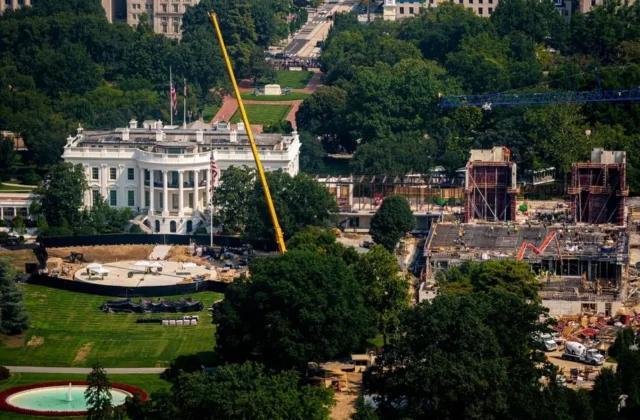
The Trump administration has taken the White House ballroom dispute to the U.S. Supreme Court, asking the justices to allow construction to continue while the legal battle moves forward. The move has pushed the controversial project onto the Supreme Court’s emergency docket and turned a dispute over a building project into a broader test of presidential authority, congressional power and judicial oversight.
The administration’s emergency application follows a D.C. Circuit ruling that blocked above-ground construction, finding that the project lacked the necessary congressional authorization. The Supreme Court has not yet ruled on whether to grant the administration’s request.
The dispute is now bigger than the ballroom itself.
At its center is a fundamental question: How much authority does a president have to make major changes to the White House without Congress?
🏛️ Why Is the White House Ballroom in Court?
The controversy began with Trump’s plan to replace the White House’s East Wing with a large ballroom and associated infrastructure.
The administration has argued that the project is privately funded and serves practical purposes, including improving security and creating a larger space for major official events.
Opponents challenged the legality of the construction.
The key legal argument against the project is that the executive branch cannot simply undertake a major structural alteration of the White House without the authorization Congress normally provides for federal construction.
The D.C. Circuit sided with the challengers and upheld a halt on above-ground work.
That decision is what brought the dispute directly to the Supreme Court.
⚖️ What Is Trump Asking the Supreme Court to Do?
The administration isn’t asking the Supreme Court to immediately resolve every underlying legal question.
Instead, it is seeking emergency relief that would allow construction to continue while the broader litigation proceeds.
That distinction is important.
An emergency application can determine what happens while a case is being litigated, without necessarily representing the Court’s final answer on the underlying constitutional or statutory questions.
The administration argues that stopping construction could create serious security and operational problems.
The plaintiffs, meanwhile, argue that the project should remain subject to the normal legal and congressional approval process.
💰 How Much Is the Ballroom Project Costing?
The project’s price tag has become one of the major political issues surrounding the dispute.
Current reporting puts the ballroom project at roughly $400 million, although broader estimates involving associated White House construction and security work have generated different figures.
The administration has emphasized private funding for the ballroom.
Critics have questioned whether related security infrastructure could ultimately involve public resources and whether Congress should have a role in approving major changes to federal property.
That financial disagreement is closely connected to the larger constitutional dispute.
🛡️ Why Does the Trump Administration Say the Project Is Necessary?
National security is one of the administration’s central arguments.
Government lawyers have argued that the project incorporates security-related infrastructure and that threats to presidential safety make the construction especially important.
The administration has cited alleged assassination attempts and other security concerns in its Supreme Court filing.
That argument changes the legal framing.
Instead of presenting the ballroom simply as an architectural or event-space project, the administration is portraying the broader construction as part of a security infrastructure surrounding the presidency.
Opponents dispute the extent to which that justification can override congressional authority and existing legal requirements.
🏛️ The Bigger Constitutional Question
The ballroom dispute raises an issue that could matter well beyond the White House.
The United States government divides power among three branches:
Congress → makes laws and controls federal spending
Executive branch → carries out laws and manages the federal government
Courts → interpret the law and resolve disputes
The question here is where the boundary lies when a president wants to make a major change to federal property.
If the administration can proceed without Congress, opponents argue that presidential power could expand considerably.
If courts can stop such a project based on statutory and constitutional requirements, the case reinforces the role of Congress and the judiciary in checking executive action.
That’s why the Supreme Court’s eventual handling of the case could be more important than the ballroom itself.
🚨 Why the Supreme Court’s Emergency Docket Matters
The Supreme Court’s emergency docket has become an increasingly important mechanism for resolving disputes while litigation is still underway.
Rather than waiting years for a case to reach a final judgment, parties can ask the justices to temporarily pause or restore lower-court orders.
That’s essentially what the Trump administration is attempting here.
The administration wants immediate relief because construction is already underway and delays could complicate the project.
The National Trust and other opponents want the lower-court restrictions to remain in place while the legal challenge continues.
🗳️ The Ballroom Case Isn’t the Only Trump Fight Reaching the Court
The Supreme Court’s emergency workload is expanding beyond the ballroom dispute.
The Trump administration is also seeking Supreme Court intervention over restrictions on its efforts to change mail-in voting procedures ahead of the 2026 midterm elections.
A federal judge in Boston blocked parts of Trump’s executive order involving mail ballots, concluding that the administration lacked the constitutional authority to impose the restrictions.
The administration has asked the Supreme Court to intervene.
That means the justices could soon be dealing with multiple disputes involving the limits of executive authority.
📬 Why the Mail-Ballot Case Could Be Even More Politically Sensitive
The mail-voting dispute has an immediate electoral dimension.
The administration’s order sought to change how the U.S. Postal Service handles certain mail ballots and establish new federal requirements.
Opponents argue that elections are primarily administered by the states and that the president cannot unilaterally impose the proposed restrictions.
The administration argues that the changes are necessary to protect election integrity.
With the November 2026 midterms approaching, any Supreme Court decision could have practical consequences for election administration.
🔥 Trump’s Response Adds Another Layer to the Fight
Trump has also responded publicly to the ballroom litigation.
In a post reported by Forbes and other outlets, he attacked opponents of the project and referred to them as “TREASONISTS.”
The rhetoric illustrates how politically charged the legal dispute has become.
But Trump’s public statements and the legal question before the Supreme Court are separate matters.
The justices will ultimately have to examine the legal authority for the construction rather than simply deciding which side has the stronger political argument.
🏗️ Why the Project’s Progress Matters
The administration has emphasized that construction is already significantly advanced.
According to reporting on the Supreme Court filing, the project was approximately 65% complete, making the timing of the litigation especially important.
Every additional day of construction could make an eventual court-ordered reversal more complicated and expensive.
That is one reason the administration wants emergency relief rather than waiting for the full appeals process to play out.
🧑⚖️ What Are the Opponents Arguing?
The National Trust for Historic Preservation and other challengers argue that the administration cannot bypass Congress when undertaking such a substantial change to the White House.
Their case also raises concerns about historic preservation and the government’s compliance with applicable legal procedures.
The D.C. Circuit’s decision provided an important boost to those arguments by finding that the administration lacked the necessary congressional approval for the project.
The Supreme Court will now decide whether the lower-court restrictions should remain in effect while the broader legal fight continues.
🔍 What Happens Next?
The immediate question is whether the Supreme Court grants the administration’s emergency request.
The Court could:
- Allow construction to continue temporarily.
- Leave the lower-court restrictions in place.
- Issue a narrower order affecting only certain portions of the construction.
- Take additional action before ultimately resolving the underlying legal dispute.
A temporary decision would not necessarily settle the entire case.
The final legal battle could continue even after the justices decide what happens to construction in the short term.
📅 Why the Timing Is Critical
The D.C. Circuit’s order is particularly consequential because construction is already underway.
The administration wants the Supreme Court to act before the lower-court restrictions fully take effect.
Reporting indicates the administration is facing an August 21 deadline tied to the construction halt, making the Supreme Court’s emergency response potentially decisive for the project’s immediate future.
That compressed timeline is exactly the type of situation in which the emergency docket becomes important.
📈 What Could the Supreme Court Decision Mean for Presidential Power?
There are several possible implications.
If the Court allows construction to continue
It could give the administration significant breathing room and allow the project to advance while litigation continues.
If the Court keeps the halt
The decision would strengthen the lower courts’ position that major changes to the White House require congressional authorization.
If the Court issues a narrow ruling
The justices could separate security-related work from the ballroom itself, allowing some construction to continue while other work remains blocked.
The exact legal reasoning will matter as much as the immediate result.
🔮 Outlook: Why Investors and Markets May Be Watching
At first glance, a White House construction dispute may seem unrelated to financial markets.
But investors often watch political and legal battles involving the presidency because they can signal the direction of broader policy.
A sustained conflict between the executive branch and courts can increase uncertainty around:
- government spending;
- election policy;
- regulation;
- trade;
- immigration;
- national security;
- and future executive actions.
The immediate financial impact of the ballroom case is likely limited.
The institutional implications, however, could be much larger if the Supreme Court uses the case to clarify the limits of presidential authority.
🪙 What Does This Mean for Gold?
Political uncertainty can influence investor interest in traditional safe-haven assets, although the ballroom case alone should not be treated as a direct gold-price catalyst.
Gold is generally more sensitive to broader forces such as:
- Federal Reserve interest-rate expectations;
- U.S. Treasury yields;
- the dollar;
- inflation;
- geopolitical risk;
- and global investor demand.
For readers tracking gold alongside major U.S. political and economic developments, GoldPriceNow.in — Live Gold Price is available for current gold-price information.
Note: I could not retrieve the live price from GoldPriceNow.in during this check, so I have not inserted an unverified gold-price number.
🏁 Bottom Line
The White House ballroom dispute has evolved into a much broader confrontation over presidential power, congressional authority and judicial oversight.
The Trump administration wants the Supreme Court to allow construction to continue while its appeal proceeds.
Opponents argue that the project cannot move forward without congressional authorization.
At the same time, a separate battle over Trump’s mail-voting restrictions is also pressing toward the Supreme Court.
That combination explains why the Court’s emergency docket is attracting so much attention.
The next major development will be the justices’ response to the ballroom request — and whether they choose to let construction continue while the larger legal battle plays out.
❓ FAQs
Why is Trump asking the Supreme Court about the White House ballroom?
The Trump administration is asking the Supreme Court to allow construction to continue after a lower appellate court upheld restrictions on above-ground work.
How much is the White House ballroom expected to cost?
Current reporting puts the ballroom project at approximately $400 million, although broader construction and security estimates have produced different totals.
Why did a lower court stop construction?
The D.C. Circuit ruled that the administration lacked the necessary congressional approval for the major White House construction project.
Is the Supreme Court stopping the ballroom project?
The Supreme Court had not issued a final decision on the administration’s emergency request in the latest reporting used for this article.
What is the Supreme Court emergency docket?
It is a mechanism through which the justices can consider urgent requests for temporary relief from lower-court decisions while litigation continues.
Why does the ballroom case matter beyond the building?
The dispute raises questions about the balance between presidential authority and Congress’s role in approving major federal construction and spending.
What is the National Trust for Historic Preservation’s role?
The organization is among the groups challenging the project and argues that the administration must comply with legal requirements governing changes to the White House.
Is Trump’s mail-voting dispute also before the Supreme Court?
Yes. The administration has asked the Supreme Court to intervene after lower courts blocked parts of Trump’s effort to change federal rules concerning mail voting.
When could the ballroom construction halt take effect?
Recent reporting indicates the lower-court restriction could take effect around August 21, increasing pressure for the Supreme Court to act.
🌐 Key Resources
- Reuters — Trump asks Supreme Court to allow White House ballroom construction
- AP News — Trump administration’s Supreme Court request
- The Guardian — Trump takes ballroom dispute to Supreme Court
- The Hill — Supreme Court emergency docket coverage
- Forbes — Trump’s response to the ballroom case
- U.S. Supreme Court — Official docket database
- GoldPriceNow.in — Live Gold Price
Keep reading
Related Articles
 Commodities
Oil Nears $95: Could the Iran War Trigger a New U.S. Inflation Shock?
Oil at $95 Is Not the Real Story A crude-oil headline is easy to write: “Oil prices rise as Iran tensions escalate.” Reuters, Bloomberg, CNBC and WSJ can publish that story within minutes. But for TheBusinessNow, that isn’t enough. The bigger question is: What happens to the American economy if oil stays near $95 —...
 Economy
U.S. National Debt Hits $40 Trillion: Why Treasury Yields Are Rising Again
The $40 Trillion Number Is Not the Whole Story The United States has crossed a psychological and financial milestone. $40 trillion. But simply writing “America owes $40 trillion” misses the more important story. The real question for markets is: Who is willing to finance America’s growing debt — and at what interest rate? That question...
 Commodities
Strait of Hormuz Standoff: The Oil Shock That Could Hit the U.S. Economy Next
Strait of Hormuz Standoff: Why the Oil Market Is Getting Nervous Again The oil market is being forced to price a problem that seemed to be easing only weeks ago: the Strait of Hormuz is still not reliably functioning as a normal commercial shipping route. On August 19, Brent crude was trading around $91.20 a...
Comments (0)