
Russia’s War Comes Home: Why Ukraine’s Strikes Are Hitting Everyday Russians Like Never Before
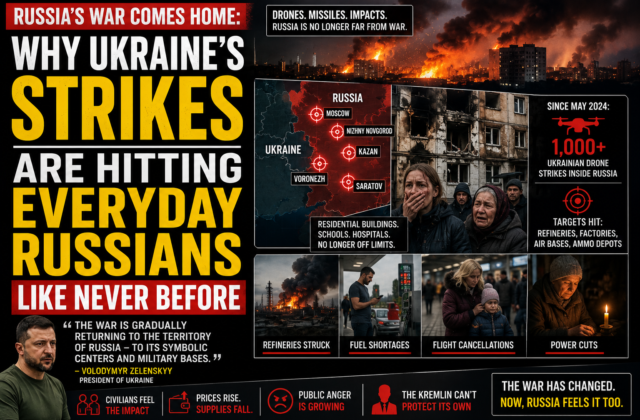
Russia’s War Comes Home: Why Ukraine’s Strikes Are Hitting Everyday Russians Like Never Before For much of the conflict, the daily realities of the Russia-Ukraine war were felt primarily on Ukrainian soil. But that dynamic is changing. Ukraine has significantly expanded its long-range drone campaign, targeting military facilities, logistics hubs, energy infrastructure, and industrial sites...
TheBussinessNow
Jul 24, 2026 · 3 min Read
Key Highlights
- 🚁 Ukraine's long-range drone campaign is increasingly reaching targets deep inside Russia.
- 🏢 Russian businesses, including logistics and e-commerce operations, are experiencing growing disruption.
- 📦 Supply chains and commercial infrastructure are becoming more exposed to the conflict.
- 🌍 The war's economic consequences are becoming more visible within Russia itself.
- 📈 Global investors continue monitoring geopolitical developments for their impact on commodities, energy, and financial markets.
- 🛡️ Russia continues strengthening air defenses while adapting to evolving battlefield tactics.
Russia’s War Comes Home: Why Ukraine’s Strikes Are Hitting Everyday Russians Like Never Before
For much of the conflict, the daily realities of the Russia-Ukraine war were felt primarily on Ukrainian soil. But that dynamic is changing.
Ukraine has significantly expanded its long-range drone campaign, targeting military facilities, logistics hubs, energy infrastructure, and industrial sites deep inside Russia. These attacks are increasingly disrupting business operations, transportation, and everyday life, bringing the consequences of the war closer to ordinary Russians.
Recent reports highlighting disruptions at Wildberries, Russia’s largest online retailer, illustrate how the conflict is increasingly affecting the country’s commercial and economic activity.
Ukraine’s Strategy Is Evolving
Ukraine has steadily increased its use of long-range drones capable of reaching targets hundreds of kilometers from the front line.
Military analysts say these operations aim to:
- Disrupt military supply chains.
- Damage logistics infrastructure.
- Pressure Russia’s defense industry.
- Increase the economic cost of the war.
- Force Russia to divert additional air defense resources.
Rather than focusing solely on front-line operations, Ukraine is attempting to stretch Russian military capabilities across a much larger geographic area.
Russian Businesses Are Feeling the Pressure
One of the clearest signs of this shift is the growing disruption to Russian companies.
According to recent reporting, attacks affecting facilities connected to Wildberries—often described as Russia’s largest e-commerce platform—have highlighted how commercial businesses are becoming indirectly affected by the broader conflict.
Business disruptions may include:
- Warehouse operations.
- Delivery networks.
- Supply chains.
- Employee safety concerns.
- Higher insurance and security costs.
While military targets remain the stated objective of Ukraine’s campaign, nearby civilian economic activity can also be affected when infrastructure is disrupted.
Everyday Life Is Changing
For many Russians living far from the border, the war previously felt distant.
That perception is shifting as reports of:
- Air raid alerts.
- Temporary airport closures.
- Drone interceptions.
- Transportation delays.
- Security restrictions.
become more common in regions previously untouched by direct military activity.
These developments do not affect every part of Russia equally, but they have increased public awareness that the conflict can have domestic consequences.
Why Infrastructure Matters
Modern warfare increasingly targets logistics as much as front-line positions.
Infrastructure plays a critical role in sustaining military operations.
Key assets include:
- Railways.
- Fuel depots.
- Warehouses.
- Industrial facilities.
- Transportation hubs.
Disruptions to these systems can slow military logistics while also affecting commercial activity and consumer supply chains.
Economic Costs Continue to Rise
Beyond the battlefield, prolonged conflict carries significant economic consequences.
Businesses may face:
- Higher operating costs.
- Increased security spending.
- Delivery delays.
- Supply chain disruptions.
- Rising insurance premiums.
Governments involved in prolonged conflicts also face increased military expenditure alongside the challenge of supporting economic activity.
How Russia Is Responding
Russia has continued expanding air-defense coverage around major cities and strategic facilities.
Authorities have also:
- Increased surveillance.
- Enhanced electronic warfare capabilities.
- Strengthened protection around critical infrastructure.
- Continued military operations in Ukraine.
Officials maintain that defensive measures are being adapted to respond to evolving threats.
What This Means for the Wider Conflict
Military experts suggest that expanding drone warfare is changing how modern conflicts are fought.
Long-range drones allow countries to:
- Strike logistics far behind front lines.
- Pressure industrial capacity.
- Force resource reallocation.
- Increase operational uncertainty.
At the same time, such attacks can raise concerns about escalation and the protection of civilian infrastructure.
Global Markets Are Watching
Geopolitical developments continue to influence investor sentiment.
Periods of heightened tension can affect:
- Gold prices.
- Oil markets.
- Defense companies.
- Airline operations.
- European financial markets.
While individual incidents do not always trigger lasting market reactions, sustained geopolitical uncertainty often increases demand for traditional safe-haven assets.
The Human Dimension
Beyond military and economic considerations, the conflict continues to affect millions of people.
Communities on both sides have experienced:
- Economic uncertainty.
- Infrastructure disruption.
- Family displacement.
- Psychological stress.
- Changes to daily life.
These impacts extend far beyond military objectives and remain one of the conflict’s most significant long-term consequences.
What Happens Next?
Several developments will be closely watched:
- The frequency of long-range drone attacks.
- Russia’s evolving air-defense strategy.
- The resilience of critical infrastructure.
- Economic effects on businesses.
- Diplomatic efforts aimed at reducing tensions.
The effectiveness of both offensive and defensive strategies is likely to shape the next phase of the conflict.
Final Analysis
Ukraine’s expanding drone campaign marks a notable evolution in the conflict, demonstrating how modern warfare increasingly targets logistics, infrastructure, and economic resilience alongside traditional military objectives. As strikes reach deeper into Russian territory, some businesses and communities are experiencing disruptions that were previously associated mainly with areas closer to the front.
While these developments do not necessarily signal a decisive shift in the overall course of the war, they illustrate how technological advances are reshaping the battlefield and extending the conflict’s economic and psychological effects. For governments, businesses, and global markets alike, the changing nature of the Russia-Ukraine war underscores that its consequences are no longer confined to the front lines but increasingly influence regional security, economic stability, and international investment sentiment.
❓ Frequently Asked Questions (FAQs)
1. Why is Ukraine increasing drone strikes inside Russia?
Military analysts say Ukraine is using long-range drones to disrupt military logistics, supply routes, defense infrastructure, and strategic facilities located deep inside Russian territory.
2. Why are Russian businesses being affected?
Some attacks and related security measures have disrupted logistics networks, warehouses, transportation routes, and commercial operations, increasing operational costs for businesses.
3. What is Wildberries and why is it significant?
Wildberries is Russia’s largest online retailer, often compared to Amazon. Disruptions affecting its operations highlight how the conflict is increasingly impacting Russia’s domestic economy.
4. Does this mean the war is escalating?
The expanding drone campaign represents an evolution in military tactics. While it increases pressure on Russia, it does not automatically indicate a broader international escalation. Governments continue to monitor developments closely.
5. How could this affect global markets?
Geopolitical uncertainty can influence:
- Gold prices
- Oil prices
- Defense stocks
- European markets
- Global investor sentiment
6. Why are investors paying attention?
Markets closely follow conflicts that may affect energy supplies, international trade, inflation, and global economic stability.
7. What should investors watch next?
Investors should monitor geopolitical developments, sanctions, energy markets, commodity prices, and any significant changes in the military or diplomatic situation.
🌍 About The Business Now
The Business Now is a global business and geopolitical news platform delivering in-depth coverage of:
- 🌍 World Affairs & Geopolitics
- 📈 Financial Markets
- 🏦 Global Economy
- 🛢️ Gold, Oil & Commodities
- 💹 Investing & Wealth
- 🤖 Technology & AI
- 🚀 Business & Corporate News
Our mission is to provide fact-driven journalism, expert market analysis, and actionable insights that help readers understand how global events impact economies, businesses, and investments.
The Business Now — Global News. Business Intelligence. Market Insights.
🟡 Check Live Gold Prices
Track the latest:

- Live 24K Gold Price
- Live 22K Gold Price
- Live 18K Gold Price
- International Spot Gold Price
- Silver Prices
- Gold Investment Calculator
Keep reading
Related Articles
 Commodities
Oil Nears $95: Could the Iran War Trigger a New U.S. Inflation Shock?
Oil at $95 Is Not the Real Story A crude-oil headline is easy to write: “Oil prices rise as Iran tensions escalate.” Reuters, Bloomberg, CNBC and WSJ can publish that story within minutes. But for TheBusinessNow, that isn’t enough. The bigger question is: What happens to the American economy if oil stays near $95 —...
 Economy
U.S. National Debt Hits $40 Trillion: Why Treasury Yields Are Rising Again
The $40 Trillion Number Is Not the Whole Story The United States has crossed a psychological and financial milestone. $40 trillion. But simply writing “America owes $40 trillion” misses the more important story. The real question for markets is: Who is willing to finance America’s growing debt — and at what interest rate? That question...
 Commodities
Strait of Hormuz Standoff: The Oil Shock That Could Hit the U.S. Economy Next
Strait of Hormuz Standoff: Why the Oil Market Is Getting Nervous Again The oil market is being forced to price a problem that seemed to be easing only weeks ago: the Strait of Hormuz is still not reliably functioning as a normal commercial shipping route. On August 19, Brent crude was trading around $91.20 a...
Comments (0)