
PM Modi Announces Tough Action on Paper Leaks, But Protesters Say the Real Questions Remain Unanswered
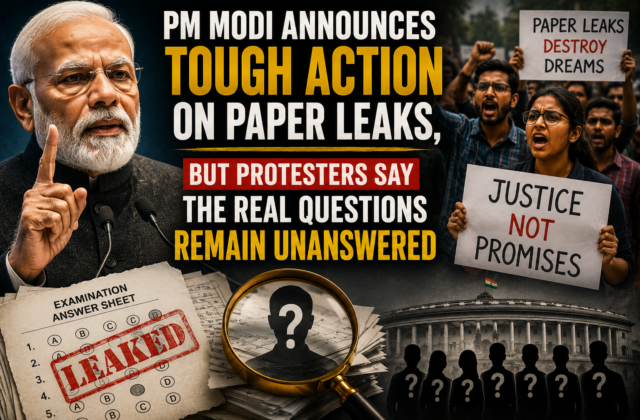
PM Modi Announces Tough Action on Paper Leaks, But Protesters Say the Real Questions Remain Unanswered India’s examination system has become one of the country’s most debated public policy issues. After years of recurring paper leak incidents affecting recruitment and entrance examinations, Prime Minister Narendra Modi has announced a fresh set of measures aimed at...
TheBusinessNow
Jul 23, 2026 · 2 min Read
Key Highlights
- 📢 Prime Minister Narendra Modi announced tougher measures against examination paper leaks, including faster prosecution and stricter punishment for those involved in organised exam fraud.
- ⚖️ The government said fast-track courts will be used to speed up trials in major paper leak cases and strengthen accountability.
- 🎓 Despite the announcement, student groups continued their protests, arguing that punishment alone cannot solve the deeper issues affecting India's examination system.
- 📚 Protesters have called for greater transparency, stronger prevention mechanisms, timely recruitment, and institutional accountability to restore trust in competitive examinations.
- 🛡️ Experts suggest that digital security, encrypted question paper distribution, AI-based monitoring, and independent audits could help reduce future exam fraud.
PM Modi Announces Tough Action on Paper Leaks, But Protesters Say the Real Questions Remain Unanswered
India’s examination system has become one of the country’s most debated public policy issues. After years of recurring paper leak incidents affecting recruitment and entrance examinations, Prime Minister Narendra Modi has announced a fresh set of measures aimed at strengthening accountability and restoring confidence in the examination process.
The announcement comes after weeks of student protests and growing public concern over repeated exam irregularities. While the government says the new measures are intended to deter organised cheating networks, many protesting students and opposition leaders argue that deeper structural issues still need to be addressed.
The debate has therefore shifted from whether action should be taken to whether the announced measures will be enough to restore trust.
What Did PM Modi Announce?
During his address, the Prime Minister emphasized that the integrity of examinations is critical for India’s youth and outlined several proposed measures.
According to government announcements, the key points include:
- ⚖️ Faster prosecution of paper leak cases through fast-track courts.
- 🚨 Stronger legal action against individuals and organised groups involved in examination fraud.
- 📄 Greater protection of examination systems.
- 🎓 A commitment to safeguard merit-based recruitment.
- 🇮🇳 Assurance that honest students should not suffer because of organised criminal networks.
The government has argued that stronger enforcement is necessary because paper leak rackets often operate across multiple states and involve sophisticated methods.
Why Are Students Still Protesting?
Despite the announcement, protests have continued in several places.
Student organisations say their concerns extend beyond punishment after a leak has already occurred.
Among the issues frequently raised are:
- Preventing leaks before exams take place.
- Faster completion of recruitment processes.
- Greater transparency in investigations.
- Timely publication of investigation reports.
- Accountability for officials responsible for examination security failures.
- Protection of students who spend years preparing for competitive examinations.
Many students argue that cancelling examinations after leaks imposes significant emotional, financial, and psychological costs on candidates who were not involved in any wrongdoing.
Why Paper Leaks Have Become a National Issue
Competitive examinations determine admission to universities and recruitment into government services for millions of young Indians every year.
When a paper leak occurs, the consequences can include:
- Cancellation of examinations.
- Delayed recruitment.
- Additional financial burden on candidates.
- Loss of public confidence.
- Increased litigation.
- Mental stress among students.
Because of these impacts, examination integrity has become both an educational and governance issue.
A Long-Standing Challenge
Paper leak incidents have been reported under governments led by different political parties over many years.
Independent investigations and media reports have documented leaks in various recruitment and entrance examinations across multiple states.
Different organisations have published different estimates of the total number of incidents because they use different methodologies and definitions. Some include only confirmed paper leaks, while others also count impersonation, OMR tampering, and related examination fraud.
As a result, there is no single officially accepted nationwide figure covering all incidents.
The Accountability Debate
One of the central questions emerging from the current protests is accountability.
Students and civil society groups have raised questions such as:
- Who is responsible when confidential examination papers are leaked?
- Should responsibility extend beyond those who physically leak papers?
- What role should examination authorities play?
- Should administrative failures trigger disciplinary action?
- How can investigation outcomes be made more transparent?
These questions remain at the heart of the ongoing public debate.
Can Tougher Laws Alone Solve the Problem?
Legal experts generally agree that stronger punishment can deter organised crime.
However, many education specialists argue that punishment alone may not eliminate paper leaks.
Several structural reforms are frequently suggested, including:
Digital Security
- End-to-end encryption.
- Secure printing systems.
- Real-time monitoring.
Administrative Oversight
- Independent audits.
- Background verification.
- Limited access to confidential papers.
Technology
- AI-assisted monitoring.
- Secure question distribution.
- Digital tracking of examination materials.
Transparency
- Public investigation reports.
- Time-bound inquiries.
- Regular security reviews.
Many experts believe prevention is ultimately more effective than prosecution after a leak has occurred.
Political Reactions
The announcement has also intensified political debate.
Government leaders argue that stronger legal measures demonstrate commitment to protecting honest students and dismantling organised cheating networks.
Opposition parties, meanwhile, have questioned whether the new measures sufficiently address institutional accountability and implementation challenges.
As with many major public issues, political parties differ on the causes of the problem and the best path forward.
Why Public Trust Matters
Competitive examinations represent opportunity for millions of young people.
For many families, years of preparation involve significant financial investment and personal sacrifice.
Repeated examination disruptions can weaken confidence in recruitment systems and increase uncertainty for candidates awaiting results.
Rebuilding trust therefore depends not only on punishment after wrongdoing but also on ensuring examinations are conducted securely and transparently.
What Happens Next?
The effectiveness of the government’s announcement will ultimately depend on implementation.
Observers will be watching:
- How quickly investigations proceed.
- Whether fast-track courts become operational.
- Conviction rates in examination fraud cases.
- Improvements in examination security.
- Adoption of new technology.
- Transparency of future investigations.
The coming months may determine whether the latest reforms become a turning point or simply another chapter in India’s long-running examination integrity debate.
Final Analysis
Prime Minister Narendra Modi’s announcement marks one of the government’s strongest public commitments to tackling examination paper leaks through stricter enforcement and faster judicial processes.
At the same time, student organisations continue to argue that punishment alone cannot fully address the problem. Their demands increasingly focus on prevention, institutional accountability, transparent investigations, and stronger examination security.
Whether these reforms succeed will depend less on the announcement itself and more on consistent implementation, measurable improvements in examination integrity, and renewed public confidence that merit—not manipulation—determines educational and employment opportunities.
For millions of students preparing for competitive examinations, the central expectation remains unchanged: a fair, secure, and transparent examination system.
Keep reading
Related Articles
 Commodities
Oil Nears $95: Could the Iran War Trigger a New U.S. Inflation Shock?
Oil at $95 Is Not the Real Story A crude-oil headline is easy to write: “Oil prices rise as Iran tensions escalate.” Reuters, Bloomberg, CNBC and WSJ can publish that story within minutes. But for TheBusinessNow, that isn’t enough. The bigger question is: What happens to the American economy if oil stays near $95 —...
 Economy
U.S. National Debt Hits $40 Trillion: Why Treasury Yields Are Rising Again
The $40 Trillion Number Is Not the Whole Story The United States has crossed a psychological and financial milestone. $40 trillion. But simply writing “America owes $40 trillion” misses the more important story. The real question for markets is: Who is willing to finance America’s growing debt — and at what interest rate? That question...
 Commodities
Strait of Hormuz Standoff: The Oil Shock That Could Hit the U.S. Economy Next
Strait of Hormuz Standoff: Why the Oil Market Is Getting Nervous Again The oil market is being forced to price a problem that seemed to be easing only weeks ago: the Strait of Hormuz is still not reliably functioning as a normal commercial shipping route. On August 19, Brent crude was trading around $91.20 a...
Comments (0)