
Nauru Officially Changes Its Name to Naoero in Major Cultural Identity Shift
Nauru Officially Changes Its Name to Naoero in Major Cultural Identity Shift The Pacific island nation formerly known as Nauru has officially changed its name to the Republic of Naoero, returning to a traditional name used in the country’s indigenous language. The change was approved through a constitutional amendment passed by Nauru’s Parliament in May...
Aroon Hook
Aug 3, 2026 · 4 min Read
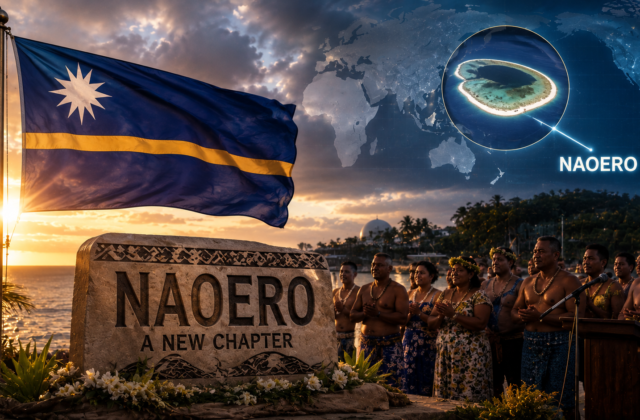
Key Highlights
- 🌏 Nauru is now officially the Republic of Naoero.
- 🇳🇷 The name change restores the country's traditional indigenous name.
- 🏛️ Nauru's Parliament approved the constitutional amendment in May 2026.
- 👤 President David Adeang said the change is about heritage, language and national identity.
- 🗣️ Citizens will now be referred to as dei-Naoero.
- 🔤 The country's international abbreviation is expected to change from NRU to NRO as the transition takes place.
Nauru Officially Changes Its Name to Naoero in Major Cultural Identity Shift
The Pacific island nation formerly known as Nauru has officially changed its name to the Republic of Naoero, returning to a traditional name used in the country’s indigenous language.
The change was approved through a constitutional amendment passed by Nauru’s Parliament in May 2026, and President David Adeang has described the move as an effort to better honor the nation’s heritage, language and identity.
The tiny Pacific nation is the world’s third-smallest country, after Vatican City and Monaco, and has a population of roughly 12,000 people.
Why Did Nauru Change Its Name?
The change is primarily about national identity and cultural heritage.
According to Reuters, President David Adeang said the traditional name Naoero was already part of the country’s identity and was used in the community and on national symbols.
The government has explained that the name “Nauru” became the internationally recognized version after European colonizers encountered difficulties pronouncing the indigenous name.
The return to Naoero is therefore being presented as a restoration rather than the invention of an entirely new national name.
President Adeang said the objective was to more faithfully honor the country’s heritage, language and identity.
When Did the Name Change Happen?
The process began earlier in 2026.
President Adeang introduced a constitutional amendment proposal in January seeking to change the country’s official name from Nauru to Naoero.
Parliament subsequently approved the amendment in May. According to the government’s May bulletin, 16 members of Parliament present voted in support of the amendment.
A referendum had initially been considered, but President Adeang later said one was unnecessary because Naoero was already established within the country’s identity and constitutional framework.
What Will Nauru Be Called Now?
The country’s official name is now:
Republic of Naoero
The shorter country name is:
Naoero
There are also changes in how citizens are referred to.
Instead of Nauruan, the country’s people will be known as:
dei-Naoero
The country’s international code is also expected to transition from NRU to NRO.

How Do You Pronounce Naoero?
The traditional name is pronounced approximately:
“Now-ero”
That differs slightly from the commonly used English pronunciation of Nauru, generally rendered as “Now-roo.”
The spelling and pronunciation are intended to more closely reflect the country’s national language.
Why Is Nauru One of the World’s Smallest Countries?
Naoero has a population of only around 12,000 people.
It is the world’s third-smallest sovereign country by population and one of the smallest nations by land area, behind Vatican City and Monaco in the commonly used ranking by population.
Despite its size, the country has an important position in the Pacific and maintains diplomatic relationships with countries and international organizations around the world.
The government has already begun notifying international organizations and foreign governments about the name change.
A Name Change With a Colonial History
The change also reflects a broader discussion about how colonial history influenced the names of places around the world.
Naoero’s traditional name was altered into the internationally used form “Nauru” after European contact.
According to Reuters, the government considers the restoration part of a broader effort to preserve ancestral heritage and strengthen the country’s cultural identity for future generations.
Similar moves have occurred elsewhere.
Countries including Eswatini and Türkiye have also adopted names that more closely reflect their preferred national terminology in international use.
However, every country’s situation is different, and Naoero’s decision is specifically rooted in its own language and history.
What Will Change Internationally?
The transition will require more than simply changing the name on a map.
Government agencies, diplomatic missions, international organizations, databases and other institutions will need to update references to the country.
The country’s international code is expected to change from NRU to NRO, while government communications increasingly use Naoero.
The transition may therefore take time across international systems.
Maps, websites, databases and media organizations may continue using “Nauru” temporarily while the new terminology becomes established.
Naoero’s Economic Challenges Remain
The name change is largely cultural rather than economic, but it comes as the Pacific nation continues to face significant economic and environmental challenges.
Naoero’s economy was historically heavily dependent on phosphate mining. The decline of that industry created significant economic difficulties for the country.
The nation also faces serious exposure to climate change and rising sea levels, like many low-lying Pacific island states.
The government’s decision to restore Naoero therefore comes at a time when preserving national identity is particularly important for a small island nation facing major external challenges.
Is This a Political Name Change?
The government has emphasized that the decision is not primarily political.
President Adeang has framed it around:
- Heritage
- Language
- Culture
- National identity
- Ancestral legacy
- Future generations
Reuters reported that Adeang specifically described the decision as being about identity and heritage rather than politics.
That distinction is important because the change does not represent a change of government or a shift in Naoero’s political system.
It is fundamentally a change in the country’s official name.
Why This Matters Beyond a Small Pacific Island
At first glance, changing Nauru’s name might seem like a minor administrative decision.
But the issue highlights a much larger global trend.
Countries increasingly want international institutions, businesses and media organizations to use names that reflect their preferred national identity and language.
For Naoero, the decision provides an opportunity to reconnect the internationally recognized name of the country with its indigenous linguistic heritage.
It also raises a broader question:
Who gets to decide what a country is called?
For Naoero, the answer is increasingly clear — the country itself.
What Happens Next?
The transition to Naoero will now move into its international phase.
Authorities will need to coordinate the change with:
- International organizations
- Foreign governments
- Diplomatic missions
- Databases
- Maps
- Websites
- Travel systems
- Financial and commercial records
The government has already begun formally notifying international organizations and countries about the change.
The old name may therefore continue appearing in older documents and databases for some time.
The Bigger Picture
Naoero’s decision is a reminder that country names are more than labels on maps.
They can represent:
Language → history → sovereignty → culture → identity.
For a small Pacific nation with a population of only about 12,000, restoring the traditional name is a significant symbolic step.
The move also demonstrates how countries can reshape the way they are represented internationally without changing their borders, government or political system.
Final Thoughts
Nauru has officially entered a new chapter as the Republic of Naoero.
The name change restores a traditional form that the country’s government says better reflects its language, heritage and national identity. Parliament approved the constitutional amendment in May, and the government is now working through the international transition.
For most people around the world, the change may initially take some getting used to.
But for Naoero, the decision represents something much deeper than a spelling change.
It is a statement about identity, heritage and the right of a nation to define itself.
❓ FAQs
What is Nauru’s new name?
The country is now officially the Republic of Naoero, with Naoero used as the shorter name.
Why did Nauru change its name?
The government says the change restores the traditional name and better reflects the country’s indigenous language, heritage and identity.
When did Nauru approve the name change?
Nauru’s Parliament approved the constitutional amendment in May 2026.
What will Nauru’s citizens be called?
Citizens will be referred to as dei-Naoero rather than Nauruans.
How is Naoero pronounced?
It is approximately pronounced “Now-ero.”
Is Nauru still the same country?
Yes. The country has changed its official name, but this does not represent a change in its territory or political system.
Will Nauru’s international code change?
Yes. The international code is expected to change from NRU to NRO as the transition is implemented.
Is Naoero the world’s smallest country?
No. Naoero is the third-smallest country by population, after Vatican City and Monaco.
📰 About The Business Now
The Business Now delivers coverage of global politics, business, finance, technology, markets, entertainment and major international developments with fact-based reporting and analysis.
🪙 Check Live Gold Prices
Track Gold, Silver, Platinum and Palladium prices, historical charts, calculators and daily market updates at:
🌐 External Resources
Keep reading
Related Articles
 Commodities
Oil Nears $95: Could the Iran War Trigger a New U.S. Inflation Shock?
Oil at $95 Is Not the Real Story A crude-oil headline is easy to write: “Oil prices rise as Iran tensions escalate.” Reuters, Bloomberg, CNBC and WSJ can publish that story within minutes. But for TheBusinessNow, that isn’t enough. The bigger question is: What happens to the American economy if oil stays near $95 —...
 Economy
U.S. National Debt Hits $40 Trillion: Why Treasury Yields Are Rising Again
The $40 Trillion Number Is Not the Whole Story The United States has crossed a psychological and financial milestone. $40 trillion. But simply writing “America owes $40 trillion” misses the more important story. The real question for markets is: Who is willing to finance America’s growing debt — and at what interest rate? That question...
 Commodities
Strait of Hormuz Standoff: The Oil Shock That Could Hit the U.S. Economy Next
Strait of Hormuz Standoff: Why the Oil Market Is Getting Nervous Again The oil market is being forced to price a problem that seemed to be easing only weeks ago: the Strait of Hormuz is still not reliably functioning as a normal commercial shipping route. On August 19, Brent crude was trading around $91.20 a...
Comments (0)