
Oregon Wildfire Crisis Deepens as Grasshopper Fire Tops 34,000 Acres and Mt. Hood Meadows Ordered to “Go Now”
Oregon Wildfire Crisis Deepens as Grasshopper Fire Tops 34,000 Acres and Mt. Hood Meadows Ordered to “Go Now” The Grasshopper Fire in Oregon has entered a more dangerous phase, with the blaze reported at more than 34,000 acres and evacuation orders reaching the Mt. Hood Meadows area. The fire has also destroyed the historic Flag...
Kim Cracy
Aug 4, 2026 · 3 min Read
Key Highlights
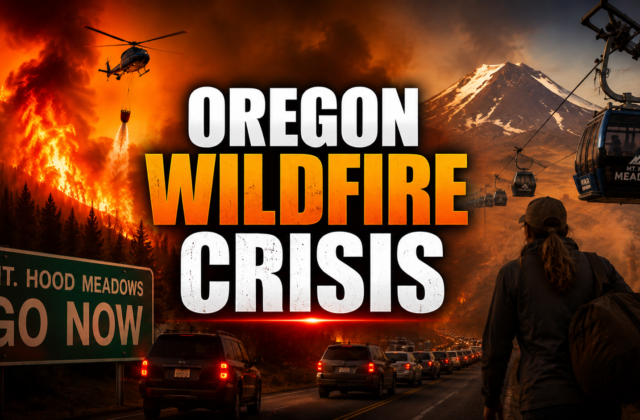
- 🚨 Mt. Hood Meadows is under a Level 3 “Go Now” evacuation order.
- 🔥 The Grasshopper Fire has burned more than 34,000 acres, according to the latest reports supplied in the news coverage.
- 🏔️ The fire is threatening areas around Mount Hood, including a major recreation destination.
- 🏚️ Historic Flag Point Lookout has been destroyed, according to the U.S. Forest Service reporting cited by local media.
- 🌫️ Heavy wildfire smoke is affecting communities across the region, with residents reporting severely reduced air quality.
- 🚧 Closures remain in place around the Grasshopper Fire area to protect the public.
- ⚠️ Changing winds could remain a major factor in how quickly the fire spreads and where smoke moves.
Oregon Wildfire Crisis Deepens as Grasshopper Fire Tops 34,000 Acres and Mt. Hood Meadows Ordered to “Go Now”
The Grasshopper Fire in Oregon has entered a more dangerous phase, with the blaze reported at more than 34,000 acres and evacuation orders reaching the Mt. Hood Meadows area. The fire has also destroyed the historic Flag Point Lookout, adding a major cultural loss to the growing wildfire emergency across the Mount Hood region.
The situation around Mount Hood changed sharply as fire activity pushed toward areas that are both heavily visited and strategically important. Mt. Hood Meadows was placed under a Level 3 “Go Now” evacuation order, meaning people in the affected area were being told to leave rather than wait for conditions to deteriorate further. Current local reporting and community observations also indicate heavy smoke around Mount Hood and rapidly changing conditions.
The scale of the Grasshopper Fire has now made it one of the most significant wildfire threats in the region, while the destruction of Flag Point Lookout underscores that the fire is not only threatening homes, businesses and recreation areas but also pieces of Oregon’s firefighting and forest-history heritage.
Grasshopper Fire Pushes Toward Mt. Hood Meadows
The most immediate concern is the fire’s movement toward the Mount Hood area.
Mt. Hood Meadows is one of Oregon’s best-known mountain recreation destinations, making the Level 3 evacuation order particularly significant.
A Level 3 “Go Now” order is not a warning to prepare for a possible evacuation later. It is an instruction to leave the affected area.
Local reports and firsthand observations shared Tuesday described the situation around Mount Hood Meadows as rapidly changing, with smoke visible across the mountain and the fire pushing toward Highway 35.
For residents, workers and visitors, the message is therefore straightforward:
Do not wait for the fire to become visible from your location before leaving an evacuation zone.
Why the 34,000-Acre Figure Matters
A wildfire covering tens of thousands of acres presents a fundamentally different firefighting challenge from a small, quickly contained fire.
Large fires can create multiple active fronts, making it difficult for crews to concentrate resources in one location.
Wind can also cause the fire perimeter to change quickly.
The Grasshopper Fire’s size means firefighters are not simply dealing with one isolated threat. They must consider communities, roads, recreation areas, forests and critical infrastructure across a broad landscape.
The Mount Hood National Forest has also confirmed that a closure is in place for the Grasshopper Fire area to help protect public safety.
That is particularly important for hikers and campers who might otherwise attempt to enter the area to see the fire.
Historic Flag Point Lookout Destroyed
One of the most painful developments is the loss of Flag Point Lookout.
The structure was not simply another building in the forest.
Flag Point has a long history as a fire-observation site. Historical information about the location records earlier lookout structures dating back decades, with the current lookout having been constructed in the 1970s.
Fire lookouts played an important role in detecting wildfires before modern satellite, aircraft and digital monitoring systems became as sophisticated as they are today.
The loss therefore represents more than the destruction of a structure.
It is also the disappearance of a physical piece of Oregon’s wildfire history.
The Forest Service has been responsible for operating and maintaining many such observation sites throughout the region.
Mount Hood Area Faces More Than Just Flames
The Grasshopper Fire’s impact extends beyond the visible fire perimeter.
Smoke is becoming a major concern.
Residents around the Portland and Mount Hood region have reported significant smoke, with local observations describing extremely poor air quality in some areas.
Wildfire smoke can travel much farther than the actual flames.
That means communities that are not directly threatened by the fire can still experience:
- Reduced visibility
- Poor outdoor air quality
- Eye irritation
- Breathing discomfort
- Disruptions to outdoor activities
- Road and travel problems
For people who are sensitive to wildfire smoke, staying informed about official air-quality guidance is particularly important.
Why Wind Could Become the Next Major Threat
Wildfires do not spread at a constant speed.
Wind can dramatically alter fire behavior by pushing flames into new fuel and carrying embers ahead of the main fire.
Local observations Tuesday indicated that winds were playing an important role in the Grasshopper Fire’s movement, with concerns about the fire pushing toward Highway 35 and the Mount Hood Meadows area.
This makes the next several hours particularly important.
A shift in wind direction can change which communities are threatened.
It can also change where smoke travels.
That is why evacuation orders can expand or change rapidly during major wildfire events.
Mount Hood Meadows Evacuation Raises the Stakes
The Level 3 evacuation at Mt. Hood Meadows is particularly significant because the area attracts large numbers of visitors and outdoor enthusiasts.
During a normal summer, the region is popular for hiking, camping, sightseeing and other outdoor activities.
But wildfire conditions change the calculation completely.
Road access can become restricted.
Smoke can make driving hazardous.
Fire crews and emergency vehicles need clear routes.
And conditions can change faster than visitors unfamiliar with wildfire behavior might expect.
The current closure around the Grasshopper Fire reinforces the message that recreational access should not take priority over emergency restrictions.
Could the Grasshopper Fire Get Worse?
That depends heavily on weather, wind, fuel conditions and firefighting progress.
The biggest short-term risk is rapid fire movement caused by wind.
If winds increase or shift toward populated areas, evacuation zones could expand.
If winds weaken and firefighting resources can operate more effectively, crews may gain opportunities to slow the fire.
But it would be premature to declare that the situation is improving simply because weather conditions temporarily become more favorable.
Large wildfires can remain active for weeks.
What Residents Near Mount Hood Should Watch
Anyone in or near affected areas should monitor official evacuation notifications, not social-media rumors.
The most important information includes:
🚨 Evacuation Levels
A move to Level 3 means leaving immediately.
🛣️ Road Closures
Routes can close quickly because of flames, smoke, fallen trees or emergency operations.
🌫️ Air Quality
Smoke conditions can change independently of the fire’s immediate location.
🌬️ Wind Direction
Wind shifts can dramatically alter the fire’s path and smoke movement.
🔥 Fire Perimeter Updates
The perimeter can change substantially between reporting periods.
What Happens Next?
The next phase of the Grasshopper Fire will likely be determined by three major factors:
Fire behavior
How aggressively the fire continues to spread will determine whether additional evacuation areas become necessary.
Weather
Wind, temperature and humidity will influence how easily vegetation burns and how quickly firefighters can operate.
Firefighting opportunities
Aircraft and ground crews need safe operating conditions to attack the fire effectively.
The situation around Mount Hood is therefore not static.
A relatively calm period could be followed by renewed fire growth if weather conditions change.
The Bigger Oregon Wildfire Picture
The Grasshopper Fire is also part of a broader wildfire emergency affecting Oregon.
The state’s forests can experience extremely challenging fire conditions when dry fuels, high temperatures, low humidity and wind combine.
Historical Forest Service material shows how quickly wind-driven fires in Oregon can change behavior and trigger large evacuation areas.
That history helps explain why officials can issue aggressive evacuation orders before flames reach a community.
The goal is to create time for people to get out before roads become dangerous or impassable.
Why the Loss of Flag Point Matters
The destruction of Flag Point Lookout gives this fire a dimension beyond acreage.
Fire lookouts represent a period when human observers stationed high above forests were among the first lines of wildfire detection.
The Flag Point site has a documented history extending back to earlier lookout structures, illustrating how important the location has been to forest observation over generations.
Its destruction is therefore a reminder that wildfire does not only consume trees.
It can erase landmarks, historical structures and places that communities associate with the landscape.
Next Outlook for Oregon Wildfires
The immediate outlook around Mount Hood remains highly dependent on fire behavior and weather conditions.
The most important developments to watch are:
1. Whether the Grasshopper Fire continues pushing west toward Highway 35.
2. Whether Level 3 evacuation zones expand or are reduced.
3. Whether firefighters can establish stronger containment lines.
4. Whether winds shift and change the fire’s direction.
5. Whether smoke conditions improve or deteriorate across northern Oregon.
6. Whether additional forest closures become necessary.
Until those factors become clearer, residents and visitors should treat the evacuation orders and closures seriously.
Final Thoughts
The Grasshopper Fire has become a major emergency around Oregon’s Mount Hood region, with the blaze reported at more than 34,000 acres and Mt. Hood Meadows placed under a Level 3 “Go Now” evacuation order.
But the numbers only tell part of the story.
The fire is affecting a landscape that combines communities, recreation areas, wilderness and historic landmarks.
The destruction of Flag Point Lookout is a particularly striking loss because the site represented decades of wildfire observation and forest history.
Meanwhile, smoke is spreading well beyond the immediate fire zone, creating another hazard for communities across the region.
🔮 Next Outlook
The coming hours and days will be crucial.
If winds remain favorable and crews gain opportunities to slow the fire, the situation could stabilize.
If strong winds push the fire toward additional populated or recreational areas, more evacuation orders and closures could follow.
For now, the safest assumption is that conditions can change quickly.
Anyone inside an active “Go Now” evacuation area should leave immediately and follow official emergency instructions rather than waiting for the fire to get closer.
❓ FAQs
What is happening with the Grasshopper Fire in Oregon?
The Grasshopper Fire has grown beyond 34,000 acres and is threatening areas around Mount Hood, including Mt. Hood Meadows.
Is Mt. Hood Meadows under evacuation?
Yes. The area has been placed under a Level 3 “Go Now” evacuation order according to current reporting.
What does Level 3 “Go Now” mean?
It means people in the affected area should leave immediately rather than wait for conditions to worsen.
Was Flag Point Lookout destroyed?
Yes. Current reporting says the historic Flag Point Lookout was destroyed by the Grasshopper Fire.
Is the Grasshopper Fire area closed?
A closure is in place around the Grasshopper Fire area for public safety.
Is smoke from the Grasshopper Fire affecting other areas?
Yes. Smoke has been reported across parts of the Mount Hood and Portland region, with local residents reporting significant air-quality problems.
Could evacuation orders change?
Yes. Wildfire evacuation zones can expand, contract or be lifted depending on fire behavior, weather and emergency conditions.
Should people visit Mount Hood while the fire is active?
People should avoid closed areas and follow official evacuation and access restrictions. Conditions around an active wildfire can change rapidly.
📰 About The Business Now
The Business Now delivers coverage of breaking U.S. and global news, business, finance, technology, markets, weather and major events with a focus on factual reporting and useful context.
🌐 External Resources
- U.S. Forest Service — Official federal forest and wildfire information.
- Oregon Department of Forestry — Oregon wildfire and forestry information.
- National Weather Service — Weather and smoke-related forecasts.
- Oregon Department of Emergency Management — Emergency and evacuation information.
Keep reading
Related Articles
 Commodities
Oil Nears $95: Could the Iran War Trigger a New U.S. Inflation Shock?
Oil at $95 Is Not the Real Story A crude-oil headline is easy to write: “Oil prices rise as Iran tensions escalate.” Reuters, Bloomberg, CNBC and WSJ can publish that story within minutes. But for TheBusinessNow, that isn’t enough. The bigger question is: What happens to the American economy if oil stays near $95 —...
 Economy
U.S. National Debt Hits $40 Trillion: Why Treasury Yields Are Rising Again
The $40 Trillion Number Is Not the Whole Story The United States has crossed a psychological and financial milestone. $40 trillion. But simply writing “America owes $40 trillion” misses the more important story. The real question for markets is: Who is willing to finance America’s growing debt — and at what interest rate? That question...
 Commodities
Strait of Hormuz Standoff: The Oil Shock That Could Hit the U.S. Economy Next
Strait of Hormuz Standoff: Why the Oil Market Is Getting Nervous Again The oil market is being forced to price a problem that seemed to be easing only weeks ago: the Strait of Hormuz is still not reliably functioning as a normal commercial shipping route. On August 19, Brent crude was trading around $91.20 a...
Comments (0)