
Democracy or “Democrazy”? India’s Institutions Face Growing Public Scrutiny
Democracy or “Democrazy”? India’s Institutions Face Growing Public Scrutiny India is the world’s largest democracy, built upon constitutional principles of justice, liberty, equality, and accountability. Yet recent political developments have sparked intense public debate over whether democratic institutions are functioning as intended or whether growing political polarization is weakening public trust. Across the country, demonstrations...
TheBusinessNow
Jul 21, 2026 · 3 min Read

Key Highlights
- 🏛️ India's political climate has become increasingly polarized, with ruling and opposition parties accusing each other of undermining democracy.
- 📚 Multiple reports indicate a significant rise in examination paper leak cases over the past decade, affecting millions of students.
- ⚖️ Political parties continue filing defamation cases and counter-allegations against one another, reflecting deep institutional mistrust.
- 📢 Student protests and demonstrations have highlighted demands for greater transparency, accountability, and employment reforms.
- 🔍 Experts argue that strengthening institutions—not weakening them—is essential for protecting democratic governance.
Democracy or “Democrazy”? India’s Institutions Face Growing Public Scrutiny
India is the world’s largest democracy, built upon constitutional principles of justice, liberty, equality, and accountability. Yet recent political developments have sparked intense public debate over whether democratic institutions are functioning as intended or whether growing political polarization is weakening public trust.
Across the country, demonstrations by students, opposition parties, and civil society groups have reflected frustrations over issues ranging from examination paper leaks and unemployment to allegations of misuse of public institutions. At the same time, the ruling Bharatiya Janata Party (BJP) maintains that many accusations against it are politically motivated and that it is implementing reforms while ensuring law and order.
The result is a deeply divided political environment where competing narratives dominate public discourse.
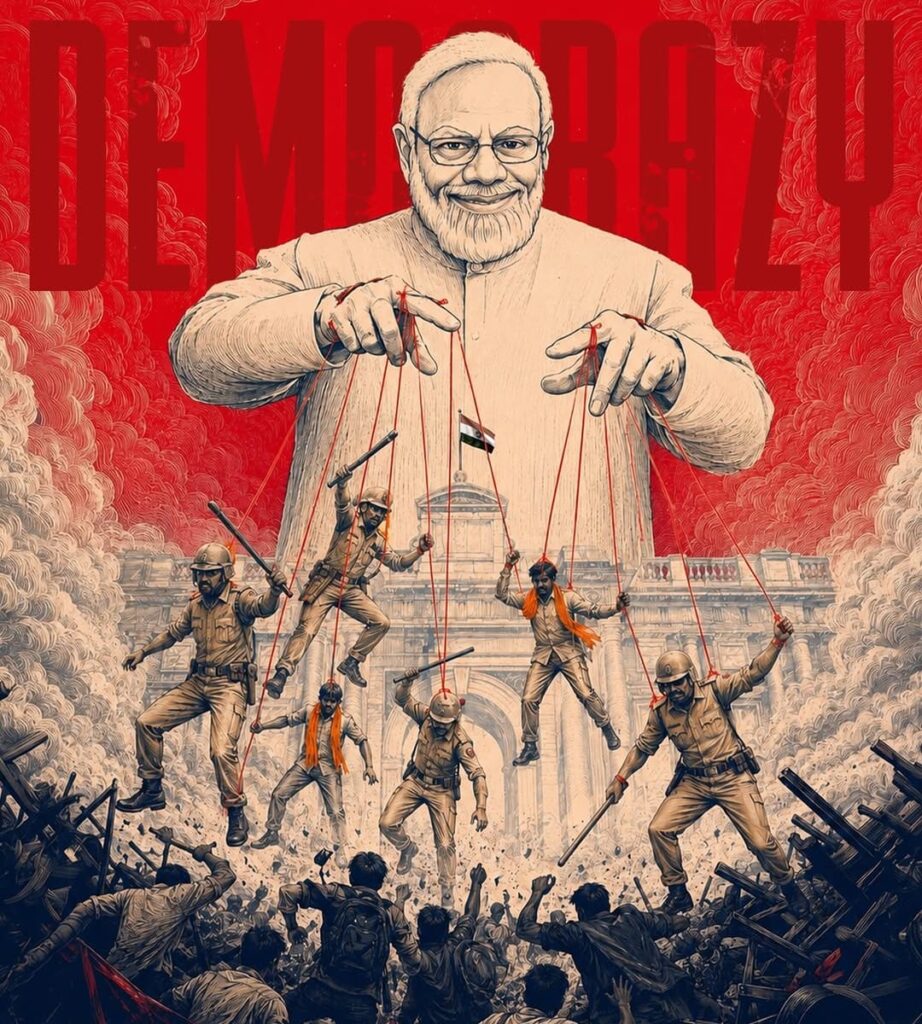
Political Allegations Continue Across Party Lines
India’s political landscape has witnessed an escalation of accusations between major parties.
In Uttar Pradesh, Samajwadi Party leader Akhilesh Yadav has accused the BJP of attempting to weaken democratic institutions ahead of future elections.
The BJP has, in turn, accused opposition parties of spreading misinformation and engaging in political propaganda.
Congress and BJP leaders have exchanged allegations in states including Karnataka and Telangana regarding governance, reservation policies, and political messaging.
In Delhi, legal disputes between the BJP and Aam Aadmi Party have included defamation suits over allegations involving elected representatives.
These disputes illustrate an increasingly confrontational political atmosphere in which legal action and public accusations have become common features of political competition.
The Exam Paper Leak Crisis
One issue that has united students across political backgrounds is the recurring problem of examination paper leaks.
Various reports have documented a significant increase in examination fraud cases over the past decade.
Different studies estimate:
- More than 70 major paper leaks between 2017 and 2024.
- Around 148 documented examination fraud cases between 2015 and 2026.
- Opposition leaders have cited figures exceeding 150 reported leaks since 2014.
Although methodologies differ, most analyses agree that millions of students have been affected.
Digital technology, encrypted messaging platforms, and organized criminal networks have reportedly made paper leaks faster and more difficult to detect.
Several states—including Rajasthan, Uttar Pradesh, Gujarat, Telangana, Haryana, and Uttarakhand—have experienced repeated controversies involving recruitment examinations and competitive tests.
Accountability Remains a Major Concern
Perhaps the most concerning aspect is not only the frequency of these incidents but also the limited number of convictions reported in many cases.
Investigations have been conducted by state police, special investigation teams, and, in some instances, the Central Bureau of Investigation (CBI). However, critics argue that lengthy investigations and delayed trials have weakened public confidence.
Students continue to demand:
- Faster investigations.
- Transparent recruitment processes.
- Stronger cybersecurity.
- Time-bound judicial proceedings.
- Greater institutional accountability.
Protests Reflect Wider Public Frustration
Recent demonstrations in Delhi, including protests around Jantar Mantar, reflected broader frustrations extending beyond a single issue.
Participants included students, unemployed youth, activists, and political workers demanding reforms in recruitment, governance, and public accountability.
While authorities stated that security measures were necessary to maintain public order, protesters argued that democratic spaces for peaceful assembly should remain protected.
These competing perspectives continue to fuel national debate.
Public Trust Is Becoming the Central Issue
Political disagreements are not unique to India.
However, when controversies involving recruitment examinations, corruption allegations, governance failures, or protests occur repeatedly, public confidence in institutions may be affected.
Trust in democracy depends on several pillars:
- Independent courts.
- Free and responsible media.
- Transparent investigations.
- Fair elections.
- Accountable public institutions.
- Peaceful democratic participation.
Strengthening these institutions is widely regarded by constitutional experts as essential regardless of which political party is in power.
The Challenge for Every Political Party
Criticism of governments is an important feature of democracy.
Equally important is ensuring that allegations are supported by evidence and examined through lawful institutions.
Every major political party in India—including the BJP, Congress, Aam Aadmi Party, Samajwadi Party, and regional parties—has at various times accused opponents of corruption, misuse of power, misinformation, or weakening democratic norms.
Ultimately, responsibility for determining the facts lies with investigative agencies and the courts rather than political rhetoric alone.
Why This Debate Matters
The discussion extends far beyond party politics.
It concerns:
- Public confidence in democratic institutions.
- The future of millions of students seeking fair opportunities.
- Transparent governance.
- Accountability in public office.
- Protection of constitutional rights.
Whether one supports the government or the opposition, these issues affect every citizen.
Conclusion
India’s democracy has repeatedly demonstrated resilience through elections, judicial review, public debate, and civic participation. At the same time, recurring controversies—from examination paper leaks to political confrontations and public protests—have intensified calls for greater transparency and institutional reform.
The health of a democracy ultimately depends not only on electoral outcomes but also on the strength, independence, and credibility of its institutions. As political competition intensifies, addressing citizens’ concerns through evidence-based investigations, judicial oversight, and transparent governance will remain critical to sustaining public trust.
FAQs
Why is the phrase “Democracy or Democrazy?” being discussed?
It is used by some commentators as a rhetorical way of expressing concern about political polarization, institutional trust, and governance. It is an opinion rather than a factual description.
Have examination paper leaks increased?
Multiple independent analyses and media reports suggest that paper leak incidents have become more frequent in recent years, although estimates vary depending on methodology.
Are allegations against political parties proven?
Political parties frequently make allegations against one another. Such claims require investigation and, where appropriate, judicial determination. Allegations alone should not be treated as established facts.
Why are students protesting?
Many demonstrations have focused on examination integrity, recruitment delays, employment opportunities, and demands for greater transparency and accountability in public institutions.
About TheBusinessNow
TheBusinessNow delivers analysis of business, economics, public policy, governance, geopolitics, commodities, and markets. Our reporting focuses on verified information, multiple perspectives, and evidence-based analysis that helps readers understand the forces shaping India and the global economy.
Keep reading
Related Articles
 Commodities
Oil Nears $95: Could the Iran War Trigger a New U.S. Inflation Shock?
Oil at $95 Is Not the Real Story A crude-oil headline is easy to write: “Oil prices rise as Iran tensions escalate.” Reuters, Bloomberg, CNBC and WSJ can publish that story within minutes. But for TheBusinessNow, that isn’t enough. The bigger question is: What happens to the American economy if oil stays near $95 —...
 Economy
U.S. National Debt Hits $40 Trillion: Why Treasury Yields Are Rising Again
The $40 Trillion Number Is Not the Whole Story The United States has crossed a psychological and financial milestone. $40 trillion. But simply writing “America owes $40 trillion” misses the more important story. The real question for markets is: Who is willing to finance America’s growing debt — and at what interest rate? That question...
 Commodities
Strait of Hormuz Standoff: The Oil Shock That Could Hit the U.S. Economy Next
Strait of Hormuz Standoff: Why the Oil Market Is Getting Nervous Again The oil market is being forced to price a problem that seemed to be easing only weeks ago: the Strait of Hormuz is still not reliably functioning as a normal commercial shipping route. On August 19, Brent crude was trading around $91.20 a...
Comments (0)