
All 8 Flock Cameras Stolen in Minnesota City as Fight Over AI License-Plate Surveillance Explodes Nationwide
All 8 Flock Cameras Stolen in Minnesota City as Fight Over AI License-Plate Surveillance Explodes Nationwide A small Minnesota city has become the latest flashpoint in America’s rapidly growing debate over Flock surveillance cameras, after all eight of its automated license-plate readers were reportedly stolen. The incident in Winona, Minnesota, comes as communities across the...
James Kim
Aug 6, 2026 · 3 min Read
Key Highlights
- 📷 All eight Flock cameras in Winona, Minnesota, were reportedly stolen.
- 🇺🇸 The incident comes amid growing national scrutiny of automated license-plate readers.
- 🔎 Flock systems are designed to capture license plates and vehicle characteristics for law-enforcement investigations.
- ⚖️ Supporters say the technology can help locate stolen vehicles, missing people and suspects.
- 🔐 Critics argue that collecting information from ordinary motorists creates broader privacy concerns.
- 🇫🇱 A Florida resident has drawn attention for protesting a Flock camera without destroying it.
All 8 Flock Cameras Stolen in Minnesota City as Fight Over AI License-Plate Surveillance Explodes Nationwide
A small Minnesota city has become the latest flashpoint in America’s rapidly growing debate over Flock surveillance cameras, after all eight of its automated license-plate readers were reportedly stolen.
The incident in Winona, Minnesota, comes as communities across the country are questioning how automated license-plate reader systems collect, store and share information about vehicles.
At the same time, protests against Flock cameras are taking increasingly visible forms elsewhere. In Florida, one resident recently attracted attention by physically positioning a protest sign in front of a camera rather than damaging the equipment. The contrasting incidents—stolen cameras in Minnesota and a highly visible protest in Florida—illustrate how sharply opinions have divided over the technology.
The debate is no longer simply about whether police should use cameras. It has expanded into a much larger argument over privacy, public safety, surveillance databases and who should control vehicle-location information.
What Happened to the Flock Cameras in Winona?
Winona police reported that all eight Flock cameras installed in the Minnesota city were stolen.
The unusual incident immediately attracted national attention because it occurred against the backdrop of an increasingly heated debate surrounding automated license-plate readers.
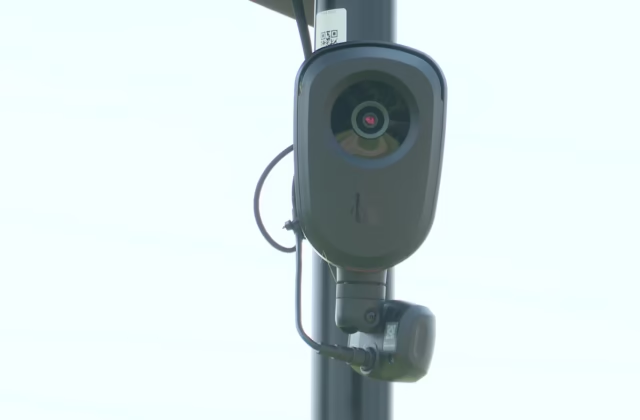
The cameras aren’t conventional traffic cameras.
Flock’s systems are designed to identify and record vehicle characteristics—including license plates—and turn that information into searchable data that participating law-enforcement agencies can use during investigations.
That capability is precisely what makes the technology attractive to police departments.
It is also what has made the cameras controversial.
Why Are Flock Cameras Being Scrutinized?
Flock cameras have expanded rapidly across the United States.
The technology can help police identify vehicles connected to investigations without requiring an officer to manually observe every passing car.
Supporters point to practical applications.
A vehicle reported stolen can potentially be identified when it passes a camera.
Investigators searching for a suspect’s vehicle can potentially reconstruct where that vehicle was detected.
Police can also use the technology in cases involving missing people or other public-safety investigations.
But the same capability creates a difficult question:
How much information about ordinary people’s movements should be collected simply because they drive past a camera?
That question has become central to the national debate.
The Privacy Argument Is Getting Louder
Critics of automated license-plate readers argue that surveillance doesn’t only involve people suspected of crimes.
The cameras can capture information about ordinary drivers who have done nothing wrong.
That means the debate isn’t simply about catching criminals.
It is about what happens to information collected from everyone else.
Civil-liberties advocates have raised concerns about:
- How long vehicle data is retained
- Who can access the information
- Whether agencies can share data across jurisdictions
- Whether databases can reveal patterns of movement
- What oversight exists over searches
- Whether residents are adequately informed
These concerns have contributed to growing political and community opposition.
Connecticut lawmakers, for example, recently called for municipalities to pause new Flock installations amid increasing privacy concerns.
Florida Is Becoming Another Major Flock Battleground
The Minnesota camera theft is not happening in isolation.
Florida has also become an increasingly visible center of the Flock debate.
Residents in several Florida communities have questioned the growing deployment of automated license-plate readers.
In Southwest Florida alone, hundreds of cameras have been mapped across communities, highlighting just how widespread the technology has become.
Local officials and police departments have defended the technology as a crime-fighting tool, while critics have pushed back over privacy and surveillance concerns.
That disagreement has increasingly spilled into public meetings, social media and protests.
The Florida Protest That Went Viral
One of the more unusual recent demonstrations involved a 77-year-old Florida resident who protested a Flock camera by holding a large sign in front of its field of view.
Rather than damaging the equipment, the protester used a long pool skimmer with a sign attached to it and positioned himself in front of the camera.
The demonstration attracted significant online attention and became a visual symbol of the growing backlash against automated license-plate surveillance.
The distinction is important.
A protest against surveillance is protected activity in many circumstances, but damaging or stealing surveillance equipment is a separate legal matter.
The Minnesota incident therefore carries a much more serious dimension than a conventional demonstration.
Flock Cameras Are Not Just “Speed Cameras”
One reason the controversy can be confusing is that Flock cameras don’t function like traditional speed-enforcement cameras.
Automated license-plate readers are designed to collect information about vehicles.
Depending on the system and configuration, that can include:
- License plate information
- Vehicle make
- Vehicle model
- Vehicle color
- Vehicle characteristics
- Time of detection
- Location of detection
Flock says its technology does not use facial recognition. Other reporting has described its systems as AI-powered tools that turn vehicle observations into searchable records.
That searchable component is what makes the technology particularly valuable to investigators—and particularly concerning to privacy advocates.
Why Police Want the Technology
From a law-enforcement perspective, the attraction is straightforward.
Imagine a stolen vehicle is reported.
Without an automated system, investigators may need to rely on eyewitness reports, traffic cameras, patrol officers or other investigative tools.
With ALPR technology, investigators can potentially search for vehicles matching relevant information and identify detections that could help establish where the vehicle traveled.
Police departments have also cited uses involving missing people and vehicles associated with criminal investigations.
That makes the cameras a potentially powerful investigative resource.
But More Surveillance Creates More Questions
The bigger the network becomes, the more important governance becomes.
If a city has several cameras, the information collected may provide limited snapshots.
But if thousands of cameras operate across multiple jurisdictions, those snapshots can potentially create a much broader picture of vehicle movements.
That leads to a fundamental policy question:
At what point does a collection of individual observations become a nationwide surveillance network?
Supporters and opponents answer that question very differently.
The National Network Is Growing
Flock’s technology has expanded substantially across the United States.
Business Insider reported that Flock cameras were operating in 49 states, with the company saying its network had reached roughly 120,000 cameras.
That scale changes the nature of the debate.
A single camera at a single intersection is one thing.
A network capable of identifying vehicles across thousands of communities is something much larger.
It is therefore unsurprising that lawmakers, police departments and civil-liberties advocates are increasingly debating rules surrounding access and data sharing.
The Debate Isn’t Simply “Police vs. Privacy”
The reality is more complicated.
Many residents want police to have tools that can help recover stolen vehicles and find dangerous suspects.
At the same time, those same residents may not want their own movements recorded and stored indefinitely.
That creates a difficult balancing act.
Public safety requires useful investigative tools.
Civil liberties require meaningful limits and oversight.
The challenge is determining where that line should be drawn.
Why the Stolen Cameras Matter
The Winona incident could become significant beyond the eight missing devices.
It demonstrates that the backlash surrounding surveillance technology has moved from online arguments and political debates into real-world confrontations.
That does not mean the theft represents the views of the broader privacy movement.
Most criticism of Flock cameras has taken the form of public meetings, lawsuits, political advocacy, demonstrations and demands for greater transparency.
But the thefts will inevitably raise another question:
How should communities respond when residents strongly oppose surveillance infrastructure?
Cities Are Already Reconsidering Flock Deployments
Some communities have begun taking action against or reconsidering their Flock contracts.
In Wisconsin, for example, officials in some municipalities have covered cameras while dealing with questions about removing or disabling equipment after decisions to stop using the systems.
Elsewhere, local residents have demanded that cameras be removed.
This suggests the debate is moving beyond whether Flock should exist at all.
It is increasingly becoming a question of:
What rules should govern the technology?
The Roadside Safety Question Is Also Growing
Privacy isn’t the only criticism surrounding Flock.
Some advocates have questioned how and where the cameras are physically installed.
The Guardian recently reported concerns that certain roadside installations could create safety risks if they don’t meet appropriate crash-safety requirements.
Flock has said it will review camera installations following those concerns.
That creates another layer to the controversy.
The technology now faces scrutiny from both privacy advocates and road-safety advocates, although their arguments are based on different concerns.
What Happens Next?
The Flock debate is likely to become increasingly important for local governments.
Communities considering the technology will have to weigh several questions.
1. How long should data be stored?
Longer retention can potentially make investigations easier, but it also increases privacy concerns.
2. Who can access the database?
Local police, other agencies and outside jurisdictions may have different legal authorities.
3. Should data be shared across state lines?
This is already becoming a major political issue.
4. What oversight should exist?
Residents may demand public reporting, audits and clear rules governing searches.
5. What happens when a community wants to stop using the system?
Contracts and equipment ownership can complicate the process.
🔮 Outlook: America’s Surveillance Debate Is Just Beginning
The Winona camera theft is likely to receive attention because of its unusual nature.
But the larger story is much broader.
America is entering a period in which AI-powered surveillance technology is becoming increasingly common in ordinary public spaces.
License-plate readers are only one part of that trend.
As these systems expand, governments will face growing pressure to demonstrate that public-safety benefits are matched by meaningful privacy protections.
The question may ultimately shift from:
“Should cities use Flock cameras?”
to:
“Under exactly what conditions should governments be allowed to use automated surveillance?”
That is a much bigger debate.
Final Thoughts
The theft of all eight Flock cameras in Winona has put an unusual spotlight on a technology already facing intense national scrutiny.
For police departments, automated license-plate readers can provide a powerful investigative tool.
For privacy advocates, they represent a potentially far-reaching system for tracking vehicles and building searchable records of movement.
And for ordinary drivers, the issue raises a question that is becoming harder to ignore:
How much of your daily movement should be captured simply because you are driving on a public road?
As Flock networks continue expanding and communities debate whether to install, regulate or remove them, the conflict between public safety and privacy is unlikely to disappear anytime soon.
The eight missing cameras in Minnesota may be the latest headline—but the national argument over surveillance is much bigger than Winona.
❓ FAQs
What are Flock cameras?
Flock cameras are automated license-plate reader systems designed to identify and record vehicle information for investigative and public-safety purposes.
Why are Flock cameras controversial?
Critics are concerned about privacy, data retention, access controls and the possibility that vehicle information could be used to track people’s movements.
What happened to the Flock cameras in Winona?
According to reports cited in the current news coverage, all eight Flock cameras in Winona, Minnesota, were stolen.
Why do police use Flock cameras?
Law-enforcement agencies say ALPR systems can help identify stolen vehicles, locate missing people and investigate vehicles connected to crimes.
Are Flock cameras facial-recognition systems?
Flock says its license-plate reader technology does not use facial recognition. The systems primarily focus on vehicle and license-plate information.
Are Flock cameras used across the United States?
Yes. Flock has deployed a large network of automated license-plate readers across the country, with the company reporting approximately 120,000 cameras in 49 states.
Is protesting a Flock camera the same as stealing or damaging one?
No. Peaceful protest and vandalism or theft are legally distinct activities. The Florida protest described in recent coverage involved placing a sign in front of a camera, while the Minnesota case involves reported theft.
🌐 External Resources
- Flock Safety — Information about the company’s technology.
- Electronic Frontier Foundation — Privacy and surveillance research.
- ACLU — Civil-liberties resources concerning surveillance.
- Minnesota Department of Public Safety — Minnesota public-safety information.
- Winona Police Department — Local law-enforcement information.
Keep reading
Related Articles
 Commodities
Oil Nears $95: Could the Iran War Trigger a New U.S. Inflation Shock?
Oil at $95 Is Not the Real Story A crude-oil headline is easy to write: “Oil prices rise as Iran tensions escalate.” Reuters, Bloomberg, CNBC and WSJ can publish that story within minutes. But for TheBusinessNow, that isn’t enough. The bigger question is: What happens to the American economy if oil stays near $95 —...
 Economy
U.S. National Debt Hits $40 Trillion: Why Treasury Yields Are Rising Again
The $40 Trillion Number Is Not the Whole Story The United States has crossed a psychological and financial milestone. $40 trillion. But simply writing “America owes $40 trillion” misses the more important story. The real question for markets is: Who is willing to finance America’s growing debt — and at what interest rate? That question...
 Commodities
Strait of Hormuz Standoff: The Oil Shock That Could Hit the U.S. Economy Next
Strait of Hormuz Standoff: Why the Oil Market Is Getting Nervous Again The oil market is being forced to price a problem that seemed to be easing only weeks ago: the Strait of Hormuz is still not reliably functioning as a normal commercial shipping route. On August 19, Brent crude was trading around $91.20 a...
Comments (0)