
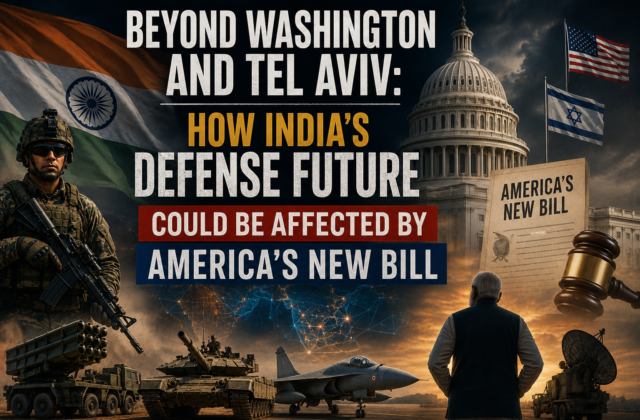
Beyond Washington and Tel Aviv: How India’s Defense Future Could Be Affected by America’s New Bill
Beyond Washington and Tel Aviv: How India’s Defense Future Could Be Affected by America’s New Bill A new provision in the United States’ annual defense legislation has triggered an intense political debate in Washington. Critics argue it could deepen military integration between the United States and Israel, while supporters describe it as a way to...
TheBusinessNow
Jul 23, 2026 · 4 min Read
Key Highlights
- 🇺🇸 A new U.S. defense bill seeks to expand military and technology cooperation with Israel.
- 🇮🇳 India is not part of the legislation, but analysts believe its strategic partnerships with both nations could create future opportunities.
- 🛰️ Defense technologies such as AI, missile defense, cyber warfare, drones, and space systems are at the center of the discussion.
- 🌏 The Indo-Pacific remains a key strategic region driving deeper cooperation among democratic partners.
- 🏭 India's growing domestic defense manufacturing ambitions could align with future international collaborations.
- 📊 Defense policy changes are closely watched by investors because they can influence aerospace, cybersecurity, and defense industry spending.
Beyond Washington and Tel Aviv: How India’s Defense Future Could Be Affected by America’s New Bill
A new provision in the United States’ annual defense legislation has triggered an intense political debate in Washington. Critics argue it could deepen military integration between the United States and Israel, while supporters describe it as a way to strengthen cooperation between two close allies.
But beyond the debate in Washington and Tel Aviv, analysts have identified another country that could be indirectly affected: India.
While India is not a party to the legislation, some defense experts believe the bill could create new opportunities for defense technology cooperation, industrial partnerships, and strategic coordination as India continues expanding its role in the Indo-Pacific.
The implications remain uncertain, but they are significant enough to attract attention from policymakers, defense analysts, and industry observers.
What Is the New U.S. Defense Bill?
The discussion centers on provisions within the U.S. National Defense Authorization Act (NDAA), the annual law that authorizes U.S. defense spending and outlines military priorities.
One provision encourages greater defense integration and cooperation between the United States and Israel in areas such as:
- Missile defense
- Artificial intelligence
- Autonomous systems
- Cybersecurity
- Space security
- Intelligence cooperation
- Advanced military technologies
The proposal has generated support among many lawmakers while also drawing criticism from others who argue it could expand military commitments or reduce congressional oversight.
Why India Is Being Mentioned
Although the legislation focuses on U.S.-Israel cooperation, some strategic analysts argue that India could indirectly benefit because it already maintains strong defense relationships with both countries.
India today works closely with:
The United States
Through initiatives including:
- COMCASA
- BECA
- LEMOA
- QUAD cooperation
- Joint military exercises
- Defense technology partnerships
Israel
Israel has become one of India’s leading defense suppliers.
Areas of cooperation include:
- Air defense systems
- Radar technology
- UAVs
- Precision-guided weapons
- Electronic warfare
- Border surveillance
The convergence of these partnerships has prompted discussion about whether future collaboration could expand further.
A Potential Technology Triangle?
Some analysts describe a possible long-term framework involving:
- U.S. innovation
- Israeli defense technology
- Indian manufacturing and industrial capacity
Such an arrangement is not created by the bill itself, nor has it been formally announced. Rather, commentators suggest that closer U.S.-Israel integration could create conditions for expanded cooperation with trusted strategic partners, including India.
Whether this develops will depend on future policy decisions and separate bilateral agreements.
Why the Indo-Pacific Matters
The strategic environment in the Indo-Pacific continues to shape defense planning.
India has increasingly emphasized:
- Maritime security
- Domestic defense production
- Advanced technology acquisition
- Regional partnerships
Meanwhile, the United States has identified the Indo-Pacific as a central focus of its long-term defense strategy.
Any expansion of technology cooperation among partners could influence the region’s broader security architecture.
Could India’s Defense Industry Benefit?
India’s “Make in India” and “Aatmanirbhar Bharat” initiatives aim to reduce dependence on imported defense equipment while expanding domestic manufacturing.
If future collaborations emerge, potential areas could include:
- Drone systems
- Missile defense components
- AI-enabled defense applications
- Cybersecurity technologies
- Space-based defense capabilities
- Electronic warfare systems
However, no new industrial agreements automatically result from the current U.S. legislation.
Why the Bill Is Controversial in the United States
The provision has also sparked domestic debate.
Some lawmakers have questioned whether deeper defense integration with Israel should proceed without additional congressional review.
Supporters argue that:
- Stronger defense cooperation enhances deterrence.
- Joint research accelerates technological innovation.
- Allied interoperability improves regional security.
Critics have raised concerns about oversight, transparency, and the broader implications of expanding military partnerships.
The Economic Dimension
Defense cooperation is also an economic issue.
Global defense spending continues to rise, creating demand for:
- Advanced electronics
- Aerospace manufacturing
- Cybersecurity
- Artificial intelligence
- Satellite technologies
India has been positioning itself as a larger participant in these sectors through policy reforms and investments in domestic production.
Why Investors Are Watching
Defense companies often respond to policy changes involving military procurement and international partnerships.
Investors may monitor developments involving:
- Defense manufacturers
- Aerospace firms
- Cybersecurity companies
- AI developers
- Space technology providers
Actual market impacts will depend on future contracts and policy implementation rather than the bill alone.
The Bigger Geopolitical Picture
The discussion surrounding the NDAA reflects broader shifts in international security.
Major democracies are increasingly cooperating in areas such as:
- Defense technology
- Intelligence sharing
- Cyber resilience
- Supply chain security
- Emerging technologies
India’s growing role in these areas has led many analysts to view it as an increasingly important strategic partner.
What Happens Next?
Several developments will determine whether the bill has wider implications:
- Final implementation of the NDAA provisions.
- Future U.S.-Israel defense initiatives.
- Separate bilateral agreements involving India.
- Defense industry collaborations.
- Regional security developments in the Indo-Pacific.
At this stage, many of the potential implications remain speculative and will depend on future policy choices.
Final Analysis
The latest debate over the U.S.-Israel defense integration provisions in the NDAA extends beyond Washington politics. While the legislation is primarily designed to strengthen cooperation between two longstanding allies, it has also prompted discussion about broader strategic implications for partners such as India.
India is not directly included in the legislation, and there is no announced trilateral defense framework resulting from the bill. However, India’s deepening defense relationships with both the United States and Israel mean that any future expansion of military technology cooperation could present opportunities in areas such as advanced manufacturing, cybersecurity, artificial intelligence, and missile defense.
Whether these possibilities become reality will depend on future agreements, political decisions, and regional security dynamics. For now, the bill serves as another reminder that modern defense policy increasingly blends military strategy, technology, industrial capacity, and geopolitics—and that decisions made in Washington can have implications far beyond America’s borders.
❓ Frequently Asked Questions (FAQs)
1. What is the new U.S.-Israel defense bill?
The discussion centers on provisions in the U.S. National Defense Authorization Act (NDAA) that promote deeper defense cooperation between the United States and Israel in areas such as missile defense, AI, cyber capabilities, and military technology.
2. Is India included in the legislation?
No. India is not directly included in the legislation. However, analysts suggest that India’s close defense ties with both the U.S. and Israel could create indirect opportunities for future collaboration.
3. How could India benefit?
Potential areas include:
- Defense technology partnerships
- AI-enabled military systems
- Cybersecurity
- Missile defense
- UAV and drone technology
- Advanced manufacturing
- Space and satellite defense
These possibilities depend on future bilateral or trilateral agreements rather than the bill itself.
4. Why has the bill sparked debate in Washington?
Some lawmakers support stronger U.S.-Israel defense integration for strategic reasons, while others argue it could expand military commitments and reduce congressional oversight.
5. What is India’s current defense relationship with Israel?
Israel is among India’s largest defense suppliers, providing radar systems, drones, missile systems, surveillance technologies, and electronic warfare capabilities.
6. Why is the Indo-Pacific important in this discussion?
The Indo-Pacific is central to U.S. and Indian strategic planning. Stronger defense technology cooperation among partners could influence regional security and maritime stability.
7. Should investors watch this development?
Defense policy can influence long-term opportunities for aerospace, cybersecurity, AI, and defense manufacturing companies. Actual market impacts will depend on future contracts and policy implementation.
🌐 About The Business Now
The Business Now is a global business, finance, and geopolitical news platform delivering data-driven reporting and original analysis on markets, defense, technology, AI, energy, and international affairs.
We explain:
- 🌍 Why major global events matter
- 📈 How markets may react
- 🏛️ The geopolitical forces shaping business
- 🚀 Emerging technologies and innovation
- 💰 Investment and macroeconomic trends
Our mission is to help readers understand the bigger picture behind today’s biggest headlines.
🟡 Check Live Gold Prices
Follow the latest 24K, 22K, and 18K gold rates, live gold charts, market news, and calculators at:
Keep reading
Related Articles
 Commodities
Oil Nears $95: Could the Iran War Trigger a New U.S. Inflation Shock?
Oil at $95 Is Not the Real Story A crude-oil headline is easy to write: “Oil prices rise as Iran tensions escalate.” Reuters, Bloomberg, CNBC and WSJ can publish that story within minutes. But for TheBusinessNow, that isn’t enough. The bigger question is: What happens to the American economy if oil stays near $95 —...
 Finance
Walmart Stock Plunges 6%: What Its Weak Outlook Says About the U.S. Consumer
Walmart Stock Plunges 6% — But the Earnings Were Not Actually Bad This is where the headline can be misleading. Walmart did not report a disastrous quarter. Quite the opposite. Revenue rose 5.9%, operating income increased 28.8%, e-commerce remained extremely strong and Walmart raised its full-year sales and profit expectations. Yet investors immediately sold the...
 Economy
U.S. National Debt Hits $40 Trillion: Why Treasury Yields Are Rising Again
The $40 Trillion Number Is Not the Whole Story The United States has crossed a psychological and financial milestone. $40 trillion. But simply writing “America owes $40 trillion” misses the more important story. The real question for markets is: Who is willing to finance America’s growing debt — and at what interest rate? That question...
Comments (0)