
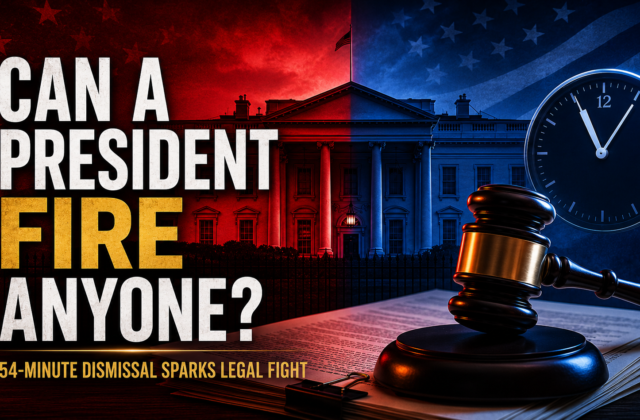
Can a President Fire Anyone? Trump’s 54-Minute Dismissal Triggers Unprecedented Legal Fight
Can a President Fire Anyone? Trump’s 54-Minute Dismissal Triggers Unprecedented Legal Fight A dramatic legal battle is unfolding in Washington after a U.S. attorney reportedly removed from office just 54 minutes after taking the position launched an extraordinary court challenge against President Donald Trump’s administration. The case has quickly become one of the most closely...
TheBusinessNow
Jul 24, 2026 · 3 min Read
Key Highlights
- ⚖️ A U.S. attorney reportedly dismissed just 54 minutes after taking office has launched an extraordinary legal challenge.
- 🇺🇸 The lawsuit raises major constitutional questions about the scope of presidential removal powers.
- 🏛️ Legal experts say the case could influence how future presidents appoint and dismiss federal officials.
- 📜 The dispute centers on whether existing federal laws and appointment procedures were properly followed.
- 👨⚖️ The case could eventually reach higher federal courts and potentially the U.S. Supreme Court.
- 📈 Investors and political analysts are watching closely because constitutional disputes can affect governance, policy stability, and market confidence.
Can a President Fire Anyone? Trump’s 54-Minute Dismissal Triggers Unprecedented Legal Fight
A dramatic legal battle is unfolding in Washington after a U.S. attorney reportedly removed from office just 54 minutes after taking the position launched an extraordinary court challenge against President Donald Trump’s administration.
The case has quickly become one of the most closely watched legal disputes in American politics because it raises a fundamental constitutional question:
How far does presidential authority extend when removing federal officials?
Legal scholars say the outcome could influence future administrations well beyond the current political cycle.
What Happened?
According to multiple reports, a U.S. attorney selected through a judicial appointment process was removed from office shortly after officially assuming the role.
The dismissal reportedly occurred approximately 54 minutes after the appointment became effective, making it one of the shortest tenures for a federal prosecutor in modern U.S. history.
Rather than quietly leaving office, the dismissed official has chosen to challenge the action in federal court.
Why This Case Is Different
Presidents have long possessed authority to appoint and remove executive branch officials.
However, this dispute differs because questions have emerged regarding:
- How the appointment was made.
- Whether judicial appointments carry different legal protections.
- Whether statutory procedures were properly followed.
- Whether presidential removal authority has constitutional limits in this specific context.
These legal questions make the case unusually significant.
The Core Constitutional Question
The central issue is not simply whether a president can dismiss an official.
Instead, the dispute focuses on how removal authority applies under the specific appointment framework involved in this case.
The court may ultimately examine:
- Constitutional separation of powers.
- Federal appointment statutes.
- Judicial appointment authority.
- Executive branch powers.
- Congressional intent behind existing law.
Why Legal Experts Are Watching Closely
Constitutional scholars note that the outcome could establish important guidance for future administrations.
Depending on the court’s reasoning, the decision could clarify:
- Presidential appointment powers.
- Removal authority.
- Independence of federal prosecutors.
- Limits of executive power.
- Future judicial appointments.
The case therefore extends beyond the individuals directly involved.
The “Rule of Law” Debate
The dismissed official has publicly argued that “the rule of law is not being followed,” according to published reports.
Supporters of the legal challenge argue:
- Independent prosecutors require institutional protection.
- Legal procedures should be followed consistently.
- Judicial appointments deserve clear statutory treatment.
Meanwhile, supporters of broad presidential authority maintain that presidents must retain sufficient control over executive branch personnel to ensure effective governance.
Executive Power Under the Spotlight
Questions surrounding presidential authority have appeared repeatedly throughout American history.
The Supreme Court has previously considered disputes involving:
- Executive authority.
- Independent agencies.
- Federal appointments.
- Removal protections.
This latest dispute could become another significant chapter in that ongoing constitutional discussion.
Political Reactions
The case has generated immediate political debate.
Some lawmakers describe the dismissal as a legitimate exercise of executive authority.
Others argue the courts should carefully review whether statutory safeguards were respected.
Because the dispute concerns constitutional powers rather than ordinary politics alone, it has attracted attention across the legal community.
Could This Reach the Supreme Court?
Many constitutional experts believe the case could ultimately move through multiple levels of the federal court system.
If lower courts issue conflicting interpretations—or if the constitutional questions are considered sufficiently significant—the dispute could eventually reach the U.S. Supreme Court.
At this stage, however, no such outcome is guaranteed.
Why Businesses and Investors Care
Although the case centers on constitutional law, institutional stability matters to financial markets.
Major legal disputes involving executive authority can influence:
- Investor confidence.
- Government policy expectations.
- Regulatory certainty.
- Institutional credibility.
- Market sentiment.
While immediate economic effects may be limited, closely watched constitutional cases often receive significant attention from investors.
What Happens Next?
The court proceedings will likely focus on:
- Whether the dismissal complied with applicable law.
- The scope of presidential removal authority.
- The legal status of the appointment.
- Constitutional interpretation.
Both sides are expected to present arguments concerning executive power and statutory authority before the court reaches any final decision.
Final Analysis
The challenge arising from the reported 54-minute dismissal of a U.S. attorney is about far more than an unusually brief tenure. It places longstanding constitutional questions regarding presidential authority, judicial appointments, and the separation of powers back under national scrutiny. While presidents generally possess broad authority over executive branch personnel, this case asks whether that authority has limits under the specific legal framework governing certain federal appointments.
As the litigation progresses, the courts—not political commentary—will determine the legal boundaries involved. Whatever the eventual outcome, the case is likely to become an important reference point in future debates over executive power and the constitutional balance between the branches of the U.S. government.
Keep reading
Related Articles
 Business
Japan’s Bond Market Is Sending a Warning: 10-Year Yields Near 3% Put the BOJ and Government Under Pressure
Japan’s Bond Market Is Sending a Warning: 10-Year Yields Near 3% Put the BOJ and Government Under Pressure Japan’s once-unthinkably low borrowing costs are disappearing. As the 10-year Japanese government bond yield approaches 3%, investors are reassessing inflation, government spending, the yen and the next move from the Bank of Japan. Japan’s bond market is...
 Global
US–South Korea Military Drills Cut Short: Trump’s Kim Jong Un Strategy Raises New Questions for the Alliance
US–South Korea Military Drills Cut Short: Trump’s Kim Jong Un Strategy Raises New Questions for the Alliance The United States and South Korea are abruptly scaling back their major joint military exercises, putting a spotlight on the changing security relationship between Washington, Seoul and Pyongyang. The annual Ulchi Freedom Shield exercise was originally scheduled to...
 Opinion
Broadway Week 2026 Returns: 25 Shows Join NYC’s 2-for-1 Ticket Rush — What to Know Before Tickets Sell Out
Broadway Week 2026 Returns: 25 Shows Join NYC’s 2-for-1 Ticket Rush — What to Know Before Tickets Sell Out Broadway Week 2026 is back, and theater fans have another chance to see some of New York City’s biggest stage productions at a significantly lower price. The fall edition is bringing a 2-for-1 ticket promotion to...
Comments (0)