
Tesla’s Reality Check: Earnings Miss Raises a Bigger Question—Can Elon Musk Still Deliver?
Tesla’s Reality Check: Earnings Miss Raises a Bigger Question—Can Elon Musk Still Deliver? For years, Tesla has been more than just an automaker. It has been one of Wall Street’s biggest growth stories, driven by innovation, ambitious leadership, and investor belief in Elon Musk’s long-term vision. Now, Tesla’s latest quarterly results have brought that optimism...
TheBusinessNow
Jul 22, 2026 · 3 min Read
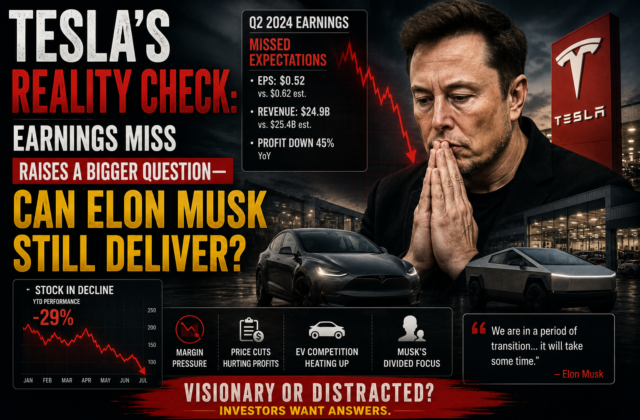
Key Highlights
- 🚗 Tesla reported a Q2 earnings miss, but revenue came in slightly above Wall Street expectations, delivering mixed signals for investors.
- 📉 The earnings miss has intensified scrutiny over Tesla's profitability amid aggressive EV price competition.
- 🤖 Investors remain focused on Elon Musk's long-term vision, including Robotaxi, Full Self-Driving (FSD), Optimus robots, and AI initiatives.
- ⚡ Tesla's energy storage business continues to emerge as an important growth driver beyond vehicle sales.
- 💰 Lower-than-expected cash burn eased some concerns about Tesla's financial flexibility despite heavy investments.
- 📊 Wall Street is increasingly valuing Tesla as an AI and technology company rather than solely an electric vehicle manufacturer.
Tesla’s Reality Check: Earnings Miss Raises a Bigger Question—Can Elon Musk Still Deliver?
For years, Tesla has been more than just an automaker. It has been one of Wall Street’s biggest growth stories, driven by innovation, ambitious leadership, and investor belief in Elon Musk’s long-term vision.
Now, Tesla’s latest quarterly results have brought that optimism under fresh scrutiny.
The company reported second-quarter earnings below analysts’ expectations, while revenue came in above consensus estimates, highlighting a mixed financial picture. Investors are now looking beyond the headline numbers to determine whether Tesla can return to stronger earnings growth as competition intensifies in the global electric vehicle (EV) market.
The Numbers That Matter
Tesla’s latest report delivered mixed signals.
Key Takeaways
- 📉 Earnings per share (EPS) missed analyst expectations.
- 📈 Revenue slightly exceeded Wall Street forecasts.
- 💰 Cash burn was lower than some analysts had feared, easing concerns about liquidity.
- 🚗 Vehicle deliveries remain under pressure compared with Tesla’s strongest growth years.
- 🤖 Investors continue to focus on AI, autonomous driving, robotics, and future product launches rather than vehicle sales alone.
While the revenue beat offered some reassurance, the earnings miss reinforced concerns about profitability in an increasingly competitive market.
Why Did Tesla Miss Earnings?
Several factors continue to weigh on Tesla’s profitability.
1. Pricing Pressure
Tesla has repeatedly adjusted vehicle prices in major markets to remain competitive.
Lower selling prices help maintain demand but reduce profit margins.
2. Global Competition
Tesla is facing stronger competition than ever.
Major rivals include:
- BYD
- General Motors
- Ford
- Hyundai
- Kia
- Volkswagen
- Rivian
- Lucid
Chinese manufacturers, in particular, continue expanding rapidly with competitively priced EVs.
3. Higher Investment Spending
Tesla continues investing heavily in:
- Artificial Intelligence
- Full Self-Driving (FSD)
- Robotaxi technology
- Optimus humanoid robots
- Battery development
- Manufacturing expansion
These investments increase short-term expenses but are intended to support long-term growth.
Wall Street Is Looking Beyond Cars
Tesla is increasingly valued as a technology company rather than simply an automaker.
Investors are closely monitoring progress in:
🤖 Full Self-Driving (FSD)
Tesla aims to expand autonomous driving capabilities, though regulatory approval and broader deployment remain key challenges.
🚖 Robotaxi Platform
Elon Musk has repeatedly described autonomous ride-hailing as a major future opportunity.
If successfully commercialized, many analysts believe it could significantly reshape Tesla’s business model.
🦾 Optimus Robot
Tesla’s humanoid robot project is still in development, but management continues to position it as a long-term growth initiative.
⚡ Energy Storage
Tesla Energy—including Megapack battery systems—has become an increasingly important contributor to the company’s diversification strategy.
Why Revenue Still Beat Expectations
Despite weaker earnings, revenue exceeded consensus estimates.
Possible contributors include:
- Stable demand across key markets.
- Growth in Tesla’s energy generation and storage business.
- Software-related revenue streams.
- Services and charging infrastructure.
This suggests Tesla continues to generate substantial sales even as profitability faces pressure.
Investors Want One Thing: Margin Recovery
The biggest question facing Tesla is not simply whether it can sell more vehicles.
Instead, investors want to know whether the company can restore higher profit margins while continuing to invest in future technologies.
Higher margins would indicate that Tesla can balance growth with profitability despite competitive pricing.
Elon Musk Remains Central to the Story
Much of Tesla’s valuation continues to reflect confidence in Elon Musk’s long-term vision.
Supporters point to:
- Leadership in EV technology.
- AI and robotics ambitions.
- Energy storage growth.
- Manufacturing innovation.
Critics argue that:
- Execution risks remain significant.
- Competition is increasing.
- AI projects may take years to generate meaningful returns.
- Vehicle growth has slowed compared with earlier years.
As a result, every earnings report becomes a referendum on Musk’s strategy.
Risks Investors Are Watching
Tesla still faces several important challenges:
- Slower EV demand in some regions.
- Intense price competition.
- Regulatory uncertainty around autonomous driving.
- Rising capital expenditure.
- Global economic uncertainty.
- Supply-chain and geopolitical risks.
These factors could influence Tesla’s financial performance over the coming quarters.
Opportunities Ahead
Despite near-term challenges, Tesla retains several long-term growth drivers:
- Expansion of Full Self-Driving technology.
- Commercialization of Robotaxi services.
- Growth in energy storage and grid-scale batteries.
- AI software development.
- Manufacturing efficiency improvements.
- Potential new vehicle models.
Many investors believe these businesses could become increasingly important over the next decade.
What This Means for Tesla Stock
Markets often react not only to current earnings but also to management’s outlook.
Investors will pay close attention to:
- Future delivery expectations.
- AI and autonomous driving updates.
- Capital expenditure plans.
- Profit margin guidance.
- Energy business growth.
- Management’s commentary on demand.
A confident outlook could support investor sentiment even after an earnings miss, while cautious guidance may increase volatility.
Final Analysis
Tesla’s latest quarterly report paints a mixed picture. The company exceeded revenue expectations but fell short on earnings, reflecting the challenges of balancing competitive pricing, large-scale investment, and profitability.
The broader question now extends beyond one quarter’s financial results. Investors are increasingly evaluating whether Tesla can successfully transform itself from the world’s leading electric vehicle manufacturer into a diversified technology company built around AI, autonomous driving, robotics, and energy solutions.
For Elon Musk, this is not just another earnings season—it is another opportunity to demonstrate that today’s heavy investments can become tomorrow’s growth engines. Whether that vision translates into sustained financial performance will remain one of the most closely watched stories on Wall Street.
❓FAQs
1. Why did Tesla miss earnings expectations?
Tesla’s earnings were affected by lower profit margins, ongoing investments in AI and autonomous driving, competitive pricing strategies, and increased operating expenses.
2. Did Tesla beat revenue expectations?
Yes. While Tesla missed analyst estimates for earnings per share (EPS), it reported revenue that exceeded Wall Street expectations.
3. Why are investors more focused on AI than vehicle sales?
Many investors believe Tesla’s future growth depends on AI technologies such as:
- 🤖 Full Self-Driving (FSD)
- 🚖 Robotaxi services
- 🦾 Optimus humanoid robots
- ⚡ AI-powered manufacturing
These businesses could become significant long-term revenue sources if successfully commercialized.
4. How does Tesla’s energy business contribute to growth?
Tesla Energy, which includes Megapack battery storage and solar products, has become an increasingly important part of the company’s diversification strategy and may reduce reliance on vehicle sales over time.
5. Who are Tesla’s biggest competitors?
Tesla competes with several global automakers, including:
- BYD
- Ford
- General Motors
- Hyundai
- Kia
- Volkswagen
- Rivian
- Lucid
Competition is particularly intense in the global EV market.
6. What should investors watch after this earnings report?
Key areas to monitor include:
- 🚗 Vehicle deliveries
- 🤖 AI and FSD progress
- 🚖 Robotaxi rollout
- ⚡ Energy storage growth
- 💵 Profit margins
- 📈 Management guidance
- 🌍 Global EV demand
7. Could Tesla stock remain volatile?
Yes. Tesla’s stock often reacts to:
- Quarterly earnings
- Elon Musk’s announcements
- AI developments
- Robotaxi updates
- EV demand trends
- Interest rate expectations
- Overall market sentiment
8. Is Tesla still considered a growth company?
Many analysts continue to classify Tesla as a long-term growth company due to its investments in AI, autonomous driving, robotics, and clean energy, although execution risks remain.
Keep reading
Related Articles
 Markets
U.S. Treasury Doubles Bond Buybacks: Why Markets Are Still Worried About Rising Yields
The Treasury Just Sent Two Messages to Wall Street At first glance, this looks like a straightforward market-support operation. Treasury says: We want to improve liquidity in longer-dated Treasury securities. Investors hear: Washington is increasingly concerned about the rise in long-term borrowing costs. And that second interpretation is what makes this story important. The Treasury...
 Commodities
Oil Nears $95: Could the Iran War Trigger a New U.S. Inflation Shock?
Oil at $95 Is Not the Real Story A crude-oil headline is easy to write: “Oil prices rise as Iran tensions escalate.” Reuters, Bloomberg, CNBC and WSJ can publish that story within minutes. But for TheBusinessNow, that isn’t enough. The bigger question is: What happens to the American economy if oil stays near $95 —...
 Economy
U.S. National Debt Hits $40 Trillion: Why Treasury Yields Are Rising Again
The $40 Trillion Number Is Not the Whole Story The United States has crossed a psychological and financial milestone. $40 trillion. But simply writing “America owes $40 trillion” misses the more important story. The real question for markets is: Who is willing to finance America’s growing debt — and at what interest rate? That question...
Comments (0)