
Salad and Go Shuts Down Every Location After Bankruptcy Filing as Fast-Growing Restaurant Chain Runs Out of Road
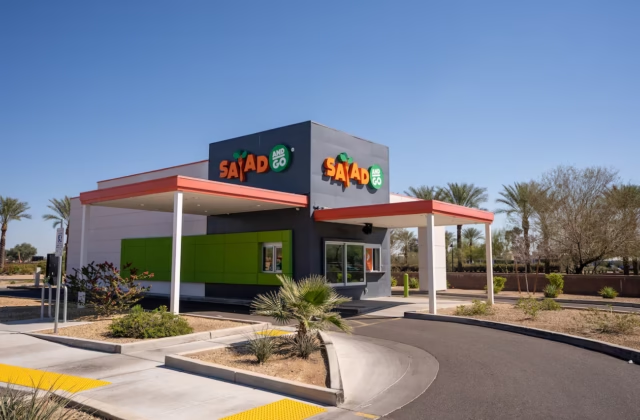
Salad and Go Shuts Down Every Location After Bankruptcy Filing as Fast-Growing Restaurant Chain Runs Out of Road Salad and Go, once celebrated for making affordable salads and healthier fast food available through a drive-thru model, is shutting down its entire restaurant network after filing for Chapter 11 bankruptcy. The Arizona-based chain is closing its...
James
Aug 5, 2026 · 3 min Read
Key Highlights
- 🥗 Salad and Go has filed for Chapter 11 bankruptcy protection.
- 🔒 The company is permanently closing its remaining restaurant locations on August 5, 2026.
- 💰 The chain cited sustained pressure on consumer demand, strategic growth challenges and rising costs.
- 📉 The company had already been shrinking its footprint after a major expansion into Texas and Oklahoma.
- 🏪 Salad and Go had grown to more than 60 locations at its peak, with reports putting its remaining footprint at around 70 before the final shutdown.
- ⚠️ A July Cyclospora outbreak was not linked to Salad and Go, but the company said it weakened confidence across the broader industry and compounded its challenges.
Salad and Go Shuts Down Every Location After Bankruptcy Filing as Fast-Growing Restaurant Chain Runs Out of Road
Salad and Go, once celebrated for making affordable salads and healthier fast food available through a drive-thru model, is shutting down its entire restaurant network after filing for Chapter 11 bankruptcy. The Arizona-based chain is closing its remaining locations permanently on August 5, 2026, bringing an abrupt end to a business that had expanded rapidly across multiple states.
The collapse is particularly striking because Salad and Go had once been one of the country’s fastest-growing restaurant concepts. The company ultimately struggled with a combination of weaker consumer demand, rising operating costs and earlier expansion decisions that management said created significant challenges.
From Fast-Growth Restaurant Star to Bankruptcy
The downfall of Salad and Go is notable because the chain wasn’t an obscure restaurant company.
Founded in Arizona in 2013, the brand built its identity around a relatively simple proposition: offer salads, wraps, breakfast items and other food through a convenient drive-thru format at prices designed to compete with traditional fast food.
The concept resonated with consumers looking for healthier options without paying premium restaurant prices.
The company subsequently expanded rapidly, eventually operating across Arizona, Nevada, Texas and Oklahoma.
But rapid growth also created operational challenges.
The Expansion Strategy That Became a Problem
One of the biggest turning points came during Salad and Go’s expansion beyond its Arizona base.
Earlier in 2026, the company announced plans to close 32 Texas and Oklahoma stores, including 25 in Texas and seven in Oklahoma, while moving its headquarters back to Arizona. Management acknowledged that the earlier Texas expansion strategy had not worked as planned.
The company had invested heavily in infrastructure intended to support much larger operations.
That included a large central kitchen in Dallas designed around expectations for substantial future growth.
Instead, the expansion was scaled back.
The result was a business carrying the consequences of a growth strategy that had not delivered the expected scale.
Rising Costs Added More Pressure
Restaurant operators have been dealing with a difficult combination of expenses.
For a fast-casual business, costs can rise across multiple areas:
- Food ingredients
- Labor
- Rent
- Utilities
- Transportation
- Packaging
- Insurance
- Restaurant maintenance
Salad and Go’s own statement pointed specifically to rising costs alongside sustained pressure on consumer demand and previous strategic growth challenges.
For a brand built around affordability, the problem becomes even more complicated.
Raising prices can protect margins but risks pushing customers toward competitors.
Keeping prices low can preserve customer loyalty but leave less room to absorb higher operating expenses.
The Affordable-Food Advantage Became a Challenge
Salad and Go’s affordability was one of its biggest selling points.
That helped the chain develop a loyal customer base.
But the same positioning could make the business vulnerable when costs increased.
Consumers wanted inexpensive meals.
Restaurants needed enough revenue per order to cover increasingly expensive operations.
That tension has become one of the major challenges facing the restaurant industry.
The Cyclospora Outbreak Was Not Linked to Salad and Go
One important distinction deserves attention.
Reports surrounding the closure have mentioned a Cyclospora outbreak in July.
However, Salad and Go said the company was not implicated in that outbreak.
Instead, the company said the outbreak weakened consumer confidence across the broader food industry and compounded the difficulties it was already experiencing.
That distinction matters because the bankruptcy should not be characterized as being caused by a food-safety incident involving Salad and Go.
The company’s stated reasons were broader and included consumer demand, previous strategic expansion challenges and rising costs.
Why the Shutdown Is So Significant
The closure represents more than another restaurant bankruptcy.
Salad and Go had positioned itself as a potential alternative to traditional fast food.
Its model combined:
Drive-thru convenience + healthier food + relatively low prices.
That combination attracted customers who wanted something different from burgers, fries and other conventional fast-food options.
The company’s failure raises questions about whether that model can remain profitable at scale when operating expenses continue rising.
What Happened to the Texas and Oklahoma Locations?
The company had already begun retreating from those markets before the final bankruptcy announcement.
In January, Salad and Go announced the closure of all its Texas and Oklahoma locations and said it would refocus on Arizona. That move involved 32 restaurants and additional facilities.
The strategy ultimately wasn’t enough to stabilize the company.
By August, the business had moved from regional retrenchment to a complete shutdown.
A Chapter 11 Filing Usually Means Reorganization—So Why Close Everything?
Chapter 11 bankruptcy protection generally provides companies with an opportunity to reorganize their finances and operations.
However, bankruptcy protection does not guarantee that a company will continue operating.
In Salad and Go’s case, the company announced that all remaining restaurants would close permanently, making the filing part of a broader wind-down rather than a straightforward turnaround story.
That makes the August 5 closure particularly significant.
What Happens to Customers and Employees?
The immediate effect is straightforward: customers can no longer rely on Salad and Go locations after the final service date.
Employees are also directly affected as the restaurant network disappears.
For communities that had incorporated the chain into their daily routines, the closure removes a relatively inexpensive drive-thru option.
The shutdown also affects suppliers, landlords and other businesses connected to the restaurant chain.
The Original Founders React
Salad and Go was founded by Tony and Roushan Christofellis, who later left the company after it was sold in 2021.
The founders subsequently launched another food business, Angie’s.
Following the closure announcement, they expressed sadness about seeing the company they created disappear while emphasizing that their broader mission of making quality food affordable continues through their newer venture.
What This Means for the Restaurant Industry
Salad and Go’s collapse offers a wider lesson for restaurant operators.
Fast growth can create impressive headlines, but expanding locations faster than the underlying economics can support can become dangerous.
Restaurant companies have to balance:
Growth
Opening more locations and reaching new customers.
Unit Economics
Ensuring individual restaurants are profitable.
Supply Chain
Keeping food and logistics costs under control.
Pricing
Remaining affordable without destroying margins.
Consumer Demand
Understanding how customers respond when prices rise.
Salad and Go’s experience shows how difficult it can be to maintain that balance.
🔮 What Happens Next?
The immediate future is clear: the remaining Salad and Go restaurants are closing permanently.
The bigger question is what happens to the brand’s assets, employees, leases and other obligations as the bankruptcy process continues.
The restaurant industry will also be watching whether competitors can capture Salad and Go’s customers by offering similarly affordable, healthier drive-thru options.
Final Thoughts
Salad and Go’s shutdown is a striking example of how quickly a high-growth restaurant concept can move from expansion to retrenchment and finally bankruptcy.
The chain had a compelling proposition: make healthier food convenient and affordable enough to compete with traditional fast food.
But sustained consumer pressure, rising costs and earlier expansion challenges proved difficult to overcome.
For customers, August 5 marks the final chapter for a restaurant brand that spent 13 years trying to redefine what fast food could look like.
For the wider restaurant industry, its collapse may serve as another warning that rapid expansion means little if the underlying economics cannot support it.
❓ FAQs
Why is Salad and Go closing?
The company said it was unable to overcome sustained pressure on consumer demand, previous strategic growth challenges and rising costs.
Did Salad and Go file for bankruptcy?
Yes. The company filed voluntary Chapter 11 bankruptcy petitions on August 4, 2026.
Are all Salad and Go locations closing?
According to the company’s latest closure announcement and today’s reporting, all remaining locations are being permanently closed on August 5, 2026.
Was Salad and Go connected to the Cyclospora outbreak?
The company said it was not implicated in the July Cyclospora outbreak. It said the outbreak nevertheless weakened consumer confidence across the industry.
Why did Salad and Go struggle after expanding?
Management cited strategic growth challenges, while earlier reporting documented the company’s retreat from Texas and Oklahoma after its expansion there failed to produce the expected results.
🌐 External Resources
- Salad and Go Official Website — Company information and location updates.
- USA Today — Latest reporting on the bankruptcy and closures.
- ABC15 Arizona — Arizona-focused coverage of the shutdown.
- U.S. Courts Bankruptcy Information — Background on Chapter 11 bankruptcy.
Keep reading
Related Articles
 Crypto
₿ Bitcoin Breaks Above $72,000: Why Trump’s Crypto Push Is Sending Crypto Stocks Higher
Bitcoin’s $72,000 Move Is Bigger Than Bitcoin A typical crypto headline would be: Bitcoin jumps above $72,000. But that misses the most important part of today’s move. The interesting part is the simultaneous rally in: Bitcoin ↓ Coinbase ↓ Strategy ↓ Circle ↓ Robinhood ↓ Bitcoin miners ↓ Crypto infrastructure That tells us investors aren’t...
 Commodities
Oil Nears $95: Could the Iran War Trigger a New U.S. Inflation Shock?
Oil at $95 Is Not the Real Story A crude-oil headline is easy to write: “Oil prices rise as Iran tensions escalate.” Reuters, Bloomberg, CNBC and WSJ can publish that story within minutes. But for TheBusinessNow, that isn’t enough. The bigger question is: What happens to the American economy if oil stays near $95 —...
 Economy
U.S. National Debt Hits $40 Trillion: Why Treasury Yields Are Rising Again
The $40 Trillion Number Is Not the Whole Story The United States has crossed a psychological and financial milestone. $40 trillion. But simply writing “America owes $40 trillion” misses the more important story. The real question for markets is: Who is willing to finance America’s growing debt — and at what interest rate? That question...
Comments (0)