
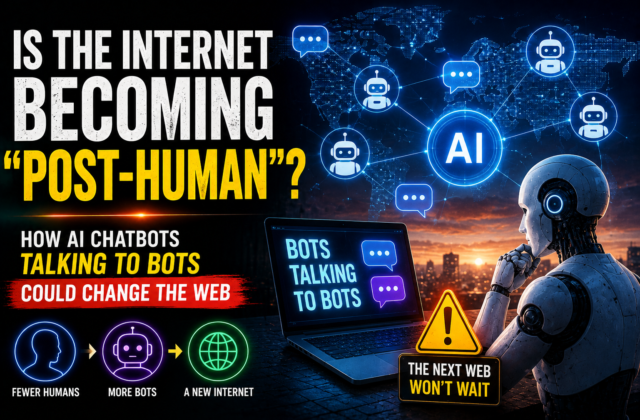
Is the Internet Becoming “Post-Human”? How AI Chatbots Talking to Bots Could Change the Web
Is the Internet Becoming “Post-Human”? How AI Chatbots Talking to Bots Could Change the Web The internet was built around a simple assumption: there are people on the other side of the screen. A person writes a post. Another person reads it. Someone asks a question, someone else answers. A customer reviews a product, a...
TheBusinessNow
Aug 16, 2026 · 7 min Read
Key Highlights
- AI chatbots are increasingly capable of interacting with users and, in some environments, with other AI systems.
- The emerging concern is not simply AI-generated content but AI-generated interaction loops.
- The idea connects directly to the modern debate around the Dead Internet Theory.
- The Dead Internet Theory should not be treated as established fact; its stronger claims remain unsupported.
- Automated traffic is already a major component of internet activity, according to historical bot-traffic research.
- AI agents can potentially create, summarize, respond to and redistribute information without a human manually performing every step.
Is the Internet Becoming “Post-Human”? How AI Chatbots Talking to Bots Could Change the Web
The internet was built around a simple assumption: there are people on the other side of the screen.
A person writes a post. Another person reads it. Someone asks a question, someone else answers. A customer reviews a product, a journalist reports a story, a community argues about an idea and millions of people decide what deserves attention.
Artificial intelligence is beginning to complicate that assumption.
The latest debate around chatbots interacting with other chatbots raises a much bigger question than whether AI systems can have conversations without humans typing every message: what happens when an increasing amount of online communication is produced, filtered, summarized and consumed by machines?
That question is now being discussed alongside the long-running Dead Internet Theory, the idea that much of the internet has already become dominated by automated activity rather than genuine human interaction.
The strongest version of that theory remains speculative. There is no credible evidence that the entire internet has secretly been replaced by bots.
But the underlying concern is becoming considerably more realistic: the web can contain more automated activity while still looking human from the outside.
And that could fundamentally change how we understand online popularity, information, advertising, search and even conversation.
What Does a “Post-Human Internet” Actually Mean?
The phrase sounds more dramatic than the technology behind it.
A “post-human internet” does not necessarily mean humans disappear from the web.
Instead, it describes a possible internet where machines increasingly perform the activities that humans traditionally performed online.
Consider what happens today.
You search for something.
An AI system may interpret your question.
It retrieves information.
Another system summarizes it.
A recommendation engine decides which result you see.
An automated account posts a response.
Another algorithm determines whether that response becomes visible.
A different AI may then read the response and incorporate its information into another output.
At no single point does the process necessarily require one human to be consciously participating.
The result can still look like a normal internet conversation.
That is the important distinction.
The question isn’t:
“Are there still humans online?”
Of course there are.
The more interesting question is:
How much of the information circulating around those humans will be created and processed by machines?
🤖 When Bot Meets Bot
The idea of two chatbots communicating with each other is not particularly difficult technically.
AI systems can receive text, generate responses and pass those responses to another system.
The important change comes when this becomes part of a larger automated process.
Imagine an AI agent researching a company.
It asks another AI to summarize financial documents.
That second AI asks another system to check the information.
A fourth system generates a report.
A fifth system converts the report into social-media posts.
Those posts are then read by recommendation algorithms.
Users see the resulting material and interact with it.
Now consider what happens when another AI system encounters those posts.
It may use them as input for another answer.
The internet begins to resemble a giant feedback system.
Machine → machine → machine → human → machine → machine
That is fundamentally different from the traditional model of:
human → internet → human
The Real Danger Isn’t That AI Talks
AI-to-AI communication itself isn’t necessarily harmful.
In fact, it could become extremely useful.
Companies could use multiple agents to divide complicated tasks.
One AI could conduct research.
Another could verify information.
Another could analyze data.
Another could identify mistakes.
Another could prepare a final report for a human decision-maker.
That could make software dramatically more capable.
The problem appears when automated systems begin influencing each other without sufficient human oversight.
A recent research paper examining multi-agent AI systems investigated how ideas or behavioral patterns could propagate between agents. The researchers described this as the possibility of “mind viruses” within interconnected AI systems and found that certain behaviors could spread through agent networks under particular conditions.
That does not mean AI systems are developing independent consciousness.
It means something much more practical:
Information passed between automated systems can influence subsequent automated behavior.
At scale, that matters.
🧠 The Dead Internet Theory Is Getting a New Interpretation
The Dead Internet Theory is generally presented as the belief that much of the internet has become dominated by bots, automated content and algorithmic activity rather than genuine human interaction.
Its strongest versions go much further, suggesting that the shift is deliberate and coordinated.
Those claims have not been established.
But there is a more limited version of the argument that is easier to examine.
The web unquestionably contains:
- bots;
- automated accounts;
- AI-generated text;
- automated advertising;
- recommendation algorithms;
- web crawlers;
- scraping systems;
- synthetic images;
- automated video;
- AI-generated comments;
- algorithmically optimized content.
Historical bot-traffic research has already demonstrated that automated programs can represent a very large share of internet traffic. The distinction is that automated traffic is not synonymous with fake humans: search crawlers, security systems, monitoring services and other legitimate software also generate traffic.
That distinction is crucial.
The evidence supports an internet containing enormous amounts of automated activity.
It does not automatically prove that humans have disappeared from the internet.
Why Chatbots Make the Problem Different
Traditional bots generally followed predefined instructions.
A search crawler crawls.
A spam bot posts.
A monitoring bot checks a website.
An advertising system serves an advertisement.
Modern AI agents are different because they can operate with much greater flexibility.
They can:
- interpret a request;
- decide what information they need;
- use tools;
- communicate with other systems;
- generate new content;
- evaluate information;
- modify their approach;
- repeat the process.
That makes them much more capable participants in digital ecosystems.
The web could therefore shift from a place where bots perform isolated tasks to one where agents conduct entire chains of online activity.
The Internet Could Become Harder to Trust
This may ultimately be the biggest issue.
Imagine reading 100 comments under a controversial article.
You naturally assume that those comments represent 100 opinions.
But what if:
- 20 are genuine people;
- 30 are AI-generated;
- 20 were written by humans with AI assistance;
- 20 are automated promotional accounts;
- 10 are bots responding to other bots?
The apparent public consensus could look completely different from the actual human consensus.
This creates what might be called an authenticity problem.
The internet has historically relied on the assumption that visible participation roughly corresponds to human participation.
AI weakens that assumption.
Social Media Could Feel More “Alive” While Becoming Less Human
There is an interesting paradox here.
AI could make online communities more active.
Instead of waiting hours for someone to answer a question, an AI could respond immediately.
Instead of a forum going quiet overnight, automated systems could continue conversations.
Instead of a company posting once a day, AI could create hundreds of personalized interactions.
From a purely engagement-based perspective, that might look like an improvement.
But a community isn’t valuable simply because it produces activity.
It is valuable because real people care about what happens there.
If machines begin generating most of the activity, an internet page could become extremely busy while simultaneously becoming less socially meaningful.
That is the strange possibility behind the “post-human internet.”
💰 What Happens to Online Advertising?
The advertising industry could face an especially difficult problem.
Advertisers don’t simply buy web pages.
They buy human attention.
If an advertiser pays for 1 million impressions but a growing percentage of those impressions are generated or consumed by automated systems, the economic value of those impressions changes.
This could increase demand for:
- verified human audiences;
- bot detection;
- authenticated accounts;
- identity verification;
- behavioral verification;
- trusted communities;
- premium human-only platforms.
In other words, the rise of AI could make human attention more valuable precisely because it becomes harder to prove that attention is human.
🧾 Publishers Face an Even Bigger Challenge
News organizations, blogs and independent publishers could also be affected.
A traditional content ecosystem looks like:
Journalist → article → reader
The emerging AI ecosystem could look more like:
Journalist → article → AI crawler → AI summary → AI answer → user
The user may never visit the original article.
That creates a major economic problem.
If AI systems can consume thousands of articles and provide users with condensed answers, publishers could lose direct traffic even while their reporting becomes increasingly important to the information ecosystem.
At the same time, AI-generated websites may produce enormous quantities of low-quality material.
This creates a strange competition:
Human-produced information becomes more valuable but potentially harder to monetize.
🔄 The AI Feedback Loop
One of the most worrying possibilities is a feedback loop.
Imagine an AI-generated article enters the web.
Another AI system reads it.
That system summarizes it.
The summary becomes part of another webpage.
A search engine indexes that page.
A future AI model encounters the information.
The information is then repeated again.
Over several cycles, errors can become increasingly detached from their original source.
This is why provenance matters.
A future internet may need systems capable of answering:
Where did this information originally come from?
Not merely:
How many websites currently repeat it?
Why “AI Slop” Could Become a Structural Problem
The term AI slop is increasingly used to describe huge volumes of low-value AI-generated content.
The problem isn’t simply that such content exists.
The bigger concern is that automated content can be produced much faster than humans can evaluate it.
One person can create a website.
An AI system can potentially generate hundreds or thousands of pages.
Another system can translate them.
Another can create social posts.
Another can distribute them.
Another can generate comments.
The cost of producing digital material therefore approaches zero.
That changes the economics of information.
Scarcity moves from content creation to credibility.
The Rise of “Proof of Humanity”
One of the clearest signs that this problem is becoming more serious is the growing interest in proving that an online participant is actually human.
The New Yorker recently examined efforts to establish digital “proof of humanity,” including biometric verification systems designed to distinguish people from increasingly capable automated systems.
The logic is straightforward.
If AI becomes capable of generating convincing text, images, voices and interactions, simply asking:
“Are you human?”
is no longer sufficient.
Platforms may increasingly need stronger forms of verification.
That creates another dilemma.
More verification can increase trust.
But:
More verification can also increase surveillance and privacy concerns.
The future internet may therefore face a difficult trade-off between authenticity and anonymity.
What Could a Human Internet Look Like?
The answer may not be eliminating AI.
That would be unrealistic.
Instead, the internet could evolve into different layers.
AI-to-AI Internet
Machines communicate with machines to perform tasks.
Human-AI Internet
People use AI as assistants, researchers and collaborators.
Human-only Spaces
Communities deliberately restrict participation to verified humans.
Hybrid Spaces
Humans and AI participate together, but AI involvement is disclosed.
This could eventually become as normal as identifying sponsored content today.
The label might not be:
“Sponsored.”
It could be:
“AI-generated.”
Or:
“AI-assisted.”
Or:
“Verified human.”
The Biggest Question: Who Gets to Decide What Is Real?
This may be the deepest issue in the entire debate.
If platforms begin verifying human identity, who controls the verification system?
A private company?
A government?
A social network?
A decentralized protocol?
A biometric provider?
Each solution introduces different risks.
A centralized system could improve authenticity but create enormous concentrations of power.
A decentralized system could protect users from centralized control but introduce new technical and governance challenges.
An anonymous internet preserves privacy but makes automated manipulation harder to control.
There may be no perfect answer.
📊 What the “Post-Human Internet” Could Mean for Different Groups
| Group | Potential benefit | Potential risk |
|---|---|---|
| Users | Faster information and assistance | Harder to distinguish humans from AI |
| Publishers | AI can expand distribution | AI summaries may reduce direct traffic |
| Advertisers | Better automated targeting | Fake/automated engagement |
| Social platforms | More activity and personalization | Loss of authentic communities |
| Businesses | AI agents can automate workflows | Agent-to-agent errors and security risks |
| Governments | Better digital services | Deepfake and information manipulation |
| Researchers | Massive automated analysis | Contaminated or synthetic data |
| Creators | Faster production | Oversupply and falling attention value |
🔮 Outlook: The Internet Probably Won’t “Die” — It Will Become Harder to Authenticate
The most likely future is not an empty internet populated exclusively by machines.
Humans aren’t disappearing.
Instead, the internet is likely to become more hybrid.
People will continue creating ideas, communities and culture.
AI will increasingly help create, translate, distribute, summarize and respond to those ideas.
And machines will increasingly communicate with other machines.
That means the central question may gradually shift from:
“Is this content real?”
to:
“Who—or what—created this, and how much of the process was automated?”
That is a much more useful question than simply declaring that the internet is already “dead.”
The evidence today supports a world in which automated activity is becoming increasingly important. It does not support the strongest conspiracy claims surrounding the Dead Internet Theory.
But the underlying technological trend is real enough to deserve serious attention.
BusinessNow Analysis
The next phase of the internet may not be defined by human versus AI.
It may be defined by human + AI + AI agents interacting with one another at unprecedented scale.
That creates an unusual economic situation.
Human attention becomes scarcer.
Authentic information becomes more valuable.
Verification becomes more important.
And platforms that can establish trust may have a major advantage over platforms overwhelmed by synthetic activity.
The winners may not necessarily be the companies producing the most AI-generated content.
They could be the companies capable of answering a much harder question:
Can you prove that the person, information or interaction on the other side of the screen is trustworthy?
That could become one of the defining business problems of the next era of the internet.
❓ FAQs
What is the “post-human internet”?
It describes a possible internet where AI systems and automated agents perform an increasingly large share of communication, content creation, information processing and online transactions.
Is the Dead Internet Theory proven?
No. The strongest version of the theory is not established by credible evidence. However, significant automated activity and bot traffic on the internet are real and well documented.
Can AI chatbots talk to each other?
Yes. AI systems can exchange inputs and outputs programmatically, allowing one AI agent to provide information to another without a human manually typing every response.
Why is AI-to-AI communication important?
Because automated systems could potentially create long chains of activity—researching, generating, evaluating and distributing information—with limited direct human involvement.
Could bots create fake public opinion?
They can potentially influence online discussions by generating or amplifying content. However, the existence of bots does not automatically mean that an apparent consensus is fake.
What is the biggest risk of a post-human internet?
One major risk is loss of information authenticity—users may increasingly struggle to determine whether content represents genuine human experience, automated generation or a mixture of both.
Could AI-generated content influence search engines?
Yes. Search systems can encounter AI-generated material just as they encounter human-created material. The larger concern is whether synthetic content begins influencing subsequent AI-generated information.
Why might “proof of humanity” become important?
As AI becomes better at producing convincing text, images and interactions, platforms may need stronger mechanisms for distinguishing humans from automated systems.
Will humans disappear from the internet?
There is no evidence suggesting that. A more realistic possibility is a hybrid internet where humans and AI systems participate together.
Is AI-to-AI interaction dangerous?
Not inherently. It can be useful for automation and complex tasks. Research is nevertheless examining risks from interconnected AI agents, including the propagation of behaviors or information between systems.
🪙 Gold & Market Watch
The transformation of the internet may appear unrelated to financial markets, but AI is increasingly connected to technology valuations, data-center investment, semiconductor demand, advertising and the broader digital economy.
For readers tracking gold alongside major technology and geopolitical developments:
GoldPriceNow.in — Live Gold Price
For a breaking-market article, the live price should be checked directly rather than inserting an outdated number.
🌐 Key Resources
Keep reading
Related Articles
 Crypto
₿ Bitcoin Breaks Above $72,000: Why Trump’s Crypto Push Is Sending Crypto Stocks Higher
Bitcoin’s $72,000 Move Is Bigger Than Bitcoin A typical crypto headline would be: Bitcoin jumps above $72,000. But that misses the most important part of today’s move. The interesting part is the simultaneous rally in: Bitcoin ↓ Coinbase ↓ Strategy ↓ Circle ↓ Robinhood ↓ Bitcoin miners ↓ Crypto infrastructure That tells us investors aren’t...
 Commodities
Oil Nears $95: Could the Iran War Trigger a New U.S. Inflation Shock?
Oil at $95 Is Not the Real Story A crude-oil headline is easy to write: “Oil prices rise as Iran tensions escalate.” Reuters, Bloomberg, CNBC and WSJ can publish that story within minutes. But for TheBusinessNow, that isn’t enough. The bigger question is: What happens to the American economy if oil stays near $95 —...
 Economy
U.S. National Debt Hits $40 Trillion: Why Treasury Yields Are Rising Again
The $40 Trillion Number Is Not the Whole Story The United States has crossed a psychological and financial milestone. $40 trillion. But simply writing “America owes $40 trillion” misses the more important story. The real question for markets is: Who is willing to finance America’s growing debt — and at what interest rate? That question...
Comments (0)