
IRGC Strait of Hormuz Warning: Iran Threatens Oil Exports as Tensions With the U.S. Escalate
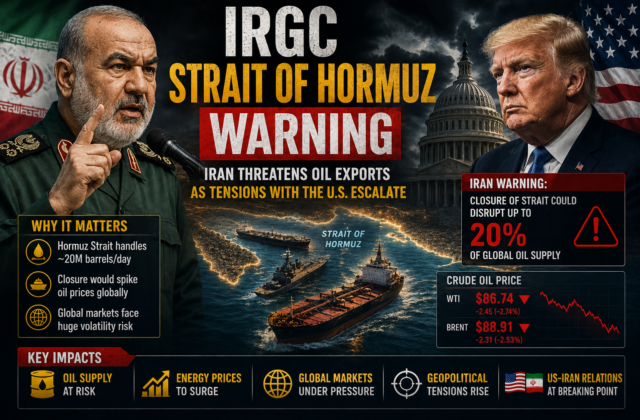
IRGC Strait of Hormuz Warning: Iran Threatens Oil Exports as U.S. Tensions Escalate The IRGC Strait of Hormuz Warning has intensified geopolitical tensions in the Middle East after Iran’s Islamic Revolutionary Guard Corps (IRGC) issued fresh warnings regarding the future of the Strait of Hormuz, one of the world’s most important oil shipping routes. According...
TheBusinessNow
Jul 14, 2026 · 2 min Read
Key Highlights
- IRGC Strait of Hormuz Warning raises fresh geopolitical tensions in the Middle East.
- Iran warned U.S. actions could delay reopening of the Strait of Hormuz.
- IRGC claimed regional oil and gas exports may remain disrupted while U.S. military presence continues.
- The Strait of Hormuz carries nearly 20% of global oil supplies, making it a vital shipping route.
- Oil markets could remain volatile as traders assess geopolitical risks.
- Rising energy prices could increase global inflation pressures.
IRGC Strait of Hormuz Warning: Iran Threatens Oil Exports as U.S. Tensions Escalate
The IRGC Strait of Hormuz Warning has intensified geopolitical tensions in the Middle East after Iran’s Islamic Revolutionary Guard Corps (IRGC) issued fresh warnings regarding the future of the Strait of Hormuz, one of the world’s most important oil shipping routes.
According to statements attributed to the IRGC, continued U.S. military actions would further delay the reopening of the Strait of Hormuz. The group also claimed that no oil or natural gas would be exported from the region as long as U.S. military presence continues, raising fresh concerns across global energy markets.
The developments immediately caught the attention of investors, commodity traders, and governments because roughly one-fifth of the world’s crude oil supply typically passes through the Strait of Hormuz.
IRGC Strait of Hormuz Warning: What Happened?
The latest IRGC Strait of Hormuz Warning includes several strong statements regarding regional security and energy exports.
According to the announcement:
- The IRGC warned that continued U.S. military operations would delay reopening the Strait of Hormuz.
- Iranian officials claimed enemy weapons and storage facilities in Bahrain and Kuwait had been targeted.
- The IRGC stated that regional oil and gas exports could remain disrupted while U.S. military forces remain active.
- The warning significantly raises geopolitical risks for global energy markets.
Although these statements increase tensions, market participants continue to monitor whether they translate into actual disruptions to shipping traffic.
IRGC Strait of Hormuz Warning: Why the Strait of Hormuz Matters
The IRGC Strait of Hormuz Warning is attracting worldwide attention because the Strait of Hormuz is one of the most strategically important maritime chokepoints.
Each day, millions of barrels of crude oil and large volumes of liquefied natural gas pass through the narrow waterway connecting Gulf producers to global markets.
Any threat affecting this route can influence:
- Global crude oil prices
- Natural gas markets
- Shipping insurance costs
- Inflation expectations
- Energy company stocks
Even without an actual closure, geopolitical uncertainty often increases market volatility.
IRGC Strait of Hormuz Warning: Impact on Global Oil Prices
The IRGC Strait of Hormuz Warning may keep oil traders cautious.
If tensions continue to escalate, investors could see:
- Higher Brent crude prices
- Increased WTI crude volatility
- Rising shipping costs
- Higher energy import expenses
- Renewed inflation concerns worldwide
Energy markets typically react immediately whenever risks emerge around the Strait of Hormuz because alternative shipping routes remain limited.
IRGC Strait of Hormuz Warning: What Investors Should Watch
Following the IRGC Strait of Hormuz Warning, investors are monitoring several developments:
- Official responses from the United States
- Statements from Gulf nations
- Activity around the Strait of Hormuz
- Changes in global crude oil inventories
- Energy market volatility
- Gold and safe-haven asset performance
Gold prices often strengthen during periods of heightened geopolitical uncertainty as investors seek defensive assets.
IRGC Strait of Hormuz Warning: Could Inflation Rise Again?
The IRGC Strait of Hormuz Warning also has potential implications for inflation.
If oil exports become disrupted or shipping costs rise significantly, higher energy prices could feed into transportation, manufacturing, and consumer goods, increasing inflationary pressures globally.
Central banks would likely monitor these developments closely when making future monetary policy decisions.
Final Thoughts on the IRGC Strait of Hormuz Warning
The IRGC Strait of Hormuz Warning highlights how geopolitical developments can rapidly influence financial markets and global energy supplies.
Although shipping through the Strait has not been officially halted, the latest statements have increased uncertainty surrounding one of the world’s most critical oil transit routes.
Investors will continue watching diplomatic developments, military activity, and oil price movements for further signals about the direction of global energy markets.
Frequently Asked Questions (FAQs)
What is the IRGC Strait of Hormuz Warning?
The IRGC Strait of Hormuz Warning refers to recent statements from Iran’s Islamic Revolutionary Guard Corps warning that continued U.S. actions could delay reopening the Strait of Hormuz.
Why is the Strait of Hormuz important?
The Strait of Hormuz is one of the world’s busiest oil shipping routes, handling roughly one-fifth of global crude oil trade.
Could the IRGC Strait of Hormuz Warning increase oil prices?
Yes. Even without an actual disruption, geopolitical risks surrounding the Strait often push oil prices higher due to supply concerns.
How could this affect global markets?
Higher energy prices could increase inflation, create stock market volatility, and boost demand for safe-haven assets like gold.
What are investors watching next?
Markets are monitoring official responses from the United States, regional governments, shipping activity, and developments affecting global energy supplies.
About TheBusinessNow
TheBusinessNow delivers global coverage of business, finance, technology, geopolitics, commodities, and economic trends. Our goal is to provide readers with original, fact-based analysis that explains how world events shape markets and investment decisions.
Watch More – Russia Sanctions Bill Updated , FBI Offers $15,000 Reward in Shocking Newborn Baby Case at Music Festival
Keep reading
Related Articles
 Crypto
₿ Bitcoin Breaks Above $72,000: Why Trump’s Crypto Push Is Sending Crypto Stocks Higher
Bitcoin’s $72,000 Move Is Bigger Than Bitcoin A typical crypto headline would be: Bitcoin jumps above $72,000. But that misses the most important part of today’s move. The interesting part is the simultaneous rally in: Bitcoin ↓ Coinbase ↓ Strategy ↓ Circle ↓ Robinhood ↓ Bitcoin miners ↓ Crypto infrastructure That tells us investors aren’t...
 Markets
U.S. Treasury Doubles Bond Buybacks: Why Markets Are Still Worried About Rising Yields
The Treasury Just Sent Two Messages to Wall Street At first glance, this looks like a straightforward market-support operation. Treasury says: We want to improve liquidity in longer-dated Treasury securities. Investors hear: Washington is increasingly concerned about the rise in long-term borrowing costs. And that second interpretation is what makes this story important. The Treasury...
 Commodities
Oil Nears $95: Could the Iran War Trigger a New U.S. Inflation Shock?
Oil at $95 Is Not the Real Story A crude-oil headline is easy to write: “Oil prices rise as Iran tensions escalate.” Reuters, Bloomberg, CNBC and WSJ can publish that story within minutes. But for TheBusinessNow, that isn’t enough. The bigger question is: What happens to the American economy if oil stays near $95 —...
Comments (0)