
Gold vs Bitcoin in 2026: Where Are Billionaires Really Putting Their Money?
Gold vs Bitcoin in 2026: Where Are Billionaires Really Putting Their Money? For years, investors have debated one of modern finance’s biggest questions: Is gold still the ultimate safe-haven asset, or has Bitcoin become the new store of value? In 2026, that debate is more relevant than ever. Gold has traded near historic highs as...
TheBusinessNow
Jul 23, 2026 · 3 min Read
Key Highlights
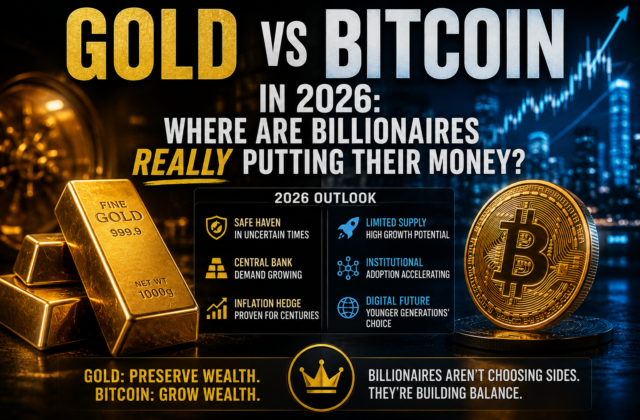
- 🥇 Gold remains the preferred reserve asset for many central banks seeking long-term financial stability.
- ₿ Bitcoin continues attracting institutional interest as a scarce digital asset with long-term growth potential.
- 💼 Many billionaire investors diversify by holding both gold and Bitcoin rather than choosing only one.
- 🌍 Geopolitical uncertainty, inflation, and global debt continue supporting demand for gold.
- 📊 Bitcoin offers higher potential returns but also significantly higher volatility than gold.
- 📈 Diversification—not an all-or-nothing approach—remains a common strategy among sophisticated investors.
Gold vs Bitcoin in 2026: Where Are Billionaires Really Putting Their Money?
For years, investors have debated one of modern finance’s biggest questions: Is gold still the ultimate safe-haven asset, or has Bitcoin become the new store of value?
In 2026, that debate is more relevant than ever. Gold has traded near historic highs as central banks continue to build reserves, while Bitcoin has remained one of the world’s most closely watched digital assets following increased institutional adoption.
Yet one common assumption doesn’t fully match reality.
Many billionaire investors are not choosing one over the other—they’re allocating capital to both, but for very different reasons.
Here’s how the world’s wealthiest investors are approaching the Gold vs Bitcoin debate in 2026.
Why Gold Is Still Winning Institutional Trust
Gold has served as a store of value for thousands of years.
In today’s environment, it continues to benefit from:
- Persistent geopolitical tensions
- Rising sovereign debt
- Central bank diversification
- Inflation concerns
- Currency depreciation risks
Perhaps the biggest trend is happening behind the scenes.
Central Banks Continue Buying Gold
Central banks around the world have remained significant buyers of gold in recent years as many countries diversify reserves away from heavy dependence on the U.S. dollar.
Unlike individual investors, central banks generally purchase gold for:
- Monetary stability
- Reserve diversification
- Crisis protection
- Long-term financial confidence
This institutional demand has helped support gold prices even during periods of higher interest rates.
Why Billionaires Still Like Gold
Several well-known investors continue viewing gold as portfolio insurance rather than a high-growth investment.
Gold offers:
- Low counterparty risk
- High global liquidity
- Long-term purchasing power preservation
- Protection during financial crises
Many family offices allocate 5–15% of portfolios to precious metals as part of long-term wealth preservation strategies, though allocations vary by investor and market conditions.
Bitcoin’s Rise Continues
Bitcoin has evolved far beyond its early reputation as a speculative cryptocurrency.
Today it is increasingly viewed by many institutional investors as:
- Digital scarcity
- An alternative asset
- A potential inflation hedge
- A long-term technology investment
Growing institutional participation—including regulated investment products in some markets—has broadened access for professional investors.
Why Billionaires Are Buying Bitcoin
Supporters argue Bitcoin offers characteristics unavailable in traditional assets.
Its appeal includes:
- Limited supply (21 million coins)
- Global accessibility
- High liquidity
- Growing institutional acceptance
- Potential for higher long-term returns
Some technology-focused investors view Bitcoin less as “digital gold” and more as a long-duration innovation asset.
Gold vs Bitcoin: The Key Differences
| Factor | Gold | Bitcoin |
|---|---|---|
| History | Thousands of years | Since 2009 |
| Physical Asset | Yes | No |
| Supply Growth | Slow | Fixed maximum supply |
| Volatility | Lower | Higher |
| Crisis Performance | Historically defensive | More variable |
| Income Generation | None | None |
| Adoption | Central banks, institutions, retail | Institutions, corporations, retail |
Rather than replacing one another, the two assets often serve different roles within diversified portfolios.
What Billionaire Investors Actually Do
Contrary to popular headlines, many sophisticated investors avoid making an “all-or-nothing” choice.
Instead, they often diversify across asset classes.
A typical diversified portfolio may include:
- Equities
- Government bonds
- Gold
- Bitcoin or other digital assets
- Private equity
- Real estate
- Cash
The exact allocation depends on each investor’s objectives, time horizon, and risk tolerance.
Which Asset Performs Better During Crises?
Historically:
Gold
Gold has often performed well during periods of:
- Financial instability
- Banking stress
- Geopolitical conflicts
- Currency weakness
Its reputation as a defensive asset has been built over centuries.
Bitcoin
Bitcoin has experienced periods of exceptional gains, but it has also undergone significant price swings.
Its performance during market stress has been mixed, with outcomes varying depending on broader financial conditions and investor sentiment.
The Risks Investors Should Know
Gold Risks
- Limited income generation
- Opportunity cost when interest rates rise
- Price fluctuations despite its defensive reputation
Bitcoin Risks
- High volatility
- Regulatory uncertainty in some jurisdictions
- Cybersecurity and custody considerations
- Rapid changes in market sentiment
Neither asset is risk-free.
So Where Is Smart Money Going?
The emerging trend appears to be diversification rather than replacement.
Many institutional investors continue holding gold for stability while allocating a smaller portion of portfolios to Bitcoin for potential growth.
This balanced approach reflects differing investment objectives rather than a belief that one asset will permanently replace the other.
What Should Retail Investors Consider?
Before investing, individuals should evaluate:
- Investment goals
- Risk tolerance
- Time horizon
- Portfolio diversification
- Liquidity needs
Financial professionals generally recommend avoiding concentration in any single asset class and ensuring investments align with personal circumstances.
Final Analysis
The debate between gold and Bitcoin is no longer about choosing a single winner. In 2026, both assets occupy distinct positions in global portfolios. Gold continues to attract central banks and investors seeking stability and long-term wealth preservation, while Bitcoin appeals to those willing to accept greater volatility in pursuit of higher potential returns.
Rather than abandoning one asset for the other, many sophisticated investors use them together as complementary holdings. Gold may help reduce portfolio risk during periods of uncertainty, while Bitcoin offers exposure to the evolving digital asset ecosystem.
For long-term investors, the more important question may not be “Gold or Bitcoin?” but “How much of each fits my investment strategy?”
❓ Frequently Asked Questions (FAQs)
1. Is gold or Bitcoin a better investment in 2026?
There is no universal answer. Gold is generally favored for wealth preservation and lower volatility, while Bitcoin attracts investors seeking higher growth potential but willing to accept greater price fluctuations. The choice depends on an individual’s financial goals, investment horizon, and risk tolerance.
2. Why are central banks buying more gold?
Many central banks have increased gold reserves to diversify their foreign exchange holdings, strengthen financial resilience, and reduce concentration risk in reserve assets. Gold remains an important component of many countries’ reserve management strategies.
3. Are billionaire investors choosing gold over Bitcoin?
Many high-net-worth investors and family offices diversify rather than choose one asset exclusively. Some allocate to gold for portfolio stability while also investing in Bitcoin or other digital assets for growth potential.
4. Is Bitcoin replacing gold as a store of value?
Bitcoin is increasingly viewed by some investors as a digital store of value, but gold continues to play a central role in global reserves, institutional portfolios, and wealth preservation. At present, many investors treat the two assets as complementary rather than direct substitutes.
5. Which asset is more volatile?
Bitcoin has historically experienced much larger price swings than gold. Gold prices also fluctuate, but generally with lower volatility than Bitcoin.
6. Can investors own both gold and Bitcoin?
Yes. Many diversified portfolios include both assets because they can serve different purposes—gold for stability and Bitcoin for potential long-term growth.
7. What should new investors consider before investing?
Investors should evaluate their financial objectives, risk tolerance, investment time horizon, diversification needs, and consult a qualified financial adviser when appropriate. Past performance does not guarantee future results.
🌐 About GoldPriceNow
GoldPriceNow is your trusted destination for precious metals and commodity market information.
The platform provides:
- 🟡 Live 24K, 22K & 18K Gold Prices
- ⚪ Live Silver Prices
- 🌍 International Spot Gold Rates
- 📈 Gold Price Charts & Market Trends
- 💰 Gold Investment Guides
- 🧮 Gold Price Calculator
- 📰 Daily Gold & Commodity News
- 🏦 Central Bank & Precious Metals Updates
Whether you’re an investor, trader, jeweler, or simply tracking daily prices, GoldPriceNow helps you stay informed with timely market insights.
🟡 Check Live Gold Prices

Keep reading
Related Articles
 Crypto
₿ Bitcoin Breaks Above $72,000: Why Trump’s Crypto Push Is Sending Crypto Stocks Higher
Bitcoin’s $72,000 Move Is Bigger Than Bitcoin A typical crypto headline would be: Bitcoin jumps above $72,000. But that misses the most important part of today’s move. The interesting part is the simultaneous rally in: Bitcoin ↓ Coinbase ↓ Strategy ↓ Circle ↓ Robinhood ↓ Bitcoin miners ↓ Crypto infrastructure That tells us investors aren’t...
 Commodities
Oil Nears $95: Could the Iran War Trigger a New U.S. Inflation Shock?
Oil at $95 Is Not the Real Story A crude-oil headline is easy to write: “Oil prices rise as Iran tensions escalate.” Reuters, Bloomberg, CNBC and WSJ can publish that story within minutes. But for TheBusinessNow, that isn’t enough. The bigger question is: What happens to the American economy if oil stays near $95 —...
 Commodities
Strait of Hormuz Standoff: The Oil Shock That Could Hit the U.S. Economy Next
Strait of Hormuz Standoff: Why the Oil Market Is Getting Nervous Again The oil market is being forced to price a problem that seemed to be easing only weeks ago: the Strait of Hormuz is still not reliably functioning as a normal commercial shipping route. On August 19, Brent crude was trading around $91.20 a...
Comments (0)