
FIFA World Cup 2026 Business Model Explained: How FIFA Makes Billions, Prize Money Distribution, Team Earnings, Sponsorship Revenue & Tournament Economics
FIFA World Cup 2026 Is More Than Football—It’s an $8.9 Billion Global Business Machine Every four years, billions of fans watch the FIFA World Cup. But behind every goal, trophy celebration, and sold-out stadium is one of the largest commercial enterprises in global sports. The 2026 FIFA World Cup, hosted by the United States, Canada,...
TheBusinessNow
Jul 11, 2026 · 5 min Read
Key Highlights
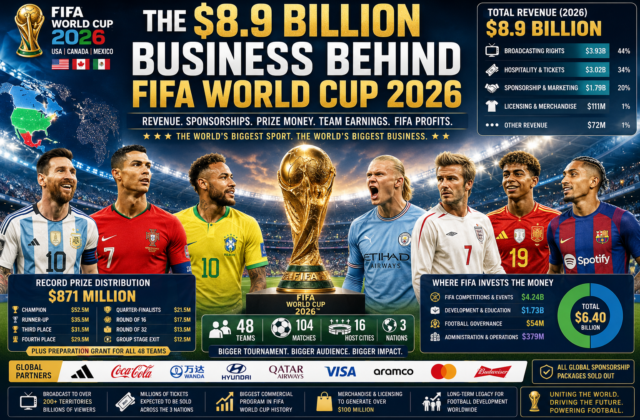
- ⚽ FIFA expects approximately $8.9 billion in 2026 revenue.
- 📺 Broadcasting rights are the largest income source at about $3.93 billion.
- 🎟️ Hospitality and ticket sales contribute roughly $3.02 billion.
- 🤝 Sponsorship and marketing rights generate around $1.79 billion.
- 🏆 The total prize distribution reaches a record $871 million.
- 💰 Every qualified team receives a preparation grant before the tournament.
FIFA World Cup 2026 Is More Than Football—It’s an $8.9 Billion Global Business Machine
Every four years, billions of fans watch the FIFA World Cup. But behind every goal, trophy celebration, and sold-out stadium is one of the largest commercial enterprises in global sports.
The 2026 FIFA World Cup, hosted by the United States, Canada, and Mexico, has become the most commercially successful edition in history. With 48 participating nations, 104 matches, record sponsorship demand, and unprecedented ticket sales, FIFA expects to generate approximately $8.9 billion in revenue during 2026, the highest annual revenue in its history.
This article explains exactly how FIFA makes money, where the money goes, how much each team earns, how sponsors benefit, and why the World Cup has become one of the world’s biggest business events.
FIFA World Cup 2026 Business Model at a Glance
| Revenue Source | Estimated Revenue (USD) | Share |
|---|---|---|
| Television Broadcasting Rights | $3.93 Billion | 44% |
| Hospitality & Ticket Sales | $3.02 Billion | 34% |
| Sponsorship & Marketing | $1.79 Billion | 20% |
| Licensing & Merchandise | $111 Million | 1% |
| Other Revenue | $72 Million | 1% |
| Total Revenue | $8.91 Billion | 100% |
Source: FIFA revised 2023–2026 budget.
Where Does FIFA Spend the Money?
FIFA reinvests most of its income into football development, competitions, and governance.
| Expense Category | Estimated Spending |
|---|---|
| FIFA Competitions & Events | $4.24 Billion |
| Development & Education | $1.73 Billion |
| Football Governance | $54 Million |
| Administration & Commercial Operations | $379 Million |
How Much Prize Money Do Teams Receive?
The 2026 tournament features a record financial distribution of $871 million across the 48 participating national associations.
| Tournament Stage | Total Earnings (Including Preparation Grant) |
|---|---|
| Champion | $52.5 Million |
| Runner-up | $35.5 Million |
| Third Place | $31.5 Million |
| Fourth Place | $29.5 Million |
| Quarterfinalists | $21.5 Million |
| Round of 16 | $17.5 Million |
| Round of 32 | $13.5 Million |
| Group Stage Exit | $12.5 Million |
Note: FIFA pays national football associations, not players directly. Each federation decides player bonuses and distributions.
Do Players Get Paid by FIFA?
No.
FIFA transfers prize money to each country’s football association. Players receive bonuses only if their national association has agreed to a payment structure.
For example:
- England players could share roughly half of the FA’s World Cup prize money if they win the tournament, based on the FA’s bonus agreement.
FIFA’s Biggest Commercial Partners
Before kickoff, FIFA announced that all global sponsorship packages for the 2026 World Cup had sold out, making it the most commercially successful World Cup sponsorship program ever.
Major partner categories include:
- Airlines
- Financial services
- Soft drinks
- Sportswear
- Technology
- Automotive
- Payment networks
- Consumer electronics
Why Broadcasters Pay Billions
Broadcast rights remain FIFA’s largest income source because the World Cup delivers unmatched global audiences.
Television and streaming partners compete aggressively for exclusive rights, generating nearly $4 billion in broadcasting revenue for the 2026 cycle.
How Much Do Host Countries Earn?
Host nations benefit from:
- Tourism
- Hotels
- Restaurants
- Local transportation
- Merchandise sales
- Temporary employment
- International exposure
However, recent analyses suggest FIFA captures the largest share of direct financial gains, while host cities often realize more modest economic returns due to infrastructure and security costs.
Why the 2026 World Cup Is Bigger Than Ever
Several structural changes have expanded the tournament’s commercial potential:
| Growth Driver | Impact |
|---|---|
| 48 Teams | More participating countries |
| 104 Matches | More broadcast inventory |
| Three Host Nations | Larger combined audience |
| Higher Ticket Inventory | Increased hospitality revenue |
| More Sponsors | Record commercial income |
| Global Streaming | Expanded digital viewership |
Why Investors and Brands Care
The FIFA World Cup is now one of the world’s most valuable media properties because it offers:
- Massive live audiences
- Premium advertising opportunities
- Global brand exposure
- Long-term licensing revenue
- Digital engagement across social media and streaming platforms
For multinational brands, the World Cup is a cornerstone marketing event that can deliver worldwide visibility in just a few weeks.
Final Take
The FIFA World Cup 2026 is no longer just a football tournament—it’s a global business platform spanning media, technology, sponsorships, tourism, and entertainment. With record revenues, an expanded competition format, and unprecedented commercial demand, the event illustrates how modern sports have evolved into multi-billion-dollar economic ecosystems.
About TheBusinessNow
TheBusinessNow delivers global coverage of business, finance, technology, geopolitics, commodities, and economic trends. Our goal is to provide readers with original, fact-based analysis that explains how world events shape markets and investment decisions.
Keep reading
Related Articles
 Commodities
Oil Nears $95: Could the Iran War Trigger a New U.S. Inflation Shock?
Oil at $95 Is Not the Real Story A crude-oil headline is easy to write: “Oil prices rise as Iran tensions escalate.” Reuters, Bloomberg, CNBC and WSJ can publish that story within minutes. But for TheBusinessNow, that isn’t enough. The bigger question is: What happens to the American economy if oil stays near $95 —...
 Finance
Walmart Stock Plunges 6%: What Its Weak Outlook Says About the U.S. Consumer
Walmart Stock Plunges 6% — But the Earnings Were Not Actually Bad This is where the headline can be misleading. Walmart did not report a disastrous quarter. Quite the opposite. Revenue rose 5.9%, operating income increased 28.8%, e-commerce remained extremely strong and Walmart raised its full-year sales and profit expectations. Yet investors immediately sold the...
 Economy
U.S. National Debt Hits $40 Trillion: Why Treasury Yields Are Rising Again
The $40 Trillion Number Is Not the Whole Story The United States has crossed a psychological and financial milestone. $40 trillion. But simply writing “America owes $40 trillion” misses the more important story. The real question for markets is: Who is willing to finance America’s growing debt — and at what interest rate? That question...
Comments (0)