
Fed’s John Williams Warns AI Could Become the Next Inflation Risk: What It Means for the U.S. Economy
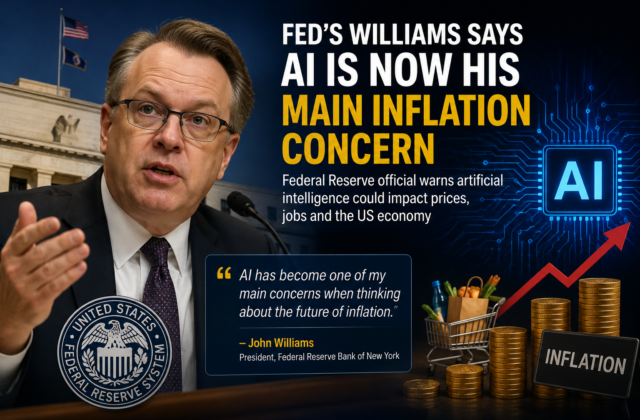
As artificial intelligence transforms industries across the globe, one of the Federal Reserve’s most influential policymakers believes the technology could become one of the biggest economic stories of the decade. John Williams, President of the Federal Reserve Bank of New York, recently said that artificial intelligence has become one of his primary concerns when thinking...
TheBusinessNow
Jul 9, 2026 · 6 min Read
Key Highlights
- 🤖 Federal Reserve President John Williams says artificial intelligence is becoming a key factor in future inflation discussions.
- 📈 AI could improve productivity while also increasing demand for infrastructure, chips, and energy.
- 💼 Investors are watching how AI may influence corporate earnings, labor markets, and economic growth.
- 🏦 The Federal Reserve will continue assessing AI alongside inflation, employment, and broader economic indicators.
- ⚠️ AI presents both opportunities for lower costs and risks of new inflationary pressures in rapidly growing sectors.
As artificial intelligence transforms industries across the globe, one of the Federal Reserve’s most influential policymakers believes the technology could become one of the biggest economic stories of the decade.
John Williams, President of the Federal Reserve Bank of New York, recently said that artificial intelligence has become one of his primary concerns when thinking about the future of inflation. His remarks highlight a growing debate among economists: while AI has the potential to increase productivity and reduce costs, it could also reshape labor markets, wages, investment patterns, and pricing across the U.S. economy.
For investors, businesses, and consumers, Williams’ comments suggest that AI is no longer just a technology story—it is becoming a macroeconomic issue.
Why Is the Federal Reserve Watching Artificial Intelligence?
The Federal Reserve’s primary goals are to maintain stable prices and maximum employment.
Artificial intelligence has the potential to influence both.
If AI enables companies to produce goods and services more efficiently, businesses may be able to lower operating costs, which could help ease inflation over time.
However, rapid adoption of AI may also trigger:
- Massive investment in data centers and computing infrastructure.
- Increased demand for advanced semiconductor chips.
- Changes in labor markets and wages.
- Shifts in productivity across industries.
These changes could affect how inflation evolves over the coming years.
AI Could Reduce Costs—but Also Create New Inflation Pressures
Economists generally see two possible outcomes.
Scenario 1: Lower Inflation
AI improves productivity.
Businesses automate repetitive tasks, reduce operating expenses, and increase efficiency.
Higher productivity can help keep prices lower while supporting economic growth.
Scenario 2: New Inflation Pressures
The rapid expansion of AI requires enormous investment.
Demand for:
- Data centers
- Electricity
- Semiconductor chips
- Skilled workers
- Cloud infrastructure
has already increased significantly.
If supply cannot keep pace with demand, prices in these sectors could rise, creating localized inflationary pressure.
This balance between productivity gains and investment-driven demand is one reason Federal Reserve officials are paying closer attention to AI.
Why Investors Are Paying Attention
John Williams’ comments arrive at a time when AI-related companies are driving a significant share of market gains.
Technology firms involved in:
- Artificial intelligence
- Semiconductors
- Cloud computing
- Cybersecurity
- Data infrastructure
have attracted substantial investor interest.
If AI continues reshaping the economy, it could also influence expectations for future Federal Reserve policy, interest rates, and corporate earnings.
What Could This Mean for Interest Rates?
The Federal Reserve does not set policy based on a single technology trend.
Instead, policymakers evaluate how developments like AI affect inflation, employment, and overall economic growth.
If AI helps lower production costs, inflationary pressures could ease over time.
If AI instead fuels higher investment demand and stronger wage growth, policymakers may need to reassess how inflation evolves.
Future interest-rate decisions will continue to depend on a broad range of economic data, not AI alone.
Industries That Could Be Most Affected
Artificial intelligence is already changing multiple sectors.
| Industry | Potential Impact |
|---|---|
| Technology | Increased AI software and hardware investment |
| Semiconductors | Higher demand for advanced AI chips |
| Manufacturing | Greater automation and productivity |
| Healthcare | AI-assisted diagnostics and research |
| Financial Services | Improved analytics and fraud detection |
| Retail | Smarter inventory management and customer personalization |
Why This Matters Beyond Wall Street
The debate around AI extends far beyond financial markets.
Businesses are investing heavily in automation, while workers are adapting to changing skill requirements.
Consumers could benefit from lower prices if productivity improves, but the transition may also reshape employment patterns in many industries.
For policymakers, understanding these changes will become increasingly important as AI adoption accelerates.
What Investors Should Watch Next
Markets are expected to monitor:
- Upcoming inflation reports.
- Federal Reserve policy meetings.
- Corporate AI investment plans.
- Productivity data.
- Employment trends.
- Technology company earnings.
Together, these indicators will help determine whether AI becomes a force that reduces inflation, contributes to new price pressures, or has a mixed impact over time.
Final Thoughts
John Williams’ remarks underscore how rapidly artificial intelligence has moved from being a technology innovation to a central topic in economic policy discussions.
While AI offers significant opportunities to improve productivity and support long-term growth, it also presents new questions about inflation, labor markets, and investment.
For investors and businesses alike, the key takeaway is that the Federal Reserve is beginning to view AI not just as a technological revolution, but as an economic force that could shape inflation and monetary policy for years to come.
Frequently Asked Questions (FAQ)
Why is the Federal Reserve concerned about AI?
The Fed is studying how AI could affect productivity, wages, investment, and inflation across the U.S. economy.
Could AI reduce inflation?
Potentially. Greater productivity and lower operating costs may reduce price pressures, although increased investment demand could create inflation in some sectors.
Will AI change interest-rate decisions?
AI alone will not determine interest rates. The Federal Reserve considers a wide range of economic indicators, including inflation, employment, and overall growth.
Which industries are likely to benefit from AI?
Technology, semiconductors, cloud computing, healthcare, manufacturing, and financial services are among the sectors expected to see significant changes from AI adoption.
About TheBusinessNow
TheBusinessNow delivers global coverage of business, finance, technology, geopolitics, commodities, and economic trends. Our goal is to provide readers with original, fact-based analysis that explains how world events shape markets and investment decisions.
Keep reading
Related Articles
 Crypto
₿ Bitcoin Breaks Above $72,000: Why Trump’s Crypto Push Is Sending Crypto Stocks Higher
Bitcoin’s $72,000 Move Is Bigger Than Bitcoin A typical crypto headline would be: Bitcoin jumps above $72,000. But that misses the most important part of today’s move. The interesting part is the simultaneous rally in: Bitcoin ↓ Coinbase ↓ Strategy ↓ Circle ↓ Robinhood ↓ Bitcoin miners ↓ Crypto infrastructure That tells us investors aren’t...
 Commodities
Oil Nears $95: Could the Iran War Trigger a New U.S. Inflation Shock?
Oil at $95 Is Not the Real Story A crude-oil headline is easy to write: “Oil prices rise as Iran tensions escalate.” Reuters, Bloomberg, CNBC and WSJ can publish that story within minutes. But for TheBusinessNow, that isn’t enough. The bigger question is: What happens to the American economy if oil stays near $95 —...
 Economy
U.S. National Debt Hits $40 Trillion: Why Treasury Yields Are Rising Again
The $40 Trillion Number Is Not the Whole Story The United States has crossed a psychological and financial milestone. $40 trillion. But simply writing “America owes $40 trillion” misses the more important story. The real question for markets is: Who is willing to finance America’s growing debt — and at what interest rate? That question...
Comments (0)