
AI vs Jobs: Which Careers Are Safest in the Next Decade? The Truth Most Workers Aren’t Ready to Hear
AI vs Jobs: Which Careers Are Safest in the Next Decade? Artificial intelligence is no longer a futuristic concept—it is transforming workplaces right now. From customer service chatbots to AI-powered software development and automated financial analysis, businesses across industries are adopting AI at an unprecedented pace. The biggest question on everyone’s mind is simple: Will...
TheBusinessNow
Jul 20, 2026 · 2 min Read
Key Highlights
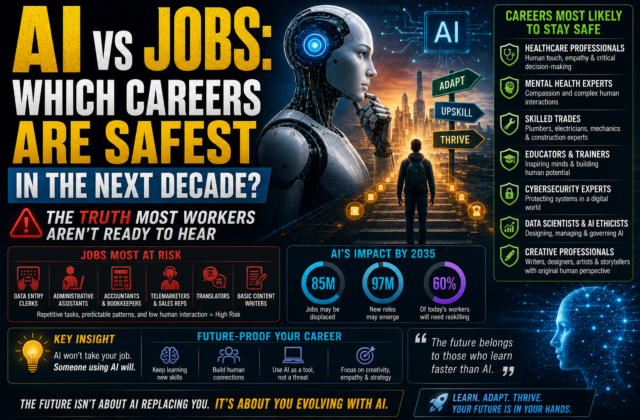
- 🤖 AI is transforming workplaces across industries, but experts expect it to reshape jobs more than eliminate them.
- 🏥 Healthcare, skilled trades, cybersecurity, education, and leadership remain among the most resilient career paths.
- 📉 Routine administrative, data-entry, and repetitive office tasks face the highest automation risk.
- 🚀 AI is creating new opportunities in machine learning, robotics, cloud computing, and AI governance.
- 💡 Human skills like creativity, emotional intelligence, and critical thinking are becoming more valuable as AI adoption grows.
- 📊 Businesses that successfully combine AI with skilled human talent may gain a significant competitive advantage.
- 🌍 The future belongs to professionals who continuously learn, adapt, and use AI as a productivity tool rather than viewing it solely as a competitor.
AI vs Jobs: Which Careers Are Safest in the Next Decade?
Artificial intelligence is no longer a futuristic concept—it is transforming workplaces right now. From customer service chatbots to AI-powered software development and automated financial analysis, businesses across industries are adopting AI at an unprecedented pace.
The biggest question on everyone’s mind is simple: Will AI replace my job?
The reality is more nuanced. AI is expected to automate certain tasks, reshape many existing roles, and create entirely new career opportunities. Rather than eliminating all jobs, AI is likely to change how people work and which skills become most valuable.
This article explores the careers most resilient to AI, the roles most exposed to automation, and the skills professionals should develop to stay competitive over the next decade.
Why AI Is Changing the Job Market Faster Than Previous Technologies
Unlike earlier waves of automation that primarily affected factory work, AI can now perform many cognitive tasks, including:
- Writing reports
- Analyzing data
- Creating presentations
- Translating languages
- Generating computer code
- Producing images and videos
- Handling customer support
- Summarizing legal and financial documents
Because AI can assist with knowledge work, its impact reaches industries far beyond manufacturing.
AI vs Jobs: Which Careers Face the Highest Automation Risk?
Jobs involving repetitive, rule-based, or highly standardized tasks are generally more susceptible to automation.
Examples include:
Administrative Support
Many scheduling, documentation, and data-entry tasks can already be completed by AI-powered software.
Basic Customer Service
Chatbots and AI assistants increasingly handle routine customer inquiries, reducing demand for entry-level support roles.
Data Entry
AI systems can process invoices, forms, and structured information with greater speed and accuracy.
Basic Bookkeeping
Many accounting tasks are becoming automated through AI-enabled financial software.
Routine Content Production
Simple news summaries, product descriptions, and standard marketing copy can now be generated with AI assistance.
Importantly, automation often replaces tasks, not entire professions. Many workers will shift toward higher-value responsibilities rather than disappear from the workforce.
The Careers Safest From AI Over the Next Decade
1. Healthcare Professionals
Doctors, surgeons, nurses, therapists, and emergency responders rely on human judgment, empathy, and complex decision-making.
While AI can support diagnosis or administrative work, it cannot fully replace human care.
2. Skilled Trades
Electricians, plumbers, HVAC technicians, welders, and construction specialists perform physical work in constantly changing environments.
Robots remain far less adaptable than experienced tradespeople.
3. Mental Health Professionals
Psychologists, counselors, and therapists depend on emotional intelligence, trust, and interpersonal relationships—areas where AI remains limited.
4. Teachers and Educators
AI can personalize learning and automate grading, but mentoring, classroom leadership, and student motivation continue to require human involvement.
5. Executives and Strategic Leaders
Senior leaders make decisions involving ethics, negotiation, long-term planning, and organizational culture.
AI can provide insights but not replace executive judgment.
6. Scientific Researchers
Innovation depends on creativity, experimentation, and critical thinking. AI accelerates research but does not independently define scientific priorities.
7. Cybersecurity Experts
As AI creates new cyber risks, demand for professionals who secure systems and investigate attacks is expected to remain strong.
8. AI Engineers and Machine Learning Specialists
Ironically, AI itself is creating demand for professionals who build, maintain, and improve intelligent systems.
9. Lawyers Handling Complex Cases
Routine legal research may become more automated, but litigation strategy, negotiation, and courtroom advocacy still require experienced professionals.
10. Creative Directors and Brand Strategists
AI can generate content, but building original campaigns, emotional storytelling, and long-term brand positioning remain distinctly human strengths.
The Jobs Most Likely to Grow Because of AI
Rather than focusing only on displacement, it is equally important to examine emerging opportunities.
Growth areas include:
- AI Prompt Engineers
- AI Product Managers
- Robotics Specialists
- AI Ethics Consultants
- Data Scientists
- Cloud Engineers
- Cybersecurity Analysts
- Automation Consultants
- Human-AI Collaboration Specialists
- AI Governance Experts
Many of these roles barely existed a few years ago.
Why Human Skills Matter More Than Ever
As AI becomes better at technical tasks, uniquely human abilities become increasingly valuable.
The most future-proof skills include:
- Critical thinking
- Leadership
- Emotional intelligence
- Creativity
- Negotiation
- Complex problem solving
- Ethical decision-making
- Communication
- Adaptability
- Collaboration
Workers who combine these capabilities with AI literacy are likely to remain highly competitive.
AI Will Transform Jobs More Than It Eliminates Them
History offers useful perspective.
The Industrial Revolution changed manufacturing.
Computers transformed offices.
The internet reshaped commerce.
Each technological shift eliminated certain occupations but also created new industries and millions of jobs.
AI appears to be following a similar pattern—although the pace of change is significantly faster.
Professionals who continuously learn new skills are generally better positioned than those who resist technological change.
Industries Expected to Benefit Most From AI
Several sectors are already using AI to improve productivity and create new business models.
Healthcare
AI-assisted diagnostics, drug discovery, and personalized medicine.
Finance
Fraud detection, investment analysis, and risk management.
Manufacturing
Predictive maintenance, robotics, and supply-chain optimization.
Retail
Demand forecasting, inventory management, and personalized shopping.
Education
Adaptive learning platforms and AI tutoring.
Logistics
Route optimization, warehouse automation, and predictive analytics.
Market Impact: Why Investors Are Watching AI Closely
Artificial intelligence has become one of the largest investment themes of the decade.
Technology companies investing heavily in AI infrastructure, semiconductors, cloud computing, and enterprise software have attracted significant investor interest.
At the same time, businesses that successfully integrate AI may improve productivity, reduce operating costs, and accelerate innovation.
However, industries with large numbers of repetitive administrative roles may face substantial workforce restructuring over the coming years.
What Should Workers Do Today?
Instead of asking whether AI will replace jobs, professionals should ask:
How can AI make me more valuable?
Practical steps include:
- Learn how AI tools apply to your profession.
- Build expertise in problem-solving rather than routine execution.
- Develop communication and leadership skills.
- Stay updated through continuous learning.
- Combine technical knowledge with domain expertise.
Those who adapt are more likely to benefit from AI than compete against it.
What Happens Next?
The next decade is unlikely to be defined by humans versus AI.
Instead, it will be defined by humans who know how to work effectively with AI versus those who do not.
Companies increasingly seek employees who can leverage AI to improve productivity while contributing creativity, judgment, ethics, and strategic thinking.
The future of work is therefore less about replacement and more about transformation.
Conclusion
The AI vs Jobs debate is often framed as a battle between humans and machines, but reality is more complex. AI is expected to automate many repetitive tasks while simultaneously creating demand for new skills and professions.
Careers built around creativity, empathy, leadership, complex problem-solving, and hands-on expertise appear more resilient, while routine administrative work faces greater automation pressure.
For professionals, the most effective long-term strategy is not to fear AI—but to learn how to use it effectively. Those who embrace continuous learning and adapt to changing technologies are likely to find the strongest opportunities in the decade ahead.
Frequently Asked Questions
Will AI replace all jobs?
No. AI is expected to automate specific tasks rather than eliminate every profession. Many roles will evolve instead of disappearing.
Which careers are safest from AI?
Healthcare, skilled trades, cybersecurity, education, leadership, scientific research, and roles requiring emotional intelligence are generally considered more resilient.
What skills should workers learn?
Critical thinking, communication, creativity, adaptability, leadership, AI literacy, and complex problem-solving are increasingly valuable.
Is AI creating new jobs?
Yes. AI is generating demand for AI engineers, cybersecurity professionals, AI ethics specialists, data scientists, automation consultants, and many other emerging roles.
About TheBusinessNow
TheBusinessNow delivers global coverage of business, finance, technology, geopolitics, commodities, and economic trends. Our goal is to provide readers with original, fact-based analysis that explains how world events shape markets and investment decisions.
Keep reading
Related Articles
 Crypto
₿ Bitcoin Breaks Above $72,000: Why Trump’s Crypto Push Is Sending Crypto Stocks Higher
Bitcoin’s $72,000 Move Is Bigger Than Bitcoin A typical crypto headline would be: Bitcoin jumps above $72,000. But that misses the most important part of today’s move. The interesting part is the simultaneous rally in: Bitcoin ↓ Coinbase ↓ Strategy ↓ Circle ↓ Robinhood ↓ Bitcoin miners ↓ Crypto infrastructure That tells us investors aren’t...
 Commodities
Oil Nears $95: Could the Iran War Trigger a New U.S. Inflation Shock?
Oil at $95 Is Not the Real Story A crude-oil headline is easy to write: “Oil prices rise as Iran tensions escalate.” Reuters, Bloomberg, CNBC and WSJ can publish that story within minutes. But for TheBusinessNow, that isn’t enough. The bigger question is: What happens to the American economy if oil stays near $95 —...
 Economy
U.S. National Debt Hits $40 Trillion: Why Treasury Yields Are Rising Again
The $40 Trillion Number Is Not the Whole Story The United States has crossed a psychological and financial milestone. $40 trillion. But simply writing “America owes $40 trillion” misses the more important story. The real question for markets is: Who is willing to finance America’s growing debt — and at what interest rate? That question...
Comments (0)