
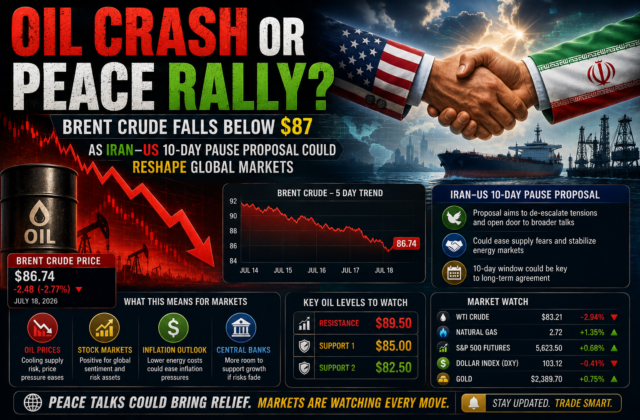
Oil Crash or Peace Rally? Brent Crude Falls Below $87 as Iran–US 10-Day Pause Proposal Could Reshape Global Markets
Oil Crash or Peace Rally? Brent Crude Falls Below $87 as Iran–US Talks Trigger Major Market Shift Just days ago, global markets were preparing for another energy shock. Now, the narrative has changed dramatically. Brent crude has fallen below the crucial $87-per-barrel level, while reports suggest mediators have proposed a 10-day pause in military strikes...
TheBusinessNow
Jul 20, 2026 · 3 min Read
Key Highlights
- 📉 Brent crude slipped below $87 per barrel.
- 🌍 Reports suggest a 10-day pause proposal between Iran and the United States.
- ✈️ Airlines could benefit if crude prices remain lower.
- ⛽ Lower oil prices may ease inflation pressures globally.
- 🛢️ Energy stocks could experience short-term volatility.
- 📊 Investors are watching whether diplomacy can stabilize global oil markets.
Oil Crash or Peace Rally? Brent Crude Falls Below $87 as Iran–US Talks Trigger Major Market Shift
Just days ago, global markets were preparing for another energy shock.
Now, the narrative has changed dramatically.
Brent crude has fallen below the crucial $87-per-barrel level, while reports suggest mediators have proposed a 10-day pause in military strikes between Iran and the United States to revive diplomatic negotiations.
For investors, this isn’t just another commodity move.
It could become one of the biggest macroeconomic stories of the week, influencing inflation, stock markets, airline companies, energy stocks, gold prices, and even central bank decisions.
The question investors are asking now is simple:
Is this the beginning of a sustained oil correction—or just a temporary pause before another geopolitical shock?
Why Brent Falling Below $87 Matters
Oil is one of the world’s most influential assets.
When crude oil moves sharply, nearly every financial market reacts.
Lower oil prices generally affect:
- Inflation
- Transportation costs
- Airline profitability
- Manufacturing expenses
- Consumer spending
- Central bank policy expectations
A decline below $87 is psychologically important because it signals that traders are reducing the geopolitical risk premium that had been built into oil prices.
What’s Driving the Decline?
1. Iran–US Diplomatic Signals
According to reports, mediators have proposed a 10-day pause in military strikes to explore renewed diplomatic discussions.
Even without a final agreement, markets often react quickly to the possibility of de-escalation.
Lower geopolitical tensions typically reduce fears of supply disruptions from the Middle East.
2. Reduced Supply Fear
During periods of conflict, traders price in the possibility of disruptions to shipping routes and oil infrastructure.
As expectations of immediate escalation ease, part of that premium disappears.
3. Profit Booking
Oil had rallied sharply during recent geopolitical tensions.
Many institutional traders may now be locking in profits after the recent surge.
Market Winners if Oil Keeps Falling
✈️ Airlines
Fuel is one of the largest expenses for airline companies.
Lower crude prices can improve margins for global carriers.
Potential beneficiaries include:
- Air India
- IndiGo
- Delta Air Lines
- United Airlines
- American Airlines
- Ryanair
🚚 Logistics
Freight and transportation companies benefit from declining fuel costs.
Lower diesel prices often reduce operating expenses across supply chains.
🏭 Manufacturing
Factories using petroleum products as inputs may see reduced production costs.
👨👩👧 Consumers
If crude prices remain weak, gasoline and diesel prices could eventually stabilize or decline in many regions, supporting household spending.
Market Losers
🛢️ Oil Producers
Integrated energy companies may face pressure if crude prices continue to weaken.
Major oil producers could see slower revenue growth if prices remain below recent highs.
Oil Service Companies
Companies involved in drilling, exploration, and oilfield services may experience softer investor sentiment if energy prices continue declining.
How Could This Affect Inflation?
One of the biggest beneficiaries of lower oil prices is inflation.
Lower energy costs eventually influence:
- Transportation
- Manufacturing
- Food logistics
- Consumer prices
If energy inflation eases, central banks could face less pressure to keep monetary policy restrictive.
Impact on Stock Markets
United States
Lower oil prices often support:
- Consumer discretionary stocks
- Technology companies
- Airlines
- Retail
Energy stocks, however, may underperform if crude remains weak.
India
India imports a significant share of its crude oil requirements.
A sustained decline in oil prices can improve:
- Corporate profitability
- Inflation outlook
- Trade balance
- Fiscal stability
Sectors that may benefit include:
- Aviation
- Paints
- Chemicals
- FMCG
- Auto
What About Gold?
Gold and crude often move independently, but geopolitical developments can influence both.
If diplomatic progress continues:
- Safe-haven demand for gold could soften.
- Risk assets such as equities may attract more investment.
However, any breakdown in negotiations could quickly reverse sentiment.
What Investors Should Watch This Week
Several developments could determine the next move in oil prices:
| Event | Market Impact |
|---|---|
| Iran-US diplomatic developments | Very High |
| OPEC+ statements | High |
| U.S. crude inventory data | High |
| Global demand indicators | Medium |
| Shipping activity in the Middle East | High |
| Currency movements (U.S. Dollar) | Medium |
Brent Crude Technical Outlook
| Level | Price |
|---|---|
| Immediate Resistance | $88.50 |
| Major Resistance | $90.00 |
| Immediate Support | $86.00 |
| Strong Support | $84.50 |
A sustained move below $86 could accelerate selling pressure, while a recovery above $88.50 may indicate renewed buying interest.
What This Means for Investors
The oil market has shifted from pricing in conflict to pricing in diplomacy.
That doesn’t mean volatility is over.
Energy markets remain highly sensitive to headlines, and any change in geopolitical developments could trigger sharp price swings.
For long-term investors, this environment highlights the importance of diversification rather than reacting to every short-term move.
Final Analysis
The drop in Brent crude below $87 per barrel is more than just a commodity headline—it reflects changing expectations about geopolitics, inflation, and the global economy. The proposed 10-day pause in Iran–US hostilities has given markets hope that diplomacy could reduce the risk of supply disruptions, leading traders to unwind part of the conflict-driven premium in oil prices.
If diplomatic efforts gain traction, sectors such as airlines, logistics, manufacturing, and consumer-focused businesses could benefit from lower energy costs. On the other hand, oil producers and energy stocks may face pressure if crude remains subdued. Investors should closely monitor official developments, OPEC+ commentary, and macroeconomic data throughout the week, as these factors will determine whether Brent crude extends its decline or rebounds on renewed geopolitical uncertainty.
FAQs
Why did Brent crude fall below $87?
Markets reacted to reports of a proposed 10-day pause in Iran–US hostilities, reducing fears of immediate supply disruptions.
Why are Iran–US talks important for oil prices?
The Middle East is a key oil-producing region, and any escalation or de-escalation in tensions can significantly influence global energy supply expectations.
Which sectors benefit from lower oil prices?
Airlines, logistics, transportation, manufacturing, FMCG, and consumer-related industries often benefit from declining fuel costs.
Will lower oil prices reduce inflation?
Lower crude prices can ease energy and transportation costs, which may help moderate inflation over time.
What should investors watch next?
Official diplomatic updates, OPEC+ decisions, U.S. oil inventory data, and broader geopolitical developments will likely drive the next move in crude oil prices.
Keep reading
Related Articles
 Commodities
Oil Nears $95: Could the Iran War Trigger a New U.S. Inflation Shock?
Oil at $95 Is Not the Real Story A crude-oil headline is easy to write: “Oil prices rise as Iran tensions escalate.” Reuters, Bloomberg, CNBC and WSJ can publish that story within minutes. But for TheBusinessNow, that isn’t enough. The bigger question is: What happens to the American economy if oil stays near $95 —...
 Economy
U.S. National Debt Hits $40 Trillion: Why Treasury Yields Are Rising Again
The $40 Trillion Number Is Not the Whole Story The United States has crossed a psychological and financial milestone. $40 trillion. But simply writing “America owes $40 trillion” misses the more important story. The real question for markets is: Who is willing to finance America’s growing debt — and at what interest rate? That question...
 Commodities
Strait of Hormuz Standoff: The Oil Shock That Could Hit the U.S. Economy Next
Strait of Hormuz Standoff: Why the Oil Market Is Getting Nervous Again The oil market is being forced to price a problem that seemed to be easing only weeks ago: the Strait of Hormuz is still not reliably functioning as a normal commercial shipping route. On August 19, Brent crude was trading around $91.20 a...
Comments (0)