
Why Is Apple Suing OpenAI? Trade Secret Theft Lawsuit Explained, AI Hardware Plans, and What It Means for the Future of AI
Introduction Apple and OpenAI—two of the biggest names in technology—are now at the center of one of the most significant legal battles in artificial intelligence. Apple has accused OpenAI of orchestrating a coordinated effort to obtain confidential information related to Apple’s future hardware projects through former employees. The lawsuit comes at a crucial moment as...
TheBusinessNow
Jul 11, 2026 · 3 min Read
Key Highlights
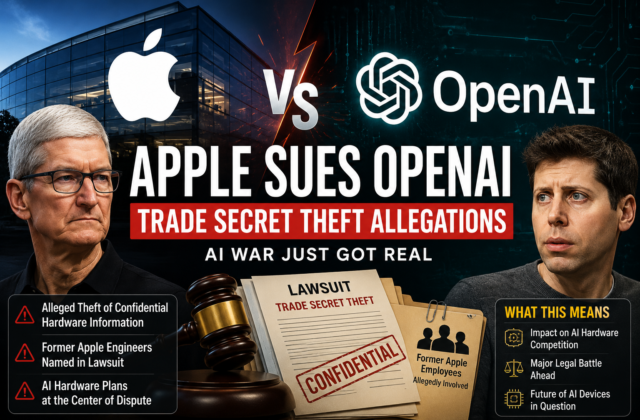
- Apple has filed a major lawsuit against OpenAI, alleging trade secret theft involving former Apple engineers and confidential AI hardware information.
- Former Apple executives Tang Tan and Chang Liu are accused of improperly accessing and using proprietary Apple data to accelerate OpenAI's consumer AI hardware development.
- Apple claims OpenAI used confidential supplier information, internal product codenames, and manufacturing techniques to gain an unfair competitive advantage.
- The lawsuit also names io Products, the AI hardware startup founded by former Apple designer Jony Ive and later acquired by OpenAI in 2025.
- Apple alleges former employees attempted to recruit current Apple engineers while encouraging them to share confidential product information and hardware components.
Introduction
Apple and OpenAI—two of the biggest names in technology—are now at the center of one of the most significant legal battles in artificial intelligence. Apple has accused OpenAI of orchestrating a coordinated effort to obtain confidential information related to Apple’s future hardware projects through former employees.
The lawsuit comes at a crucial moment as OpenAI rapidly expands beyond software into AI-powered consumer hardware, while simultaneously defending itself against multiple copyright lawsuits from major news publishers. Together, these legal challenges could reshape the competitive landscape of artificial intelligence and consumer technology.
Why Apple Filed the Lawsuit
According to Apple’s complaint filed in the U.S. District Court for the Northern District of California, former Apple executives Tang Tan and Chang Liu allegedly obtained confidential information before joining OpenAI and companies connected to its hardware ambitions.
Apple claims the information included:
- Supplier information
- Internal product codenames
- Hardware development plans
- Manufacturing techniques
- Prototype-related information
- Confidential engineering files
The company argues that this information could accelerate OpenAI’s push into AI-powered consumer devices.
The Role of Former Apple Engineers
Apple alleges that Tang Tan emailed company information to himself before leaving Apple and later used internal Apple project names during recruitment interviews.
According to the complaint, candidates were even encouraged to bring physical Apple components to interviews.
Chang Liu is accused of accessing Apple’s internal systems using a previously unknown software bug and downloading confidential hardware documents relating to unreleased products.
Apple further claims Liu advised another former colleague on how to avoid Apple’s internal security monitoring while communicating with OpenAI.
Why io Products Is Also Named
Apple has also included io Products in the lawsuit.
The startup was founded by former Apple designer Jony Ive and Tang Tan before being acquired by OpenAI in 2025.
According to Apple, confidential manufacturing methods and supplier relationships were allegedly used while OpenAI accelerated development of AI-powered consumer hardware.
If proven, the allegations could significantly affect OpenAI’s hardware roadmap.
OpenAI’s Growing Legal Challenges
Apple’s lawsuit is not the only major legal issue facing OpenAI.
Separately, The New York Times and several other publishers have accused the company of mishandling evidence in an ongoing copyright lawsuit.
Publishers argue OpenAI:
- Failed to preserve important ChatGPT logs.
- Misrepresented its ability to search training data.
- Deleted billions of conversations despite preservation orders.
- Delayed discovery during litigation.
If the court agrees, sanctions could strengthen the publishers’ copyright claims.
Could This Affect ChatGPT?
For everyday ChatGPT users, there is currently no indication that the lawsuits will disrupt access to the service.
However, the legal proceedings could influence:
- AI training practices
- Data retention policies
- Transparency requirements
- Partnerships with hardware manufacturers
- Future AI-powered consumer devices
What This Means for Apple’s AI Strategy
Apple has invested heavily in Apple Intelligence and on-device AI.
The company argues that protecting confidential engineering information is essential as competition intensifies.
The lawsuit also highlights Apple’s growing interest in maintaining tight control over future AI hardware products, where proprietary manufacturing processes and supplier relationships can provide a competitive advantage.
What This Means for OpenAI
OpenAI has rapidly expanded from a software-focused AI company into a broader technology business.
Its ambitions now include:
- AI hardware
- Custom chips
- Consumer devices
- Enterprise AI
- Robotics
The outcome of these legal disputes could influence how quickly OpenAI can pursue these initiatives and how future AI companies manage intellectual property and employee transitions.
Key Takeaways
- Apple has sued OpenAI over alleged trade secret theft involving former Apple employees.
- Apple claims confidential hardware information was used to accelerate OpenAI’s AI device development.
- Former Apple executives Tang Tan and Chang Liu are central figures in the lawsuit.
- OpenAI also faces a separate copyright dispute brought by The New York Times and other publishers.
- The cases could have significant implications for AI hardware, intellectual property, and future AI regulation.
FAQs
Why is Apple suing OpenAI?
Apple alleges that former employees improperly obtained confidential hardware information and that OpenAI benefited from those trade secrets in developing AI hardware.
Who is Tang Tan?
Tang Tan is a former Apple executive who now leads hardware efforts at OpenAI and is named in Apple’s lawsuit.
What is io Products?
io Products is an AI hardware startup founded by Jony Ive and Tang Tan that was acquired by OpenAI in 2025.
Will ChatGPT be affected?
There is no indication that current ChatGPT services will be interrupted, although the legal cases could influence future AI development and business practices.
About TheBusinessNow
TheBusinessNow delivers global coverage of business, finance, technology, geopolitics, commodities, and economic trends. Our goal is to provide readers with original, fact-based analysis that explains how world events shape markets and investment decisions.
Keep reading
Related Articles
 Commodities
Oil Nears $95: Could the Iran War Trigger a New U.S. Inflation Shock?
Oil at $95 Is Not the Real Story A crude-oil headline is easy to write: “Oil prices rise as Iran tensions escalate.” Reuters, Bloomberg, CNBC and WSJ can publish that story within minutes. But for TheBusinessNow, that isn’t enough. The bigger question is: What happens to the American economy if oil stays near $95 —...
 Economy
U.S. National Debt Hits $40 Trillion: Why Treasury Yields Are Rising Again
The $40 Trillion Number Is Not the Whole Story The United States has crossed a psychological and financial milestone. $40 trillion. But simply writing “America owes $40 trillion” misses the more important story. The real question for markets is: Who is willing to finance America’s growing debt — and at what interest rate? That question...
 Commodities
Strait of Hormuz Standoff: The Oil Shock That Could Hit the U.S. Economy Next
Strait of Hormuz Standoff: Why the Oil Market Is Getting Nervous Again The oil market is being forced to price a problem that seemed to be easing only weeks ago: the Strait of Hormuz is still not reliably functioning as a normal commercial shipping route. On August 19, Brent crude was trading around $91.20 a...
Comments (0)