
US Dollar Holds Steady as Oil Stabilizes While Initial Jobless Claims Fall: What It Means for Markets Today
US Dollar Trades with a Softer Tone as Oil Prices Stabilize The US dollar remained under mild pressure during Thursday’s trading session as crude oil prices stabilized, reducing demand for traditional safe-haven assets. At the same time, fresh labor market data showed that US initial jobless claims declined by 2,000 to 215,000, signaling that the...
TheBusinessNow
Jul 9, 2026 · 4 min Read
Key Highlights
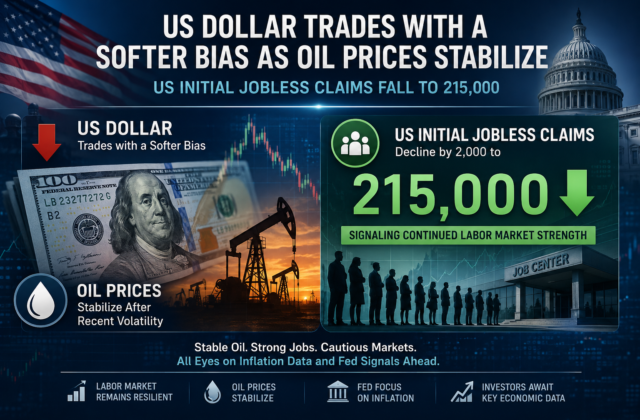
- US Dollar trades with a softer bias as oil prices stabilize after recent market volatility.
- Initial Jobless Claims fall by 2,000 to 215,000, signaling continued strength in the U.S. labor market.
- Stable oil prices reduce safe-haven demand, limiting gains in the U.S. dollar.
- Healthy employment data reinforces confidence in the resilience of the U.S. economy.
- Markets remain cautious as investors await upcoming inflation data and Federal Reserve signals.
US Dollar Trades with a Softer Tone as Oil Prices Stabilize
The US dollar remained under mild pressure during Thursday’s trading session as crude oil prices stabilized, reducing demand for traditional safe-haven assets. At the same time, fresh labor market data showed that US initial jobless claims declined by 2,000 to 215,000, signaling that the American job market continues to demonstrate resilience.
The combination of a stable energy market and a healthy labor market is giving investors mixed signals about the next direction for the US economy and Federal Reserve policy.
US Initial Jobless Claims Drop to 215,000
The latest weekly report showed initial jobless claims fell by 2,000 to 215,000, slightly improving from the previous week.
The lower reading indicates:
- The US labor market remains relatively strong.
- Employers continue to retain workers despite economic uncertainty.
- Consumer spending could remain supported through stable employment.
- The Federal Reserve may continue monitoring inflation rather than reacting to labor market weakness.
Although weekly jobless claims can fluctuate, economists generally view readings near 215,000 as consistent with a healthy employment environment.
Why the US Dollar Is Trading with a Softer Bias
Despite encouraging employment data, the US dollar struggled to gain momentum.
Several factors contributed to the softer tone:
- Crude oil prices stabilized after recent volatility.
- Investors reduced demand for defensive assets.
- Market participants remain cautious ahead of upcoming inflation and Federal Reserve developments.
- Currency traders are waiting for stronger economic catalysts before increasing long-dollar positions.
This resulted in relatively subdued movement across major currency pairs.
Oil Prices Help Calm Market Volatility
Energy markets played an important role in Thursday’s trading.
After recent geopolitical concerns triggered price swings, oil prices steadied, helping improve investor sentiment.
Stable crude prices generally reduce immediate inflation concerns while also lowering demand for safe-haven currencies such as the US dollar.
Investors continue monitoring:
- Global crude oil supply
- OPEC+ production decisions
- Middle East developments
- Worldwide energy demand
Any significant movement in oil prices could quickly influence currency markets again.
What This Means for the Federal Reserve
The latest economic data presents a balanced picture for policymakers.
A resilient labor market supports the broader economy, while softer dollar trading reflects cautious investor positioning rather than economic weakness.
The Federal Reserve is expected to continue focusing on:
- Inflation trends
- Employment strength
- Consumer spending
- Financial market conditions
- Economic growth
Future policy decisions will likely depend on several upcoming economic reports rather than a single week’s labor market data.
Market Reaction
Financial markets showed relatively limited volatility following the release.
Investors observed:
- A slightly weaker US dollar
- Stable crude oil prices
- Continued confidence in the US labor market
- Cautious positioning across forex markets
Traders are now turning their attention toward upcoming inflation indicators and additional economic data that could provide clearer direction for interest rate expectations.
What Investors Should Watch Next
The next major catalysts for financial markets include:
- Consumer inflation data (CPI)
- Producer Price Index (PPI)
- Federal Reserve communications
- Retail sales figures
- Crude oil inventory reports
- Dollar Index (DXY) movement
Together, these indicators will help determine whether the dollar resumes its strength or continues trading within its recent range.
Final Takeaway
Thursday’s economic updates painted a picture of a stable but cautious US economy. The decline in initial jobless claims to 215,000 highlights continued labor market resilience, while steady oil prices have eased some of the safe-haven demand supporting the US dollar.
For investors, the focus now shifts to upcoming inflation data and Federal Reserve signals, which are likely to determine the next significant move in the US dollar and broader financial markets.
About TheBusinessNow
TheBusinessNow delivers global coverage of business, finance, technology, geopolitics, commodities, and economic trends. Our goal is to provide readers with original, fact-based analysis that explains how world events shape markets and investment decisions.
Keep reading
Related Articles
 Commodities
Oil Nears $95: Could the Iran War Trigger a New U.S. Inflation Shock?
Oil at $95 Is Not the Real Story A crude-oil headline is easy to write: “Oil prices rise as Iran tensions escalate.” Reuters, Bloomberg, CNBC and WSJ can publish that story within minutes. But for TheBusinessNow, that isn’t enough. The bigger question is: What happens to the American economy if oil stays near $95 —...
 Economy
U.S. National Debt Hits $40 Trillion: Why Treasury Yields Are Rising Again
The $40 Trillion Number Is Not the Whole Story The United States has crossed a psychological and financial milestone. $40 trillion. But simply writing “America owes $40 trillion” misses the more important story. The real question for markets is: Who is willing to finance America’s growing debt — and at what interest rate? That question...
 Commodities
Strait of Hormuz Standoff: The Oil Shock That Could Hit the U.S. Economy Next
Strait of Hormuz Standoff: Why the Oil Market Is Getting Nervous Again The oil market is being forced to price a problem that seemed to be easing only weeks ago: the Strait of Hormuz is still not reliably functioning as a normal commercial shipping route. On August 19, Brent crude was trading around $91.20 a...
Comments (0)