
Supreme Court Status Report: EOW Investigation Finds No Evidence Linking Key IHFL Loans to Entities Associated with Sameer Gehlaut
Supreme Court Status Report: EOW Investigation Finds No Evidence Linking Key IHFL Loans to Entities Associated with Sameer Gehlaut A fresh status report filed by the Delhi Police Economic Offences Wing (EOW) before the Supreme Court has put a new focus on the financial allegations surrounding former Indiabulls Housing Finance Limited (IHFL) promoter Sameer Gehlaut....
TheBusinessNow
Aug 19, 2026 · 10 min Read
Key Highlights
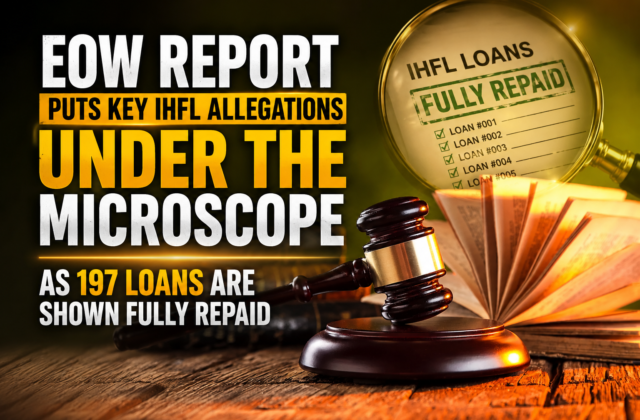
- 197 loan accounts across five corporate groups were examined.
- Aggregate sanctioned loans were approximately ₹8,267.86 crore.
- Gross collections were approximately ₹11,073.77 crore.
- The EOW report records all 197 accounts as fully repaid and closed.
- In the DLF matter, the ₹66 crore investment preceded the relevant IHFL borrowing by 17 months.
- In the Vatika matter, the investments reportedly preceded the relevant IHFL borrowing by more than two years.
- Investigators reportedly found no financial trail linking IHFL loan proceeds to Gehlaut-associated entities in the key transactions examined.
Supreme Court Status Report: EOW Investigation Finds No Evidence Linking Key IHFL Loans to Entities Associated with Sameer Gehlaut
A fresh status report filed by the Delhi Police Economic Offences Wing (EOW) before the Supreme Court has put a new focus on the financial allegations surrounding former Indiabulls Housing Finance Limited (IHFL) promoter Sameer Gehlaut.
The report, filed on August 11, 2026 in Special Leave Petition (Civil) No. 2993 of 2025, examines allegations involving loans extended by IHFL, now known as Sammaan Capital Limited, to five major corporate borrower groups — DLF, Vatika, Chordia, Americorp and Reliance ADAG.
What makes the report particularly significant is not simply the size of the transactions, but what investigators say they found when they followed the money.
The EOW’s investigation, according to the material supplied for this analysis, found that all 197 loan accounts examined had been fully repaid and closed, while several of the alleged financial links to Gehlaut-associated entities were not supported by a documented money trail.
The findings do not amount to a final judicial ruling. They are investigative findings recorded in a status report, and the underlying legal proceedings remain important. But they substantially change the factual picture that needs to be examined.
The number at the centre of the investigation is ₹8,267.86 crore
The investigation covered 197 loan accounts belonging to the five corporate groups.
According to the EOW report described in the source material, Sammaan Capital produced a certificate from chartered accountants N.D. Kapur & Co.
The certificate reportedly recorded:
- ₹8,267.86 crore in aggregate sanctioned loans
- ₹11,073.77 crore in gross collections
- 197 loan accounts
- All 197 accounts closed
That repayment figure is one of the most important elements of the report.
Gross collections were approximately ₹2,805.91 crore higher than the sanctioned principal amount across the accounts examined.
That does not, by itself, resolve every allegation surrounding the transactions. Loan repayment and the legality of the underlying transactions are separate questions.
But it does provide an important factual counterpoint to allegations involving wrongful loss to the lender.
Why the chronology matters more than the headline allegations
Financial investigations often turn on a deceptively simple question:
Did the alleged source of money actually exist before the alleged destination transaction?
That question appears repeatedly in the EOW’s examination.
In several instances described in the status report, investments allegedly connected to Gehlaut-associated entities occurred before the relevant companies borrowed money from IHFL.
That chronology can materially weaken an allegation that IHFL loan proceeds financed those earlier investments.
The DLF and Vatika cases provide particularly notable examples.
DLF case: the ₹66 crore investment and the 17-month gap
One of the allegations examined by the EOW concerned a ₹66 crore investment in EMU Realcon Pvt. Ltd., an entity associated with Sameer Gehlaut.
The investigation reportedly established that the investment occurred during FY 2014-15.
But there was a major timing issue.
Of the three DLF entities involved in the investment, only one subsequently borrowed from IHFL — and that borrowing occurred 17 months after the investment.
That creates an obvious chronological problem for the allegation that the IHFL loan proceeds were used to finance the ₹66 crore investment.
The EOW reportedly found that the investigation had not uncovered a financial trail or documentary evidence showing that IHFL funds were directly or indirectly routed into entities associated with Gehlaut.
The report also records that the loans were repaid and accounted for, with no financial loss to IHFL identified in relation to the transactions examined.
Why this matters
If money is alleged to have travelled from A → B, investigators generally need evidence showing the money was available at A before it reached B.
If B happened 17 months before the relevant borrowing from IHFL, the alleged financing theory becomes considerably more difficult to establish unless another mechanism or funding source can be demonstrated.
That distinction is central to understanding the EOW’s findings.
Chordia investigation turns on the ₹50 crore professional-fee payment
Another transaction examined by investigators involved a ₹50 crore payment by Built To Live Realty LLP, a Chordia Group entity, to Indiabulls Real Estate Limited (IBREL).
The investigation reportedly examined:
- Tax invoices
- Banking records
- Ledger entries
- Audited financial statements
- Documentation concerning the underlying services
The services described in the source material included strategic market research, project planning, assistance with land acquisition, urban planning, regulatory compliance, project-management support and advisory services for a major real-estate development.
The EOW also reportedly considered the corporate status of IBREL.
Rather than being a privately held company exclusively owned by Gehlaut, IBREL was a listed company.
That distinction matters because a payment to a listed corporate entity cannot automatically be treated as a personal benefit to its promoter.
The investigation reportedly found no evidence that the ₹50 crore payment was subsequently transferred to Gehlaut personally or to an entity controlled by him.
The report also records that material examined by the EOW, SEBI and the National Housing Bank did not establish a direct connection between the IHFL loans and an alleged benefit to Gehlaut or his entities.
Vatika case reveals another major timing discrepancy
The Vatika-related investigation produced another chronology that investigators considered significant.
The allegation concerned investments by Agnes Developers Pvt. Ltd. into entities associated with Gehlaut.
The investments were reportedly made in 2014.
But the relevant IHFL borrowing by Agnes Developers occurred only in August 2016.
That is a gap of more than two years.
Once again, the timing challenges the proposition that the earlier investment was funded by the later IHFL borrowing.
The EOW reportedly found no financial trail or documentary evidence showing that IHFL funds were directly or indirectly routed into Gehlaut-associated companies.
The Vatika loans were also reportedly repaid with interest, with no evidence of write-offs or financial loss to IHFL identified in the investigation.
This is where the investigation becomes bigger than one transaction
The EOW’s examination did not apparently depend on a single bank statement or one corporate document.
The status report records examination of a broad collection of material, including:
- Loan sanction records
- Loan disbursement records
- Bank statements
- Client ledgers
- Audited financial statements
- Corporate records
- Regulatory material
- Findings associated with SEBI
- National Housing Bank material
- Ministry of Corporate Affairs records
- Enforcement Directorate-related material
That matters because allegations involving complex corporate lending cannot normally be evaluated simply by looking at the original loan agreement.
Investigators have to establish what happened before, during and after the loan.
That means tracing the movement of funds, identifying beneficiaries, checking corporate relationships and comparing transaction dates.
The 197-account finding changes the financial-loss question
The repayment data deserves separate attention.
The source material says the five corporate groups collectively received approximately ₹8,267.86 crore in sanctioned loans.
Gross collections, however, were approximately ₹11,073.77 crore.
And all 197 accounts were recorded as closed.
This does not mean that repayment automatically proves every transaction was proper.
It does, however, make the question of actual lender loss more complicated.
There is a major difference between:
An allegation that money was improperly diverted
and
evidence that the lender ultimately suffered a quantifiable financial loss because of that alleged diversion.
The EOW findings described in the report address that distinction directly.
The most important takeaway is the missing money trail
Perhaps the most consequential phrase emerging from the investigation is not the total loan amount.
It is the absence of a documented financial trail.
Across key transactions, the EOW reportedly found no evidence showing that IHFL loan proceeds were routed into entities associated with Sameer Gehlaut.
That does not prove that every allegation is false.
It means investigators, based on the material examined so far, did not identify the evidence required to establish the alleged flow of funds in those instances.
That distinction is crucial in responsible reporting.
What the EOW report does not mean
The report should not be interpreted as a Supreme Court judgment clearing every allegation against every person involved.
There are three different things that need to be kept separate:
1. The original allegations
These are the claims contained in the FIR and related proceedings.
2. The EOW investigation
This examines whether documentary, financial and other evidence supports those allegations.
3. The court’s eventual determination
Only the competent court can ultimately determine the legal consequences of the allegations and evidence.
Therefore, the EOW findings are significant investigative developments, but they should not be described as a final judicial exoneration.
Why the Gehlaut angle is drawing attention
Sameer Gehlaut was the promoter associated with the Indiabulls group, making the alleged financial relationships especially consequential.
The allegations examined by investigators appear to focus on whether corporate borrowers who received IHFL financing subsequently transferred or invested money into companies associated with Gehlaut, potentially creating a quid-pro-quo arrangement.
But the investigation described in the status report repeatedly confronts that theory with two questions:
Where is the money trail?
and
Did the alleged source transaction actually occur before the alleged destination transaction?
In the DLF and Vatika matters, the chronology described by the EOW makes the second question particularly important.
What could happen next
The EOW status report is unlikely to be the end of the matter.
The Supreme Court proceedings remain relevant, and further submissions, responses, evidence or judicial directions could alter how the investigation develops.
The central questions going forward are likely to include:
- Whether any additional financial evidence emerges
- Whether the chronology identified by investigators is challenged
- Whether other borrower groups produce different findings
- Whether regulators or investigative agencies reach additional conclusions
- How the Supreme Court evaluates the status report
- Whether further investigation is directed
- Whether any remaining allegations can be supported by documentary evidence
For investors, lenders and corporate-governance observers, the distinction between allegation, investigation and adjudication will remain essential.
What This Could Mean for Corporate Governance
The case illustrates why transaction chronology and fund tracing are so important in large corporate investigations.
A corporate payment involving a promoter-linked entity may attract scrutiny, but scrutiny alone does not establish wrongdoing.
Investigators must establish:
Source → movement of funds → recipient → purpose → beneficiary
If one of those links cannot be established through documentary or financial evidence, the allegation becomes significantly harder to prove.
The EOW’s report, as described in the supplied material, appears particularly important because investigators did not simply examine whether transactions existed. They examined when those transactions happened and where the money went.
That is the more consequential question for the legal process.
About The Business Now
The Business Now is a digital business and finance news platform covering markets, companies, economic developments, technology, global business, policy and major events.
Our focus is on turning complex developments into clear, data-driven and context-rich reporting, while distinguishing reported allegations from verified findings and official determinations.
For major corporate and financial stories, readers should consider the underlying filings, regulatory documents and court records alongside media reports.
Track Gold Prices Alongside Major Market News
Gold often becomes an important market indicator during periods of geopolitical uncertainty, inflation concerns and financial-market volatility.
For current gold-rate tracking and gold-related market information, readers can visit GoldPriceNow.in.
Use it alongside business and market coverage when monitoring how precious metals are responding to major economic and geopolitical developments.
Key Resources
- Supreme Court of India — official court information and case-related resources.
- SEBI — securities-market regulatory information and corporate disclosures.
- National Housing Bank — housing-finance regulatory information.
- Ministry of Corporate Affairs — company and corporate-registry resources.
- Enforcement Directorate — official information concerning investigations under its statutory mandate.
- GoldPriceNow.in — live gold-price tracking
Editorial note: This analysis is based primarily on the EOW status-report details provided in your source material. The web search I performed did not locate an independently accessible copy of the August 11, 2026 status report, so I have not presented the report’s claims as independently verified facts beyond the supplied material. The EOW findings should not be treated as a final judicial determination.
Keep reading
Related Articles
 Commodities
Oil Nears $95: Could the Iran War Trigger a New U.S. Inflation Shock?
Oil at $95 Is Not the Real Story A crude-oil headline is easy to write: “Oil prices rise as Iran tensions escalate.” Reuters, Bloomberg, CNBC and WSJ can publish that story within minutes. But for TheBusinessNow, that isn’t enough. The bigger question is: What happens to the American economy if oil stays near $95 —...
 Economy
U.S. National Debt Hits $40 Trillion: Why Treasury Yields Are Rising Again
The $40 Trillion Number Is Not the Whole Story The United States has crossed a psychological and financial milestone. $40 trillion. But simply writing “America owes $40 trillion” misses the more important story. The real question for markets is: Who is willing to finance America’s growing debt — and at what interest rate? That question...
 Commodities
Strait of Hormuz Standoff: The Oil Shock That Could Hit the U.S. Economy Next
Strait of Hormuz Standoff: Why the Oil Market Is Getting Nervous Again The oil market is being forced to price a problem that seemed to be easing only weeks ago: the Strait of Hormuz is still not reliably functioning as a normal commercial shipping route. On August 19, Brent crude was trading around $91.20 a...
Comments (0)