
Michigan Backlash Could Threaten Democrats’ Senate Comeback — Why the El-Sayed Victory Is a Bigger Test Than It Looks
Michigan Backlash Could Threaten Democrats’ Senate Comeback — Why the El-Sayed Victory Is a Bigger Test Than It Looks Abdul El-Sayed’s victory in Michigan’s Democratic Senate primary has given the party’s progressive wing a major breakthrough. But the backlash surrounding his nomination is creating a difficult question for Democrats: can they turn a divisive primary...
TheBusinessNow
Aug 18, 2026 · 8 min Read
Key Highlights
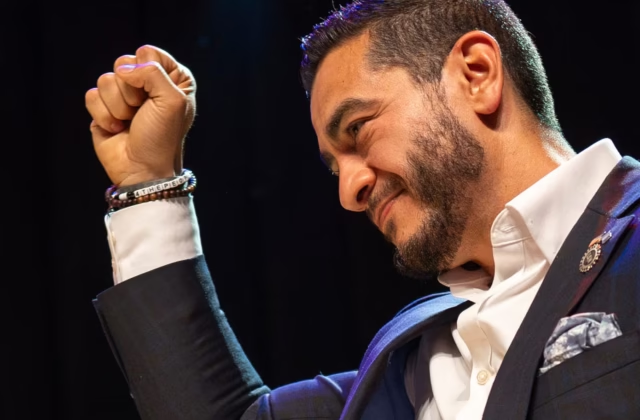
- Abdul El-Sayed won Michigan's Democratic Senate primary on Aug. 4.
- His victory was a major win for the party's progressive wing.
- El-Sayed defeated Democratic Rep. Haley Stevens in a closely watched contest.
- The primary became a national test of progressive influence inside the Democratic Party.
- Michigan is considered a critical state in the battle for Senate control.
- El-Sayed will face Republican Mike Rogers in the November general election.
Michigan Backlash Could Threaten Democrats’ Senate Comeback — Why the El-Sayed Victory Is a Bigger Test Than It Looks
Abdul El-Sayed’s victory in Michigan’s Democratic Senate primary has given the party’s progressive wing a major breakthrough. But the backlash surrounding his nomination is creating a difficult question for Democrats: can they turn a divisive primary victory into a coalition broad enough to win a crucial swing-state Senate race in November?
Michigan is not simply another Senate contest. The state is one of the seats Democrats need to defend or win if they are serious about regaining control of the Senate. That makes the Democratic Party’s internal fight over ideology, electability and the direction of the party unusually consequential.
El-Sayed, a former Wayne County public health official and physician, defeated Rep. Haley Stevens in the Aug. 4 Democratic primary. His victory was significant because it marked the first time a progressive candidate of his profile had won the Democratic nomination for Michigan’s open Senate seat. He now faces Republican former Rep. Mike Rogers in November.
The immediate challenge is that the primary exposed substantial divisions inside the Democratic coalition. El-Sayed’s supporters view his victory as evidence that voters are rejecting establishment politics. His critics worry that his progressive positions and the backlash surrounding his candidacy could make the general election harder in a state Republicans are targeting.
That tension is now at the center of the Michigan Senate race.
Why Michigan Matters So Much to Democrats
The stakes in Michigan go beyond one candidate.
Democrats are trying to rebuild their Senate position in 2026, and Michigan is one of the states viewed as critical to that effort. Earlier analysis of the primary described the seat as one Democrats needed to hold if they hoped to have a realistic path toward a Senate majority.
That explains why the primary generated so much national attention.
Democratic leaders and establishment-aligned groups had favored Stevens, viewing her as a potentially stronger general-election candidate against Rogers.
El-Sayed represented a fundamentally different strategy.
Rather than positioning himself as a centrist alternative, he campaigned openly as a progressive populist, emphasizing healthcare, economic inequality and opposition to corporate influence.
His victory therefore wasn’t simply a change in the name on the November ballot.
It was a test of which Democratic message can win in a competitive Midwestern state.
El-Sayed’s Victory Was a Blow to the Democratic Establishment
The Michigan primary became one of the clearest examples this cycle of the Democratic Party’s internal ideological divide.
Stevens had establishment support and significant financial backing.
El-Sayed had progressive endorsements, grassroots energy and support from figures including Bernie Sanders and Alexandria Ocasio-Cortez.
The result challenged the assumption that a heavily financed moderate would necessarily have the advantage.
Axios reported that El-Sayed defeated Stevens despite being outspent nearly 10 to 1, making the result one of the clearest examples this cycle of money failing to guarantee victory.
That result could influence future Democratic primaries.
Progressive candidates can now point to Michigan and argue that grassroots enthusiasm and ideological clarity can overcome enormous financial disadvantages.
For establishment Democrats, however, the question is different:
Can a candidate who wins a Democratic primary by mobilizing the party’s left also win enough moderate and independent voters in November?
That is the test now facing El-Sayed.
Why the Backlash Matters
The backlash isn’t coming from only one direction.
Republicans have already begun portraying El-Sayed as too progressive for Michigan.
At the same time, some Democrats have expressed concern that his positions could create difficulties with voters outside the party’s progressive base.
This argument isn’t entirely new.
Even before the primary, Washington Post reporting documented Democratic concerns that El-Sayed’s progressive profile could create a general-election problem in a state that voted for Donald Trump in 2024.
But El-Sayed has rejected the assumption that Michigan voters necessarily want moderate candidates.
In an interview before the primary, he argued that Michigan’s voters should not automatically be characterized as moderate simply because they have supported candidates from both parties.
His argument is essentially that economic frustration and dissatisfaction with political establishments can create an opening for populist candidates.
The November election will test whether that theory works beyond a Democratic primary electorate.
The Biggest Challenge: Building a General-Election Coalition
Winning a primary and winning a statewide Senate election require different coalitions.
A primary campaign can focus heavily on voters who are:
- Highly engaged
- Ideologically motivated
- More likely to vote in primaries
- Strongly aligned with a candidate’s policy agenda
A general election is much broader.
El-Sayed will need support from Democrats who preferred Stevens, independents and potentially voters who do not share his progressive agenda.
That creates an unusual balancing act.
He needs to keep the grassroots enthusiasm that powered his primary campaign without allowing the Republican campaign to define him exclusively through his most controversial positions.
The Israel Debate Could Remain a Major Issue
Israel and U.S. foreign policy became one of the most divisive issues during the Democratic primary.
El-Sayed has been a vocal critic of unconditional U.S. military assistance to Israel, and his position attracted strong support among some Arab American and progressive voters.
But it also generated intense opposition.
The issue became particularly important in Michigan because of the state’s significant Arab American population and the broader debate within the Democratic Party over the Israel-Gaza conflict.
The controversy could continue into the general election.
Republicans have already sought to use El-Sayed’s progressive positions to portray him as outside the political mainstream.
How effectively the El-Sayed campaign responds could influence whether the issue expands beyond the Democratic base.
El-Sayed’s Historic Nomination Has Another Dimension
The Michigan nomination is also historically significant.
El-Sayed became the first Muslim nominated by Michigan’s Democratic Party for the U.S. Senate, according to AP reporting.
That milestone has been celebrated by Muslim Americans, but it has also coincided with a surge of anti-Muslim rhetoric surrounding his campaign.
That dynamic adds another layer to the election.
The campaign will not only be about policy and party ideology.
It could also become a national conversation about Muslim representation in American politics and the political boundaries of religious identity.
For Democrats, responding to attacks against El-Sayed while keeping the campaign focused on Michigan-specific economic issues could become an important strategic challenge.
Why Money Didn’t Stop El-Sayed
One of the most interesting aspects of the Michigan primary was the amount of money deployed against El-Sayed.
Yet spending alone did not prevent his victory.
Axios noted that El-Sayed won despite being outspent by nearly 10 to 1.
That does not mean money no longer matters in American politics.
Campaign spending remains enormously important for advertising, voter outreach, organizing and communications.
But Michigan demonstrates that financial advantages can fail when they don’t translate into voter enthusiasm.
For progressive Democrats, that may be the most important lesson from the race.
The primary showed that a candidate with a highly motivated grassroots coalition can sometimes outperform a better-funded opponent.
The November Matchup: El-Sayed vs. Mike Rogers
The next phase of the race will be fundamentally different.
El-Sayed now faces Mike Rogers, the Republican nominee and former member of Congress.
Rogers is likely to present himself as the more conventional choice for Michigan voters while portraying El-Sayed as too far to the left.
El-Sayed, meanwhile, has an opportunity to frame the race around healthcare costs, economic pressures, corporate power and dissatisfaction with Washington.
The contest could therefore become a direct argument over what Michigan voters believe is most important:
ideological change or political stability.
Democrats Now Have to Unite
The primary campaign was intensely competitive, and the divide between El-Sayed and Stevens supporters was visible throughout the contest.
But Democrats cannot afford to fight the primary again in the general election.
The party’s immediate challenge is coalition building.
That means bringing together:
- Progressive voters
- Moderate Democrats
- Black voters
- Arab American voters
- Young voters
- Working-class voters
- College-educated voters
- Independents who may be open to Democratic candidates
The primary itself showed that these groups do not always vote the same way.
Reuters reported that Stevens performed better among working-class and Black voters, while El-Sayed had stronger support among white college-educated voters.
That makes coalition building particularly important.
El-Sayed cannot simply recreate his primary electorate.
He has to expand it.
What Could Decide the Michigan Senate Race?
Several factors are likely to matter.
1. Economic issues
Michigan voters could prioritize inflation, wages, healthcare costs and household finances over ideological debates.
2. Turnout
The ability to mobilize younger and progressive voters could be critical for El-Sayed.
3. Independent voters
The general-election electorate will be substantially broader than the Democratic primary electorate.
4. National political environment
The presidential party’s standing and broader national sentiment could affect Senate races across the country.
5. Republican attacks
Rogers and national Republicans are likely to focus heavily on El-Sayed’s progressive positions.
6. Democratic unity
Whether Stevens supporters and establishment Democrats fully rally behind El-Sayed could matter enormously.
The Bigger Democratic Party Question
Michigan is becoming a case study in a much larger debate.
Should Democrats move toward a more progressive economic and political agenda, or should they prioritize candidates they believe can win swing-state voters?
El-Sayed’s victory strengthens the argument for the first approach.
But the November election will provide the more important evidence.
If he wins, progressives will have a powerful example that an openly progressive candidate can win a competitive Midwestern Senate seat.
If he loses, Democratic moderates will likely argue that Michigan proved the importance of electability.
Either way, the result could influence Democratic recruitment and primary strategy for years.
BusinessNow Outlook
The Michigan Senate race has moved from an intraparty battle to a national test of Democratic strategy.
El-Sayed has already demonstrated that progressive candidates can overcome establishment opposition, major financial disadvantages and conventional assumptions about electability.
Now he has to demonstrate something harder: that the coalition capable of winning a Democratic primary can expand into a statewide general-election majority.
That is why the current backlash matters.
It isn’t necessarily evidence that El-Sayed cannot win. Nor does his primary victory prove that he will.
It shows that Democrats have entered a new phase of the Michigan race where party unity, independent voters, economic messaging and Republican attacks will matter at least as much as progressive enthusiasm.
With Senate control potentially hanging in the balance, Michigan could become one of the most closely watched races of the 2026 midterms.
📰 About The BusinessNow
The BusinessNow is a digital news and current-affairs publication covering business, finance, markets, technology, politics, global affairs and major developments shaping the economy and public conversation.
Our coverage focuses on what happened, why it matters and what readers should watch next, while separating confirmed developments from political claims, analysis and speculation.
❓ FAQs
Who is Abdul El-Sayed?
Abdul El-Sayed is a physician and former Wayne County public health official who won the Democratic nomination for Michigan’s open U.S. Senate seat in August 2026.
Who will El-Sayed face in November?
El-Sayed will face Republican nominee and former Rep. Mike Rogers in the general election.
Why is Michigan important for Senate control?
Michigan is considered a critical Senate battleground, and Democrats need to perform strongly in states such as Michigan to have a viable path toward regaining Senate control.
Why was El-Sayed’s primary victory significant?
His victory represented a major breakthrough for the Democratic Party’s progressive wing in a competitive swing state.
Was El-Sayed heavily outspent?
Yes. Axios reported that El-Sayed defeated Stevens despite being outspent by nearly 10 to 1.
Why are some Democrats worried about his nomination?
Some Democrats have argued that El-Sayed’s progressive positions could make it more difficult to appeal to moderate and independent Michigan voters in November. That concern was documented before the primary as well.
What role could Arab American voters play?
Michigan has a significant Arab American population, and El-Sayed’s positions on Israel and Gaza helped make foreign policy an important issue during the Democratic primary.
Has El-Sayed faced anti-Muslim attacks?
Yes. AP reported a surge in anti-Muslim rhetoric surrounding his historic nomination.
What is the biggest challenge for El-Sayed now?
The central challenge is expanding his primary coalition to include moderate Democrats, independents and other statewide voters while maintaining the grassroots enthusiasm that powered his nomination.
🥇 Check Live Gold Prices
For readers tracking markets alongside political developments, check the latest gold and silver prices through GoldPriceNow.in.
Note: I’m not inserting a live gold-price number here without a verified live feed.
🔗 Key Resources
- The Washington Post — Michigan Democrats and Senate strategy
- News4JAX — Michigan primary and midterm map
- UVA Center for Politics — El-Sayed and the Michigan primary
- Reuters — El-Sayed’s Michigan primary victory
- Cook Political Report — Michigan Senate primary analysis
- GoldPriceNow.in — Live gold and silver prices
Keep reading
Related Articles
 Commodities
Oil Nears $95: Could the Iran War Trigger a New U.S. Inflation Shock?
Oil at $95 Is Not the Real Story A crude-oil headline is easy to write: “Oil prices rise as Iran tensions escalate.” Reuters, Bloomberg, CNBC and WSJ can publish that story within minutes. But for TheBusinessNow, that isn’t enough. The bigger question is: What happens to the American economy if oil stays near $95 —...
 Economy
U.S. National Debt Hits $40 Trillion: Why Treasury Yields Are Rising Again
The $40 Trillion Number Is Not the Whole Story The United States has crossed a psychological and financial milestone. $40 trillion. But simply writing “America owes $40 trillion” misses the more important story. The real question for markets is: Who is willing to finance America’s growing debt — and at what interest rate? That question...
 Commodities
Strait of Hormuz Standoff: The Oil Shock That Could Hit the U.S. Economy Next
Strait of Hormuz Standoff: Why the Oil Market Is Getting Nervous Again The oil market is being forced to price a problem that seemed to be easing only weeks ago: the Strait of Hormuz is still not reliably functioning as a normal commercial shipping route. On August 19, Brent crude was trading around $91.20 a...
Comments (0)