
USS Abraham Lincoln Under Pressure: Top U.S. Commander Visits Carrier as Sailor Families Demand Answers
USS Abraham Lincoln Under Pressure: Top U.S. Commander Visits Carrier as Sailor Families Demand Answers The USS Abraham Lincoln has become the center of a growing debate over the cost of America’s prolonged military operations against Iran. As the aircraft carrier prepares for relief after an unusually long deployment, U.S. Central Command chief Adm. Brad...
TheBusinessNow
Aug 16, 2026 · 3 min Read
Key Highlights
- Adm. Brad Cooper, commander of U.S. Central Command, visited the USS Abraham Lincoln during its prolonged deployment.
- The carrier has been deployed for more than 240 days, with some reports putting the continuous deployment above 250 days.
- The Lincoln has supported U.S. operations connected to the conflict with Iran, including a naval blockade.
- WSJ reporting says the carrier has launched more than 10,000 sorties during the deployment.
- Families have reported concerns involving food, drinking water, sanitation and mental-health support.
- Defense Secretary Pete Hegseth has rejected reports that conditions aboard the carrier have deteriorated to the extent described, calling them misrepresented.
USS Abraham Lincoln Under Pressure: Top U.S. Commander Visits Carrier as Sailor Families Demand Answers
The USS Abraham Lincoln has become the center of a growing debate over the cost of America’s prolonged military operations against Iran. As the aircraft carrier prepares for relief after an unusually long deployment, U.S. Central Command chief Adm. Brad Cooper has visited the ship while lawmakers and Navy families continue raising concerns about crew welfare, morale and the sustainability of extended deployments.
The visit comes at a particularly sensitive moment.
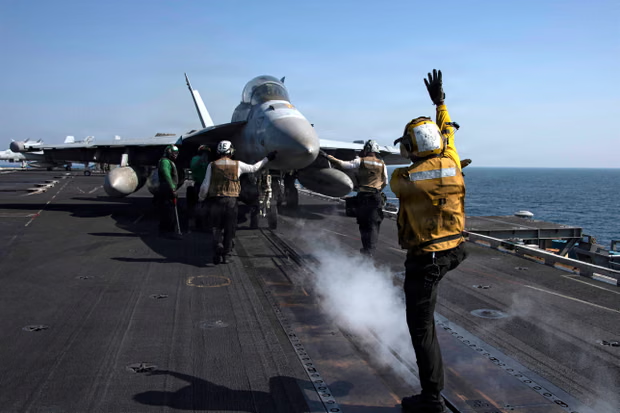
The Lincoln has spent more than eight months at sea during a high-intensity deployment connected to U.S. operations against Iran. The carrier has reportedly conducted more than 10,000 sorties and spent more than 200 days in a combat zone without a port call, according to reporting supplied by The Wall Street Journal.
At the same time, families of sailors have described serious concerns involving food, water, sanitation and mental-health support. The Pentagon has disputed or downplayed some of those claims, creating an unusual public confrontation between military families and senior officials.
The result is a story that goes beyond one aircraft carrier.
It raises a much larger question for the U.S. Navy:
How long can America’s most powerful warships remain continuously deployed at wartime tempo before the strain begins affecting the people and readiness behind the mission?
Why Adm. Brad Cooper’s Visit Matters
Adm. Brad Cooper’s visit to the USS Abraham Lincoln carries significance because he is not simply another senior officer visiting a ship.
As commander of U.S. Central Command, Cooper oversees U.S. military operations across a region that has become central to the current confrontation with Iran.
His visit comes while the Lincoln is preparing to return from a deployment that has stretched far beyond the normal expectations of a routine carrier rotation.
The Associated Press reported that the carrier had been at sea for more than 240 consecutive days while supporting U.S. operations against Iran.
That makes the visit both operationally and symbolically important.
On the operational side, the carrier remains a major component of American military power in the region.
On the personnel side, the visit comes as questions about the physical and psychological burden on the crew have become increasingly public.
The two issues are now impossible to discuss separately.
The USS Abraham Lincoln Has Been at Sea for an Extraordinary Length of Time
Aircraft carriers are designed for extended deployments.
But extended does not necessarily mean indefinite.
The Lincoln left San Diego in November and subsequently became deeply involved in the U.S. military response to the conflict with Iran. Reuters reported that the carrier had been at sea for more than 200 days without a port call, while the crew numbered roughly 5,000 sailors and Marines.
The Navy has traditionally planned deployments around rotations that allow crews to receive maintenance, resupply and periods of recovery.
War changes those calculations.
A carrier cannot simply leave an operational theater because a planned deployment period has expired if commanders believe its capabilities remain necessary.
That is precisely the dilemma now facing the Navy.
More Than 10,000 Sorties Put the Deployment in Perspective
One of the most important details in the WSJ reporting is the scale of the Lincoln’s operational activity.
The carrier has reportedly launched more than 10,000 sorties during its wartime deployment.
That figure provides context that is missing from simply saying the ship has been “deployed for a long time.”
A carrier is effectively a floating airbase.
Every aircraft launch involves pilots, deck crews, maintenance personnel, fuel systems, weapons handling teams, air-traffic coordination and command-and-control operations.
At sustained wartime tempo, the burden extends across almost the entire ship.
That means the impact of a prolonged deployment is not limited to sailors who fly aircraft.
Thousands of people are required to keep the carrier operating continuously.
Why Sailor Families Are Angry
The most politically sensitive part of the story involves allegations from families of sailors aboard the Lincoln and other deployed vessels.
The Guardian reported that several families described concerns involving nutrition, drinking water, mental-health services and prolonged separation from home. Some families said sailors had lost substantial weight during the deployment.
Those accounts have become a major source of public pressure because families are hearing directly from sailors.
The families argue that the issue isn’t simply that military service is difficult.
Their complaint is that the conditions being described go beyond the ordinary hardship associated with deployment.
Some relatives have accused senior officials of dismissing their concerns rather than investigating them.
That has created a trust problem.
Pentagon Pushes Back on Reports of a Crisis
The administration’s position is substantially different.
Defense Secretary Pete Hegseth has rejected reports that conditions aboard the carrier have deteriorated as severely as described by families and some media outlets.
Reuters reported that Hegseth characterized reports of poor conditions as “completely misrepresented.”
The Navy has also disputed the characterization of the situation as a widespread mental-health crisis.
That distinction matters.
There are two separate questions:
Are individual sailors experiencing serious problems?
And:
Does the evidence demonstrate a systemic crisis across the carrier?
Public reporting establishes serious allegations and concerns, but the available information does not independently establish every claim being made about the entire crew.
That is why the Navy’s forthcoming relief and post-deployment assessments could be particularly important.
Trump Has Also Defended the Extended Deployment
President Donald Trump has taken an unusually forceful position on the length of the deployment.
Reuters reported that Trump said the Lincoln’s deployment was “not nearly long enough.”
That comment has intensified the political debate.
For military planners, keeping a carrier in the region means maintaining a powerful tool for deterrence and combat operations.
For sailors and their families, every additional month can mean more time away from home and additional physical and psychological pressure.
For the Navy, the issue is even broader.
A carrier that remains deployed longer cannot simultaneously return home for normal maintenance, crew recovery and training cycles.
That creates potential consequences for the next deployment cycle.
The Navy Is Preparing a Replacement
The Lincoln is not expected to remain in its current role indefinitely.
The USS George Washington is reportedly moving toward the region to relieve it.
That relief operation is important because it illustrates how the Navy attempts to maintain continuous carrier presence without leaving one crew at sea indefinitely.
But replacing a carrier is not as simple as moving another ship into the same location.
The replacement carrier requires:
- its own crew;
- aircraft;
- fuel;
- weapons;
- maintenance resources;
- logistics support;
- communications;
- escorts;
- and an operational transition.
The Navy therefore has to manage both the immediate replacement and the long-term rotation schedule.
The Readiness Problem Could Be Bigger Than One Ship
This is where the controversy becomes strategically important.
If the U.S. continues conducting prolonged operations around Iran, the Navy could face pressure on multiple carrier strike groups simultaneously.
A carrier’s deployment affects more than the ship itself.
It affects:
Maintenance schedules → Crew rotations → Training cycles → Aircraft availability → Future deployments
A carrier that remains deployed for months beyond its original plan can potentially compress the time available for maintenance and preparation afterward.
That does not automatically mean the Navy is becoming less capable.
But it does mean the force has less margin for error.
Ruben Gallego Raises a Broader Warning
Sen. Ruben Gallego has become one of the lawmakers questioning the extended carrier deployment.
His criticism focuses on the broader effect of keeping the Lincoln deployed for an unusually long period.
That concern reflects an issue that military planners have wrestled with for decades:
A force can be operationally successful in the short term while becoming harder to sustain over the long term.
A carrier may accomplish its immediate mission perfectly.
But if the deployment causes maintenance delays, crew exhaustion or aircraft availability problems, the consequences can appear later.
That is why readiness is measured over years, not simply during a single military operation.
What This Means for the Iran Conflict
The Lincoln remains strategically important because aircraft carriers give the United States the ability to project airpower without relying entirely on land bases.
That is especially valuable in the Middle East, where access to bases can be politically sensitive and where the Strait of Hormuz remains strategically important.
The carrier therefore provides Washington with options.
It can support air operations.
It can contribute to deterrence.
It can protect broader maritime operations.
And its presence can signal that the U.S. has the ability to escalate if necessary.
But that capability comes with a cost.
The longer the conflict continues, the greater the pressure on the Navy to rotate ships and crews while maintaining enough forces in the region.
The Human Cost Is Becoming Part of the Strategic Debate
Military operations are often discussed through aircraft numbers, missiles, ships and territory.
The Lincoln controversy adds another metric:
human endurance.
The sailors operating the carrier are essential to its combat capability.
If morale falls, if experienced personnel leave the service, or if mental-health problems become widespread, the consequences could eventually affect readiness.
The Guardian’s reporting indicates that some families believe exactly that is already happening.
The Navy, however, disputes the broader characterization of a systemic crisis.
The distinction should be resolved through evidence rather than political rhetoric.
🔎 What We Know vs. What Remains Disputed
| Issue | Current picture |
|---|---|
| Carrier deployment | Exceptionally long |
| Combat operations | Confirmed as part of U.S. operations against Iran |
| Sorties | WSJ reports 10,000+ |
| Crew size | About 5,000 sailors and Marines |
| Relief carrier | USS George Washington reportedly moving to replace Lincoln |
| Family concerns | Food, water, sanitation and mental-health support |
| Pentagon position | Hegseth says reports are misrepresented |
| Trump position | Defended the continued deployment |
| Mental-health crisis | Serious individual cases reported; Navy disputes evidence of a broader increase |
| Final return date | Not clearly established in the supplied reporting |
This distinction is important because the story contains both documented operational facts and contested allegations.
📉 Why This Could Become a Bigger Political Issue
The controversy arrives at a politically sensitive time.
The administration has defended its military strategy toward Iran while emphasizing pressure and continued naval operations.
Meanwhile, families are asking whether the government is adequately supporting the personnel carrying out that strategy.
That creates a difficult political equation.
The longer the conflict continues → the longer deployments may become → the greater the pressure on military families → the greater the scrutiny of Pentagon leadership.
Congress could therefore become more involved if lawmakers conclude that the Navy’s deployment model is creating unacceptable readiness or personnel risks.
🔮 Outlook: What Happens Next?
The immediate focus will likely be the relief of the USS Abraham Lincoln.
If the USS George Washington takes over its mission as expected, the Lincoln can finally begin the process of returning home and recovering from the deployment.
But the controversy will not necessarily end when the ship leaves the region.
The Navy will have to assess:
1. Crew welfare
What physical and psychological effects did the extended deployment have?
2. Maintenance
How much work does the carrier require after such a prolonged operational period?
3. Aircraft readiness
How did the unusually high operational tempo affect the carrier’s aircraft?
4. Personnel retention
Will prolonged wartime deployments affect sailors’ decisions to remain in the Navy?
5. Future rotations
Can the Navy maintain a similar level of presence without repeatedly extending deployments?
Those answers could influence how Washington manages future military operations.
BusinessNow Outlook
The USS Abraham Lincoln story is becoming more than a dispute about conditions aboard one ship.
It is an early test of how much operational pressure the U.S. Navy can absorb while sustaining a prolonged military campaign.
The carrier has clearly delivered significant combat capability. The reported 10,000-plus sorties demonstrate the scale of its contribution.
But military effectiveness cannot be measured only by sorties.
A sustainable force also needs healthy crews, functioning equipment, predictable maintenance and enough reserve capacity to replace units when required.
The arrival of the USS George Washington should reduce the immediate burden on the Lincoln.
The bigger question is whether the Navy can avoid turning extraordinary wartime deployments into a recurring pattern.
If the Iran conflict continues, that question could become increasingly important for U.S. military readiness, defense spending and American foreign policy.
❓ FAQs
Why did the commander of U.S. Central Command visit the USS Abraham Lincoln?
Adm. Brad Cooper visited the carrier while it remained involved in U.S. military operations against Iran. His visit came amid an unusually prolonged deployment and growing public scrutiny of conditions aboard the ship.
How long has the USS Abraham Lincoln been deployed?
The carrier has been deployed for more than eight months, with reports indicating more than 240 consecutive days at sea and more than 200 days without a port call.
How many sailors are aboard the USS Abraham Lincoln?
Reports put the combined number of sailors and Marines aboard the carrier at approximately 5,000.
What has the USS Abraham Lincoln been doing?
The carrier has supported U.S. military operations connected to the conflict with Iran. WSJ reporting says its aircraft have conducted more than 10,000 sorties during the deployment.
Why are sailors’ families concerned?
Families have raised concerns about food, drinking water, sanitation, mental-health support and the effects of prolonged deployment.
Has the Pentagon acknowledged a crisis aboard the carrier?
Defense Secretary Pete Hegseth has rejected reports that conditions aboard the carrier are as severe as described, calling them misrepresented.
Is the USS Abraham Lincoln being replaced?
Yes. The USS George Washington is reportedly moving toward the region to relieve the Lincoln.
Why is an extended carrier deployment a concern for the Navy?
Long deployments can place pressure on crew morale, maintenance schedules, aircraft readiness and future deployment rotations. The exact long-term impact on the Lincoln will become clearer after the carrier returns.
What did Trump say about the deployment?
Trump defended the continued deployment and said the carrier’s time at sea was “not nearly long enough.”
Could the controversy affect U.S. military readiness?
Potentially. If extended deployments become frequent, the Navy could face greater pressure on maintenance, personnel retention and future force rotations. That is an issue lawmakers are increasingly examining.
🪙 Gold & Market Watch
Geopolitical tensions involving Iran, the Strait of Hormuz and U.S. military operations can influence global risk sentiment, crude-oil expectations, the U.S. dollar, Treasury yields and demand for traditional safe-haven assets such as gold.
For readers tracking precious metals alongside geopolitical developments:
GoldPriceNow.in — Live Gold Price
The live gold price is best checked directly on GoldPriceNow.in rather than inserting a potentially outdated figure into a breaking-news article.
🌐 Key Resources
- The Wall Street Journal — Iran War Commander Visits USS Abraham Lincoln
- Politico — Extended Carrier Deployment
- The Guardian — Navy Families Raise Concerns
- Reuters — Trump Defends USS Lincoln Deployment
- Reuters — Hegseth Responds to Lincoln Conditions Reports
- AP News — U.S. Central Command Chief Visits USS Lincoln
- GoldPriceNow.in — Live Gold Price
Keep reading
Related Articles
 Commodities
Oil Nears $95: Could the Iran War Trigger a New U.S. Inflation Shock?
Oil at $95 Is Not the Real Story A crude-oil headline is easy to write: “Oil prices rise as Iran tensions escalate.” Reuters, Bloomberg, CNBC and WSJ can publish that story within minutes. But for TheBusinessNow, that isn’t enough. The bigger question is: What happens to the American economy if oil stays near $95 —...
 Economy
U.S. National Debt Hits $40 Trillion: Why Treasury Yields Are Rising Again
The $40 Trillion Number Is Not the Whole Story The United States has crossed a psychological and financial milestone. $40 trillion. But simply writing “America owes $40 trillion” misses the more important story. The real question for markets is: Who is willing to finance America’s growing debt — and at what interest rate? That question...
 Commodities
Strait of Hormuz Standoff: The Oil Shock That Could Hit the U.S. Economy Next
Strait of Hormuz Standoff: Why the Oil Market Is Getting Nervous Again The oil market is being forced to price a problem that seemed to be easing only weeks ago: the Strait of Hormuz is still not reliably functioning as a normal commercial shipping route. On August 19, Brent crude was trading around $91.20 a...
Comments (0)