
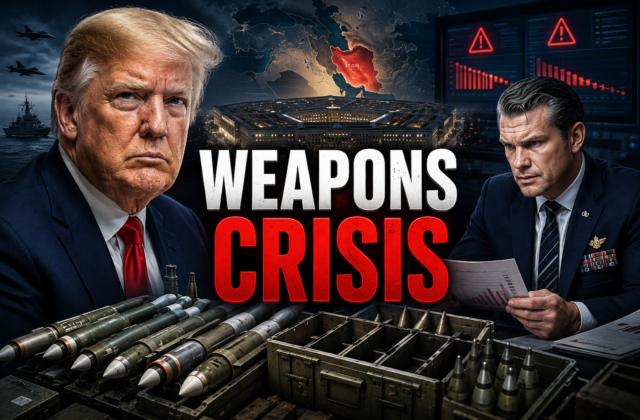
Trump Demands Answers From Hegseth Over U.S. Weapons Shortages as Iran War Strains Pentagon Stockpiles
Trump Demands Answers From Hegseth Over U.S. Weapons Shortages as Iran War Strains Pentagon Stockpiles The widening conflict with Iran is putting new pressure on the Pentagon as President Donald Trump has reportedly demanded answers from Defense Secretary Pete Hegseth over shortages of critical U.S. weapons and the military’s ability to sustain operations. The reported...
Johan Wale
Aug 6, 2026 · 3 min Read
Key Highlights
- 🇺🇸 Trump has reportedly sought explanations from Defense Secretary Pete Hegseth over weapons shortages.
- 🇮🇷 The pressure comes amid continued military tensions involving Iran.
- 🚀 High-demand weapons and air-defense interceptors are particularly important in a prolonged conflict.
- 🏭 The situation highlights limitations in America's ability to rapidly replenish certain sophisticated weapons.
- ⚠️ A longer conflict could intensify competition between immediate battlefield requirements and the need to preserve U.S. strategic reserves.
- 📈 Defense contractors and weapons manufacturers could face increased pressure to accelerate production.
Trump Demands Answers From Hegseth Over U.S. Weapons Shortages as Iran War Strains Pentagon Stockpiles
The widening conflict with Iran is putting new pressure on the Pentagon as President Donald Trump has reportedly demanded answers from Defense Secretary Pete Hegseth over shortages of critical U.S. weapons and the military’s ability to sustain operations.
The reported confrontation comes as Washington faces a difficult balancing act: maintaining military pressure in the Middle East while ensuring American forces have enough interceptors, precision munitions and other critical supplies for a potentially prolonged conflict.
The issue is bigger than a single disagreement between Trump and Hegseth. It raises questions about U.S. weapons production, defense-industry capacity, stockpile management and America’s ability to fight a high-intensity conflict without exhausting key munitions.
Why Trump Is Asking About Weapons Shortages
For any military operation, having advanced weapons is only part of the equation.
The United States also needs enough ammunition to sustain operations over time.
A modern conflict can consume weapons at a much faster pace than conventional peacetime planning assumes.
Air-defense interceptors are particularly important because they may be used to defend military bases, ships and other critical infrastructure against incoming missiles and drones.
If inventories fall faster than factories can replace them, commanders can face difficult decisions about how those weapons are allocated.
That makes weapons availability a strategic issue—not simply a Pentagon procurement problem.
The Iran Conflict Is Testing U.S. Stockpiles
The reported dispute comes as U.S. forces face sustained demands in the Middle East.
Iran possesses a substantial arsenal of missiles and drones, creating a battlefield where air-defense systems can be required repeatedly.
The United States also has forces and military assets spread across multiple regions.
That creates another challenge.
The Pentagon cannot simply assume that every weapon currently in a warehouse is available for immediate use.
Some weapons must be reserved for other contingencies.
Others require maintenance, testing or transportation.
And certain sophisticated systems can take months or even years to manufacture.
Why Interceptor Missiles Are Especially Important
One of the biggest concerns surrounding modern warfare is the cost and availability of missile-defense interceptors.
An incoming missile can potentially be intercepted by an expensive defensive weapon.
That creates a difficult economic equation.
The attacker may launch a relatively inexpensive projectile, while the defender uses a much more expensive interceptor to stop it.
During a prolonged conflict, the numbers become significant.
The Pentagon therefore has to consider not only whether it can stop an attack today, but whether it will have enough interceptors weeks or months later.
America’s Weapons Industry Faces a Bigger Test
The reported shortage also exposes a longstanding challenge in the U.S. defense industry.
America possesses some of the world’s most advanced military technology.
But advanced technology does not automatically translate into unlimited production capacity.
Manufacturing highly sophisticated weapons involves:
- Specialized components
- Semiconductor supply chains
- Explosives and propellants
- Precision manufacturing
- Highly trained workers
- Strict testing requirements
- Specialized production facilities
Increasing production therefore cannot always happen overnight.
Why Production Capacity Matters
Imagine the Pentagon orders thousands of additional missiles.
That doesn’t necessarily mean thousands can immediately be delivered.
Factories may already be operating at high capacity.
Some components may have long lead times.
New production lines may require significant investment.
Suppliers may need to expand alongside the main contractor.
And weapons must still undergo testing before being deployed.
This creates a gap between military demand and industrial capacity.
The Iran conflict could make that gap more visible.
Hegseth Faces a Difficult Balancing Act
Defense Secretary Pete Hegseth is now operating under pressure from multiple directions.
The Pentagon must support American forces in active operations while maintaining readiness for other potential conflicts.
That means deciding:
How much can be deployed now?
How much must remain in reserve?
How quickly can depleted stocks be replaced?
And perhaps most importantly:
What happens if another major crisis begins while U.S. weapons inventories are already under pressure?
Those questions extend far beyond the current conflict.
The China Factor
The weapons-shortage debate also has implications for U.S. strategy toward China.
Washington has spent years preparing for the possibility of a major conflict in the Indo-Pacific.
A conflict involving China could require enormous quantities of missiles, air-defense systems, naval weapons and other munitions.
If the United States consumes significant quantities of those weapons during another conflict, military planners have to consider how quickly stocks can be rebuilt.
This is why U.S. officials increasingly view industrial capacity as part of national security.
Could Defense Companies Benefit?
The situation could create opportunities for defense manufacturers if Washington accelerates procurement.
Companies involved in:
- Missile production
- Air defense
- Precision weapons
- Radar systems
- Drone defense
- Satellite communications
- Military electronics
could see stronger demand.
However, investors should distinguish between higher government demand and immediate financial gains.
Defense contracts often involve lengthy procurement cycles, production schedules and government approvals.
A headline about weapons shortages does not automatically mean a contractor will immediately report higher profits.
The Cost Problem
There is another issue.
Modern weapons are extremely expensive.
A prolonged conflict could force the United States to spend substantially more on replenishing inventories.
That could increase pressure on the federal budget at a time when Washington is already dealing with substantial fiscal challenges.
The government therefore faces a three-way problem:
Military requirements + weapons production + budget constraints.
Solving one does not necessarily solve the others.
Could the U.S. Increase Weapons Production Quickly?
The Pentagon has been working for years to expand America’s industrial base.
But building additional production capacity can take time.
New factories require:
- Government contracts
- Capital investment
- Equipment
- Skilled workers
- Supplier networks
- Testing facilities
- Regulatory approvals
The fastest solution is often expanding existing facilities rather than creating entirely new manufacturing ecosystems.
Even then, production increases may take months or years.
What Trump and Hegseth Must Decide
The immediate challenge is determining how aggressively the United States should replenish weapons used during the conflict.
Several options are available.
Increase Procurement
The government could place larger orders with defense manufacturers.
Expand Production
Existing factories could receive funding to increase output.
Prioritize Critical Weapons
The Pentagon could concentrate resources on systems most heavily consumed.
Protect Strategic Reserves
Military planners could limit certain deployments to preserve stocks for future emergencies.
None of these options is simple.
The Bigger Strategic Warning
The most important lesson may be that modern warfare consumes sophisticated weapons much faster than many people realize.
For decades, the United States maintained a military designed around technological superiority and rapid global deployment.
But a major conflict can test whether America’s industrial base can sustain that advantage.
The issue is no longer simply:
“Does the United States have the world’s most advanced weapons?”
It is also:
“Can the United States produce enough of them quickly enough?”
🔮 What Happens Next?
The weapons-shortage debate could become one of the most important defense-policy stories surrounding the Iran conflict.
Near Term
The Pentagon is likely to prioritize immediate operational requirements and monitor weapons inventories closely.
Medium Term
Washington could accelerate contracts for missile and interceptor production.
Long Term
The conflict could trigger a broader restructuring of America’s defense-industrial base.
That could mean new factories, expanded production lines and larger long-term weapons contracts.
📊 What Investors Should Watch
Investors tracking defense stocks should watch:
- Pentagon procurement announcements
- Missile-production contracts
- Air-defense spending
- Defense-budget increases
- Weapons replenishment programs
- Earnings guidance from major contractors
- Supply-chain constraints
- U.S. military operations in the Middle East
The companies positioned to expand production capacity could become increasingly important to Washington’s strategy.
Final Thoughts
The reported pressure on Pete Hegseth over U.S. weapons shortages comes at a critical moment for American defense policy.
The Iran conflict is demonstrating how quickly modern warfare can consume expensive and sophisticated weapons.
For Trump and the Pentagon, the challenge is not simply winning the immediate military confrontation.
They also have to ensure that America’s weapons stockpiles remain sufficient for future threats.
That means Washington may increasingly focus on a question that has become central to modern national security:
Can America’s defense industry produce weapons as quickly as America’s military can use them?
The answer could shape U.S. military strategy long after the current Iran crisis ends.
❓ FAQs
Why is Trump reportedly questioning Hegseth about weapons shortages?
Reports indicate Trump has sought explanations about U.S. weapons availability as military operations and tensions involving Iran place additional demands on American stockpiles.
What weapons are most important in this situation?
Air-defense interceptors, precision-guided munitions, missiles and other sophisticated weapons can be particularly important during sustained operations.
Why can’t the Pentagon simply order more weapons?
Many advanced weapons require specialized components, manufacturing facilities and extensive testing. Increasing production can therefore take considerable time.
Could defense stocks benefit?
Potentially. Increased Pentagon procurement could benefit companies producing missiles, air-defense systems, military electronics and other defense equipment. However, government contracts and revenue recognition can take time.
Does this mean the U.S. military is running out of weapons?
Not necessarily. A shortage of particular weapons or concerns about inventory levels should not automatically be interpreted as the United States running out of military equipment overall.
🌐 External Resources
- U.S. Department of Defense — Official Pentagon announcements and defense policy.
- U.S. Central Command — Official updates on U.S. military operations in the Middle East.
- U.S. Army — U.S. Army news and operational information.
- Reuters — International reporting on the Iran conflict and U.S. defense policy.
- Yahoo News — Latest reporting referenced in the developing story.
Keep reading
Related Articles
 Commodities
Oil Nears $95: Could the Iran War Trigger a New U.S. Inflation Shock?
Oil at $95 Is Not the Real Story A crude-oil headline is easy to write: “Oil prices rise as Iran tensions escalate.” Reuters, Bloomberg, CNBC and WSJ can publish that story within minutes. But for TheBusinessNow, that isn’t enough. The bigger question is: What happens to the American economy if oil stays near $95 —...
 Economy
U.S. National Debt Hits $40 Trillion: Why Treasury Yields Are Rising Again
The $40 Trillion Number Is Not the Whole Story The United States has crossed a psychological and financial milestone. $40 trillion. But simply writing “America owes $40 trillion” misses the more important story. The real question for markets is: Who is willing to finance America’s growing debt — and at what interest rate? That question...
 Commodities
Strait of Hormuz Standoff: The Oil Shock That Could Hit the U.S. Economy Next
Strait of Hormuz Standoff: Why the Oil Market Is Getting Nervous Again The oil market is being forced to price a problem that seemed to be easing only weeks ago: the Strait of Hormuz is still not reliably functioning as a normal commercial shipping route. On August 19, Brent crude was trading around $91.20 a...
Comments (0)