
Trump Orders $5 Million White House Helipad Redo After Complaining It Was Slanted
Trump Orders $5 Million White House Helipad Redo After Complaining It Was Slanted President Donald Trump has ordered changes to the newly built White House helipad after reportedly expressing dissatisfaction with the way the landing area was constructed. The helipad, which has undergone weeks of around-the-clock work, is now being modified after Trump reportedly complained...
Brian
Aug 4, 2026 · 3 min Read

Key Highlights
- 🏛️ Trump has ordered changes to the newly constructed White House helipad.
- 🚁 The president reportedly complained that the helipad was slanted.
- 💰 The project has been reported as costing around $5 million.
- 🌙 Construction reportedly involved weeks of around-the-clock work.
- 🔧 Workers are now making modifications following Trump's dissatisfaction.
- 🇺🇸 The project is attracting attention because of its cost, speed and location at the White House.
- 📢 The latest development adds to broader scrutiny of construction projects connected to the presidential complex.
Trump Orders $5 Million White House Helipad Redo After Complaining It Was Slanted
President Donald Trump has ordered changes to the newly built White House helipad after reportedly expressing dissatisfaction with the way the landing area was constructed. The helipad, which has undergone weeks of around-the-clock work, is now being modified after Trump reportedly complained that the surface was slanted.
The development is drawing attention not only because of the unusual nature of the presidential construction request, but also because of the reported cost and the speed at which the project has been carried out.
According to the latest reports from The Washington Post, Forbes and The Independent, Trump was dissatisfied with the finished helipad and directed that changes be made.
The episode has once again placed a spotlight on the extensive construction and renovation activity surrounding the White House during Trump’s administration.
Why Trump Wants the White House Helipad Changed
A presidential helipad is not an ordinary piece of infrastructure.
It must provide a stable, carefully engineered landing surface while meeting demanding operational and safety requirements.
According to reports, Trump was dissatisfied with the finished result and believed the surface was slanted.
That reportedly prompted the president to request modifications even after workers had spent weeks completing the project.
The situation has raised a simple but expensive question:
Why was the helipad not built to Trump’s expectations the first time?
The answer will likely depend on the technical specifications originally approved for the project and whether the reported slope was intentional or considered a construction problem.
The $5 Million Price Tag Is Drawing Attention
The reported cost is one of the biggest reasons the story is attracting national attention.
A multimillion-dollar construction project at the White House naturally receives scrutiny because the site is one of the most recognizable government properties in the United States.
The reported $5 million figure also puts the helipad project into a broader conversation about spending on presidential facilities.
A change order or reconstruction can increase costs further depending on how extensive the modifications become.
At this stage, the reports do not establish that the entire project will cost substantially more than the previously reported figure.
That distinction matters.
The $5 million figure should therefore be treated as the reported project cost rather than an established final cost after the latest modifications.
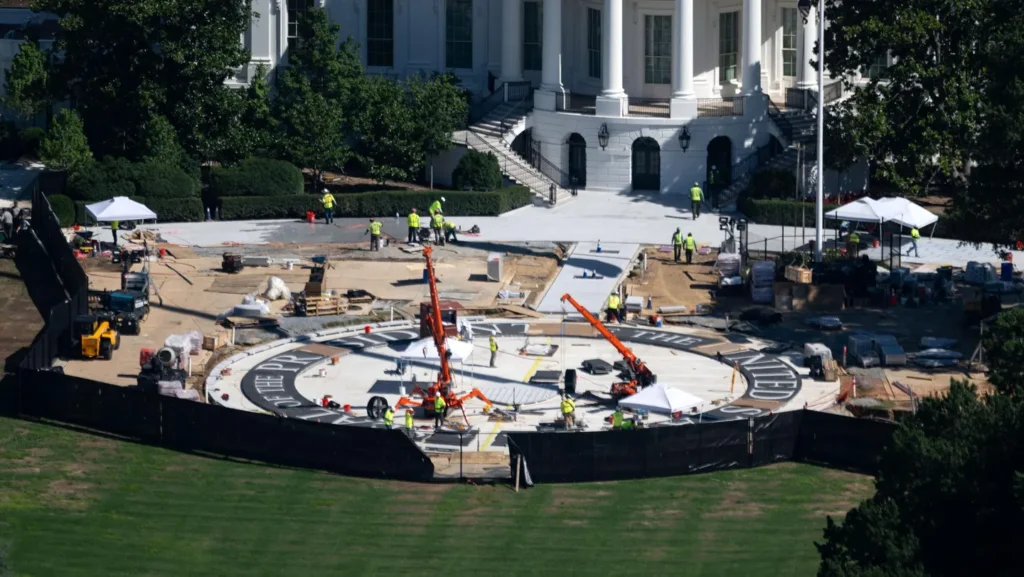
Why a Sloped Helipad Could Matter
Not every slope on a helipad would necessarily indicate faulty construction.
Helipads can be engineered with specific drainage and structural considerations.
However, the surface must meet strict requirements for safe helicopter operations.
A presidential landing facility also needs to account for factors including:
- Surface stability
- Drainage
- Load-bearing capacity
- Helicopter clearance
- Lighting
- Markings
- Emergency access
- Security
- Operational requirements
If the finished surface does not meet the required specifications, modifications could be necessary.
That is why determining whether the reported slope was intentional engineering or an unwanted construction issue will be important.
Weeks of Around-the-Clock Work
Another striking detail is the reported pace of construction.
The project has reportedly involved workers operating around the clock for weeks.
That level of activity reflects the unusual demands surrounding construction at the White House.
The presidential complex cannot be treated like a normal construction site.
Security restrictions, presidential movements, restricted access and operational requirements can complicate even relatively straightforward work.
Construction teams therefore have to coordinate their schedules around one of the most security-sensitive locations in the country.
Why the White House Needs a Helipad
The White House has long relied on Marine One and helicopter operations for presidential transportation.
The helipad provides a secure location for helicopter movements involving the president.
Because presidential helicopter operations can involve extremely tight schedules, the landing area needs to be ready for use whenever required.
That makes the quality of the facility particularly important.
A conventional construction mistake might be corrected at a later date.
A presidential landing facility faces a much higher operational standard.
Trump Has a Reputation for Personally Focusing on Construction Details
The helipad controversy also fits into a broader pattern associated with Trump’s long career in real estate and property development.
Trump has frequently presented himself as someone who pays close attention to architecture, construction, design and physical appearance.
That background helps explain why a seemingly small construction detail could become a presidential issue.
For Trump, the reported complaint was not simply about aesthetics.
It involved a physical feature of a facility located at the center of the presidential complex.
The Bigger White House Construction Story
The helipad project comes amid a period of significant construction activity involving the White House and surrounding federal property.
The Trump administration has pursued several highly visible projects and changes around the presidential complex.
Those projects have generated debate over:
- Government spending
- Construction contracts
- Preservation
- Security
- Presidential authority
- Architectural changes
- Public transparency
A recent letter from Sen. Richard Blumenthal to federal officials, for example, raised questions about several construction projects and contracts associated with the Trump administration.
The helipad episode is therefore arriving in an environment where White House construction decisions are already receiving substantial attention.
Could the Helipad Redo Cost More?
Possibly—but the final cost cannot be assumed from the current reports.
If the modifications involve only surface work, markings or drainage adjustments, the additional expense could be relatively limited.
If workers must remove and reconstruct a substantial portion of the facility, the cost could be considerably higher.
Other factors could also influence the final bill:
Labor
Materials
Security requirements
Engineering
Equipment
Scheduling
Restricted access to the White House grounds
Until officials release detailed figures, it would be premature to claim that the redo has added a specific amount to taxpayers’ costs.
Why the Story Is Going Viral
The story combines several elements that naturally generate strong public interest.
💰 The Cost
A reported multimillion-dollar helipad immediately attracts attention.
🏛️ The Location
It is being built at the White House.
🚁 The Presidential Connection
The facility is directly connected to presidential transportation.
🔧 The Redo
The project reportedly needs changes shortly after completion.
👤 Trump’s Personal Involvement
The president reportedly noticed the issue and ordered modifications.
Together, those details create a story that is unusual even by Washington standards.
What Is Confirmed and What Still Needs Clarification?
It is important to separate reported facts from assumptions.
Reported
- Trump was dissatisfied with the helipad.
- Changes have been ordered.
- Reports say he complained about the surface being slanted.
- Construction reportedly took place around the clock.
- The project has been reported at roughly $5 million.
Still unclear
- The exact engineering specification of the original surface.
- Whether the reported slope violated any safety requirement.
- The precise additional cost of the modifications.
- Whether the entire helipad will be reconstructed or only portions will be changed.
- Whether the final project cost will exceed the reported figure.
Those questions will likely become clearer as additional information emerges.
What Happens Next?
The immediate focus will be on the scope of the modifications.
If the problem is primarily cosmetic or related to drainage, the work could potentially be completed without rebuilding the entire landing area.
If engineers determine that the surface does not meet required operational standards, more extensive reconstruction could be necessary.
The final cost will also become an important part of the story.
For taxpayers and government-watchdog groups, the key question will be whether the reported changes represent a routine construction adjustment or an avoidable expense resulting from a problem with the original work.
Next Outlook
🟢 Best-Case Scenario
The changes are limited, the helipad quickly meets all operational requirements and the additional cost remains modest.
🟡 Most Likely Watch Point
Officials provide more information about why the surface was changed and whether the original slope was part of the design.
🔴 Biggest Concern
A major reconstruction increases the project’s cost substantially and triggers additional questions about planning, contracting and oversight.
Why This Matters Beyond the Helipad
At first glance, the story may appear to be nothing more than an unusual White House construction anecdote.
But government construction projects involve public resources.
That makes questions surrounding cost, contracting and oversight relevant even when the project itself is relatively small compared with the federal budget.
The White House is also a uniquely sensitive environment.
Every modification must balance presidential preferences with engineering requirements, security concerns, historic considerations and taxpayer-funded construction.
That combination makes even a seemingly simple helipad project unusually complicated.
Final Thoughts
Trump’s decision to order changes to the newly built White House helipad has turned an infrastructure project into a national political and spending story.
The reported complaint that the landing surface was slanted has prompted workers to modify the facility after weeks of intensive construction.
The reported $5 million price tag makes the episode particularly eye-catching, although the final cost of the modifications remains unclear.
For now, the most important questions are not simply whether the helipad looked right to Trump.
They are whether the original construction met its engineering requirements, why modifications became necessary and how much the changes will ultimately cost.
🔮 Next Outlook
Expect continued attention on the project as more details emerge about the engineering work, construction contracts and final price.
If the changes are completed quickly and without significant additional expense, the story could fade into the background.
If the redo becomes substantially more expensive, however, the White House helipad could become another flashpoint in the debate over presidential construction projects and government spending.
❓ FAQs
Why is Trump changing the White House helipad?
Reports say Trump was dissatisfied with the newly constructed helipad and complained that its surface was slanted.
How much did the White House helipad reportedly cost?
The project has been reported as costing approximately $5 million.
Was the helipad unsafe?
Current reporting does not establish that the helipad was unsafe. The precise engineering reason for the changes has not been fully detailed publicly.
Was the entire helipad rebuilt?
Reports indicate that changes are being made, but the full scope of the modifications has not been established.
Why does the White House need a helipad?
The facility supports presidential helicopter operations, including Marine One movements.
Will taxpayers pay for the additional work?
The project involves government property, but the precise funding and any additional cost resulting from the modifications need to be confirmed through official documentation.
Why is the story attracting so much attention?
The combination of a reported $5 million price tag, weeks of intensive construction, presidential involvement and a redo has made the project unusually newsworthy.
📰 About The Business Now
The Business Now covers U.S. politics, business, finance, technology, markets, infrastructure and major breaking news with factual reporting and context behind the headlines.
🪙 Check Live Gold Prices
Track Gold, Silver, Platinum and Palladium prices, historical charts, calculators and daily market updates at:
🌐 External Resources
Keep reading
Related Articles
 Commodities
Oil Nears $95: Could the Iran War Trigger a New U.S. Inflation Shock?
Oil at $95 Is Not the Real Story A crude-oil headline is easy to write: “Oil prices rise as Iran tensions escalate.” Reuters, Bloomberg, CNBC and WSJ can publish that story within minutes. But for TheBusinessNow, that isn’t enough. The bigger question is: What happens to the American economy if oil stays near $95 —...
 Economy
U.S. National Debt Hits $40 Trillion: Why Treasury Yields Are Rising Again
The $40 Trillion Number Is Not the Whole Story The United States has crossed a psychological and financial milestone. $40 trillion. But simply writing “America owes $40 trillion” misses the more important story. The real question for markets is: Who is willing to finance America’s growing debt — and at what interest rate? That question...
 Commodities
Strait of Hormuz Standoff: The Oil Shock That Could Hit the U.S. Economy Next
Strait of Hormuz Standoff: Why the Oil Market Is Getting Nervous Again The oil market is being forced to price a problem that seemed to be easing only weeks ago: the Strait of Hormuz is still not reliably functioning as a normal commercial shipping route. On August 19, Brent crude was trading around $91.20 a...
Comments (0)