
Trump’s ‘Pinky Herman’ Remark Goes Viral: How One Rally Comment Sparked a Political and Late-Night Comedy Storm
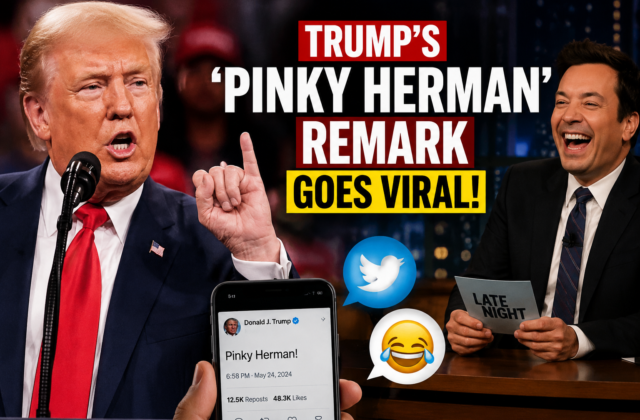
Trump’s ‘Pinky Herman’ Remark Goes Viral: How One Rally Comment Sparked a Political and Late-Night Comedy Storm Donald Trump once again found himself at the center of political headlines after a campaign rally in Georgia, where he referred to Democratic Senator Jon Ossoff using the nickname “Pinky Herman.” The remark quickly spread across social media,...
TheBusinessNow
Jul 24, 2026 · 3 min Read
Key Highlights
- 🇺🇸 Donald Trump's "Pinky Herman" remark at a Georgia rally quickly became a viral political story.
- 📱 The comment spread rapidly across social media and dominated political news coverage.
- 🎭 Late-night hosts including Jimmy Fallon and Seth Meyers incorporated the remark into their comedy monologues.
- 🗳️ The incident highlights how modern campaign moments can instantly shape national political conversations.
- 🌎 Georgia continues to play a central role in U.S. electoral politics, making campaign events there especially significant.
- 📺 The episode demonstrates the growing overlap between politics, entertainment, and viral online culture.
Trump’s ‘Pinky Herman’ Remark Goes Viral: How One Rally Comment Sparked a Political and Late-Night Comedy Storm
Donald Trump once again found himself at the center of political headlines after a campaign rally in Georgia, where he referred to Democratic Senator Jon Ossoff using the nickname “Pinky Herman.”
The remark quickly spread across social media, generating millions of online views and becoming the focus of commentary from political analysts, journalists, and late-night television hosts. Within hours, comedians including Jimmy Fallon and Seth Meyers incorporated the moment into their monologues, highlighting how campaign rhetoric increasingly shapes America’s political and media landscape.
While the nickname itself became the headline, the incident also underscored a broader reality: in today’s digital era, a single campaign remark can dominate news cycles almost instantly.
What Happened at the Georgia Rally?
During a political rally in Georgia, Trump criticized Senator Jon Ossoff while referring to him as “Pinky Herman.”
The unusual nickname immediately caught the audience’s attention and rapidly circulated online through video clips shared across multiple social media platforms.
Supporters viewed the comment as another example of Trump’s signature campaign style, while critics argued it distracted from substantive policy discussions.
Why Did the Comment Go Viral?
Several factors contributed to the rapid spread of the remark:
- Trump’s campaign events routinely attract significant media coverage.
- Short video clips perform exceptionally well on social media.
- Political nicknames often become viral discussion topics.
- The timing coincided with heightened political attention ahead of upcoming elections.
Within hours, the phrase became one of the most discussed political moments online.
Late-Night Television Responds
The incident quickly moved beyond political reporting.
Late-night comedy shows referenced the remark extensively.
According to published reports:
- Jimmy Fallon joked about the nickname during his opening monologue.
- Seth Meyers also discussed the rally while adding his own comedic interpretation.
This illustrates how modern political events increasingly become part of popular culture.
Trump’s Long History of Political Nicknames
Trump has frequently used memorable nicknames for political opponents throughout his political career.
Supporters often argue these labels make campaign messaging more memorable.
Critics contend that they personalize political disagreements and shift attention away from policy issues.
Regardless of perspective, such remarks consistently generate significant media attention.
Social Media Amplifies Political Moments
Unlike previous election cycles, today’s campaign moments spread almost instantly.
Short clips from rallies are frequently shared across:
- X
- TikTok
- YouTube
As a result, political messaging now reaches audiences far beyond those physically attending campaign events.
Why Political Communication Has Changed
Modern campaigns increasingly compete not only for votes but also for online attention.
Viral moments often receive more engagement than lengthy policy speeches.
Political strategists recognize that memorable moments can:
- Increase media coverage.
- Mobilize supporters.
- Dominate news cycles.
- Expand online visibility.
However, they can also intensify criticism and deepen political divisions.
The Georgia Political Context
Georgia remains one of the most closely watched battleground states in American politics.
Competitive Senate races and presidential elections have increased national attention on the state in recent election cycles.
Because of this, remarks made during Georgia campaign events often receive heightened national coverage.
Reactions Across the Political Spectrum
Responses varied significantly.
Supporters
Many supporters viewed the comment as classic Trump campaign humor and evidence of his unconventional political communication style.
Critics
Opponents argued the nickname reflected increasingly personal political rhetoric and diverted attention from policy debates.
Political Observers
Analysts noted that regardless of opinion, the incident successfully dominated political headlines.
Media Attention Beyond Politics
The story expanded well beyond traditional political reporting.
Coverage appeared across:
- Political news outlets
- Entertainment media
- Comedy programs
- Social media influencers
- Opinion columns
This demonstrates how modern political communication frequently intersects with entertainment.
Why This Matters
Although the nickname itself may not influence public policy, the episode highlights larger trends in contemporary politics:
- Campaign messaging increasingly competes for viral attention.
- Social media accelerates political narratives.
- Entertainment and politics continue to overlap.
- Public figures face immediate national scrutiny for every major statement.
In today’s media environment, even a brief campaign remark can shape public conversation for days.
Final Analysis
Donald Trump’s “Pinky Herman” remark at a Georgia rally became one of the day’s most widely discussed political moments, illustrating how campaign events increasingly extend beyond traditional political audiences. While supporters saw the nickname as characteristic campaign rhetoric and critics viewed it as another example of highly personalized political discourse, both sides acknowledged the enormous attention it generated.
The episode also reflects a broader transformation in political communication. Social media, 24-hour news coverage, and late-night comedy now amplify campaign moments almost instantly, often turning a single remark into a national conversation. As the election season continues, viral moments like this are likely to remain an influential part of America’s political landscape, shaping headlines as much as policy proposals.
❓ Frequently Asked Questions (FAQs)
1. What did Donald Trump say at the Georgia rally?
During a campaign rally in Georgia, Donald Trump referred to Senator Jon Ossoff with the nickname “Pinky Herman,” a remark that quickly gained widespread attention online and in the media.
2. Why did the “Pinky Herman” comment go viral?
The comment spread rapidly because short clips from Trump’s rallies often receive millions of views on social media and become topics of discussion among political commentators and late-night television hosts.
3. How did late-night hosts react?
Television personalities including Jimmy Fallon and Seth Meyers referenced the remark during their monologues, adding comedy commentary to the political moment.
4. Who is Jon Ossoff?
Jon Ossoff is a Democratic U.S. Senator representing Georgia and has been a frequent political opponent of Donald Trump.
5. Why are campaign nicknames important in politics?
Political nicknames often attract media attention, become memorable among supporters and critics, and can dominate news cycles, although they also generate debate about political discourse.
6. Does this incident have any effect on policy?
The remark itself does not affect government policy, but it illustrates how campaign messaging can shape media coverage and public conversation during an election season.
7. Why is Georgia politically significant?
Georgia remains one of America’s most closely watched battleground states, making campaign events there especially important for national political coverage.
🌍 About The Business Now
The Business Now delivers trusted coverage of:
- 🌎 Global Politics & Elections
- 📈 Financial Markets
- 💼 Business & Economy
- 🌍 Geopolitics
- 🤖 AI & Technology
- 🛢️ Gold, Oil & Commodities
- 🏀 Sports & Global Events
We provide fact-based journalism, market intelligence, and in-depth analysis to help readers understand the stories shaping business, politics, technology, and the global economy.
The Business Now — Global News. Business Intelligence. Market Insights.
Keep reading
Related Articles
 Commodities
Oil Nears $95: Could the Iran War Trigger a New U.S. Inflation Shock?
Oil at $95 Is Not the Real Story A crude-oil headline is easy to write: “Oil prices rise as Iran tensions escalate.” Reuters, Bloomberg, CNBC and WSJ can publish that story within minutes. But for TheBusinessNow, that isn’t enough. The bigger question is: What happens to the American economy if oil stays near $95 —...
 Economy
U.S. National Debt Hits $40 Trillion: Why Treasury Yields Are Rising Again
The $40 Trillion Number Is Not the Whole Story The United States has crossed a psychological and financial milestone. $40 trillion. But simply writing “America owes $40 trillion” misses the more important story. The real question for markets is: Who is willing to finance America’s growing debt — and at what interest rate? That question...
 Commodities
Strait of Hormuz Standoff: The Oil Shock That Could Hit the U.S. Economy Next
Strait of Hormuz Standoff: Why the Oil Market Is Getting Nervous Again The oil market is being forced to price a problem that seemed to be easing only weeks ago: the Strait of Hormuz is still not reliably functioning as a normal commercial shipping route. On August 19, Brent crude was trading around $91.20 a...
Comments (0)