
Trump Approves Historic Saudi Nuclear Deal: Strategic Breakthrough or Regional Gamble?
Trump Approves Historic Saudi Nuclear Deal: Strategic Breakthrough or Regional Gamble? The geopolitical landscape of the Middle East may be entering a new chapter. President Donald Trump has approved a landmark civilian nuclear cooperation agreement with Saudi Arabia, a move that supporters describe as a strategic breakthrough for U.S.-Saudi relations but critics warn could reshape...
TheBusinessNow
Jul 23, 2026 · 2 min Read
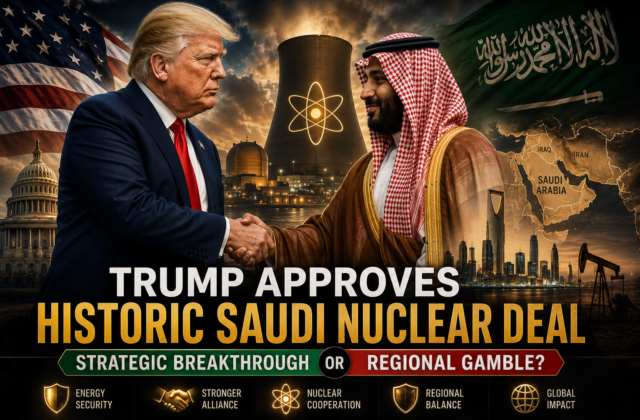
Key Highlights
- 🇺🇸 President Trump has approved a framework for civilian nuclear cooperation with Saudi Arabia.
- ⚛️ The agreement is intended to support Saudi Arabia's peaceful nuclear energy ambitions under Vision 2030.
- 🌍 Supporters see the deal as a strategic opportunity to deepen U.S.-Saudi ties and strengthen oversight of nuclear development.
- ⚠️ Critics warn the agreement could alter regional security dynamics and encourage greater nuclear competition in the Middle East.
- 🛢️ The deal could have long-term implications for energy markets, infrastructure investment, and global geopolitics.
- 📊 Investors are watching defense, nuclear technology, engineering, and energy sectors for potential opportunities arising from future implementation.
Trump Approves Historic Saudi Nuclear Deal: Strategic Breakthrough or Regional Gamble?
The geopolitical landscape of the Middle East may be entering a new chapter.
President Donald Trump has approved a landmark civilian nuclear cooperation agreement with Saudi Arabia, a move that supporters describe as a strategic breakthrough for U.S.-Saudi relations but critics warn could reshape the region’s fragile security balance.
The proposed agreement is designed to help Saudi Arabia develop a civilian nuclear energy program with American support. However, the announcement has sparked an intense debate in Washington and abroad over whether it could encourage a wider regional competition in nuclear capabilities.
For investors, diplomats, and energy markets, the implications extend far beyond electricity generation.
What Is the Agreement?
The agreement aims to establish a framework for civilian nuclear cooperation between the United States and Saudi Arabia.
According to U.S. officials and media reports, discussions include cooperation on:
- Civilian nuclear reactors
- Nuclear fuel management
- Scientific research
- Technology transfer
- Energy diversification
- Long-term strategic cooperation
Supporters argue that American participation would provide stronger oversight and higher safety standards than if Saudi Arabia turned to alternative partners.
Why Saudi Arabia Wants Nuclear Energy
Saudi Arabia has ambitious economic goals under Vision 2030.
The Kingdom wants to reduce its dependence on oil by investing in:
- Renewable energy
- Nuclear electricity generation
- Hydrogen production
- Advanced manufacturing
- Artificial intelligence
- Smart cities
Although Saudi Arabia remains one of the world’s largest oil exporters, using nuclear power for domestic electricity could allow more crude oil to be exported instead of consumed at home.
Why the Deal Is So Controversial
The biggest concern is not nuclear electricity itself.
Rather, the debate focuses on nuclear fuel-cycle capabilities, particularly uranium enrichment.
Several lawmakers and non-proliferation experts have warned that allowing enrichment capabilities without strong safeguards could increase long-term proliferation risks, even if the current program is intended for peaceful purposes.
Supporters argue that any agreement should include robust monitoring under international nuclear standards.
Fears of a Regional Arms Race
Critics warn that the agreement could influence strategic calculations across the Middle East.
Countries such as:
- Iran
- Turkey
- Egypt
- United Arab Emirates
may closely watch how Saudi Arabia’s nuclear program develops.
Some analysts fear that if multiple regional powers pursue advanced nuclear capabilities simultaneously, security competition could intensify.
At present, these concerns are forward-looking scenarios, not confirmed outcomes.
What Does This Mean for Iran?
The agreement arrives during a period of continued regional rivalry between Saudi Arabia and Iran.
Although diplomatic relations have improved compared with previous years, strategic competition continues over:
- Regional influence
- Maritime security
- Missile programs
- Proxy conflicts
- Energy security
Any significant shift in Saudi Arabia’s strategic capabilities is likely to be closely monitored by Tehran.
Israel’s Perspective
Israel has traditionally supported efforts to prevent nuclear weapons proliferation across the Middle East while maintaining close security cooperation with the United States.
Some analysts believe Washington will seek to ensure that any civilian nuclear cooperation with Saudi Arabia includes safeguards designed to maintain regional stability.
Why the United States Supports the Deal
Supporters inside Washington argue that engaging directly gives the United States greater influence over how Saudi Arabia develops its nuclear sector.
Officials also point to broader strategic objectives:
- Strengthening U.S.-Saudi relations
- Expanding American energy exports
- Supporting U.S. nuclear technology companies
- Countering growing Chinese and Russian influence
- Maintaining long-term regional partnerships
Could China and Russia Lose Influence?
The global competition for civilian nuclear projects has intensified.
Both China and Russia have expanded international nuclear cooperation through reactor exports and infrastructure financing.
By participating in Saudi Arabia’s nuclear development, the United States aims to remain a leading strategic partner in one of the world’s most important energy-producing regions.
Economic Implications
The agreement could have economic implications beyond geopolitics.
Potential beneficiaries include:
- Nuclear engineering firms
- Infrastructure companies
- Energy technology providers
- Construction contractors
- Advanced manufacturing companies
Long-term projects of this scale typically involve billions of dollars in investment over many years.
What Could It Mean for Oil Markets?
The agreement is unlikely to have an immediate impact on global oil production.
However, over the long term, if Saudi Arabia generates more domestic electricity from nuclear energy, it could free additional crude oil for export.
Whether this meaningfully affects global oil prices will depend on future production decisions, demand trends, and broader market conditions.
Investors Are Watching Closely
Financial markets are monitoring several sectors:
- Energy
- Nuclear technology
- Defense
- Infrastructure
- Engineering
- Industrial manufacturing
Investors are also assessing how the agreement may influence broader geopolitical stability, which can affect commodity prices and market sentiment.
What Happens Next?
Several steps remain before the agreement reaches full implementation.
Key issues include:
- Congressional review
- Final legal framework
- International Atomic Energy Agency (IAEA) safeguards
- Technical agreements
- Regulatory approvals
- Long-term implementation plans
The ultimate structure of the cooperation will determine how many of today’s concerns materialize.
Final Analysis
President Trump’s approval of a landmark civilian nuclear cooperation agreement with Saudi Arabia represents one of the most significant strategic developments in Middle East diplomacy in recent years.
Supporters view the agreement as an opportunity to strengthen a key alliance, support Saudi Arabia’s economic transformation, and ensure that any nuclear development proceeds under strong international oversight. Critics, meanwhile, argue that the deal raises important questions about regional security, nuclear proliferation, and the possibility of a future arms competition in an already volatile region.
At this stage, the agreement concerns civilian nuclear cooperation, not the development of nuclear weapons. Its long-term impact will depend on the final legal framework, international safeguards, and how regional powers respond in the years ahead.
Whether history remembers this as a strategic breakthrough or a regional gamble will depend less on today’s announcement than on how the agreement is implemented—and how the Middle East evolves around it.
❓ Frequently Asked Questions (FAQs)
1. What is the U.S.-Saudi nuclear deal?
The proposed agreement establishes a framework for civilian nuclear cooperation between the United States and Saudi Arabia. It is intended to support Saudi Arabia’s peaceful nuclear energy ambitions while remaining subject to legal, regulatory, and international safeguards.
2. Does the deal allow Saudi Arabia to build nuclear weapons?
No. The reported agreement concerns civilian nuclear energy, not nuclear weapons. Any implementation would be expected to involve oversight and safeguards under international nuclear non-proliferation frameworks.
3. Why does Saudi Arabia want nuclear energy?
Saudi Arabia aims to diversify its economy under Vision 2030, reduce domestic oil consumption for electricity generation, expand clean energy sources, and support long-term industrial development.
4. Why are some U.S. lawmakers concerned?
Some lawmakers and non-proliferation experts have expressed concerns about nuclear fuel-cycle capabilities, regional security, and the possibility that the agreement could encourage other countries in the Middle East to pursue similar nuclear programs.
5. How could this affect the Middle East?
Supporters believe the agreement could strengthen strategic partnerships and energy cooperation, while critics warn it may influence the regional security balance and increase geopolitical competition.
6. Will the deal affect global oil prices?
There is unlikely to be an immediate impact. Over the long term, increased domestic nuclear power generation in Saudi Arabia could reduce domestic oil use, potentially allowing more crude to be exported. Oil prices will still depend on global supply, demand, and geopolitical developments.
7. What happens next?
The agreement is expected to undergo additional legal, political, and regulatory processes, including discussions on safeguards, implementation, and any required approvals before major projects move forward.
🌐 About The Business Now
The Business Now is an independent global business, finance, and geopolitics publication delivering fact-based reporting, market insights, and in-depth analysis on the stories shaping economies and markets worldwide.
We cover:
- 🌍 Global Geopolitics
- 📈 Stock Markets & Investing
- 🛢️ Oil, Gold & Commodities
- 💹 Macroeconomics & Central Banks
- 🚀 Technology & Artificial Intelligence
- 🏛️ International Business & Policy
The Business Now — Where Global News Meets Market Intelligence.
🟡 Check Live Gold Prices
Track live 24K, 22K, and 18K gold prices, market trends, charts, and gold calculators at:

Keep reading
Related Articles
 Commodities
Oil Nears $95: Could the Iran War Trigger a New U.S. Inflation Shock?
Oil at $95 Is Not the Real Story A crude-oil headline is easy to write: “Oil prices rise as Iran tensions escalate.” Reuters, Bloomberg, CNBC and WSJ can publish that story within minutes. But for TheBusinessNow, that isn’t enough. The bigger question is: What happens to the American economy if oil stays near $95 —...
 Economy
U.S. National Debt Hits $40 Trillion: Why Treasury Yields Are Rising Again
The $40 Trillion Number Is Not the Whole Story The United States has crossed a psychological and financial milestone. $40 trillion. But simply writing “America owes $40 trillion” misses the more important story. The real question for markets is: Who is willing to finance America’s growing debt — and at what interest rate? That question...
 Commodities
Strait of Hormuz Standoff: The Oil Shock That Could Hit the U.S. Economy Next
Strait of Hormuz Standoff: Why the Oil Market Is Getting Nervous Again The oil market is being forced to price a problem that seemed to be easing only weeks ago: the Strait of Hormuz is still not reliably functioning as a normal commercial shipping route. On August 19, Brent crude was trading around $91.20 a...
Comments (0)