
World Cup for Sale? FIFA’s Billion-Dollar Stake Plan Triggers a Massive Football Backlash
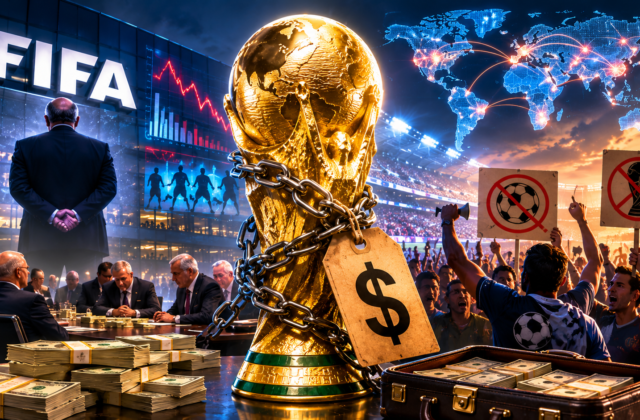
World Cup for Sale? FIFA’s Billion-Dollar Stake Plan Triggers a Massive Football Backlash FIFA has triggered a major new battle over the future of football after unveiling plans to bring private investors into a new $20 billion commercial subsidiary that would manage the business and event operations surrounding the World Cup and other FIFA competitions....
TheBusinessNow
Jul 30, 2026 · 4 min Read
Key Highlights
- ⚽ FIFA plans to create a $20 billion commercial subsidiary linked to the World Cup.
- 💰 The organization could raise up to $4.2 billion from outside investors.
- 📊 Investors could receive minority, non-controlling stakes of up to 20%.
- 🔥 UEFA has fiercely criticized the proposal and says football's “soul” should not be traded.
- 🌍 FIFA says the money would fund grassroots football, infrastructure, women's football and national teams.
- 🏦 J.P. Morgan is working with FIFA on the proposed capital raise.
- 👔 Thrive Eternal, founded by Joshua Kushner, is expected to lead the proposed investor group.
World Cup for Sale? FIFA’s Billion-Dollar Stake Plan Triggers a Massive Football Backlash
FIFA has triggered a major new battle over the future of football after unveiling plans to bring private investors into a new $20 billion commercial subsidiary that would manage the business and event operations surrounding the World Cup and other FIFA competitions.
The proposal, known as FIFA Forward Enterprise (FFE), could raise as much as $4.2 billion by selling minority, non-controlling stakes of up to 20% to outside investors. FIFA says the money would be reinvested into football development worldwide. But UEFA and several football leaders have reacted angrily, arguing that the sport’s most important competitions should not become financial assets for private investors.
What Is FIFA Actually Trying to Sell?
The headline “World Cup for Sale” is attention-grabbing, but the structure is more complicated.
FIFA is not proposing to sell the World Cup itself or hand control of the tournament to a private company.
Instead, FIFA wants to create a new subsidiary called FIFA Forward Enterprise.
The company would consolidate FIFA’s commercial and event operations, including areas such as broadcasting, sponsorship, ticketing, licensing and tournament operations.
FIFA says it would retain control of the subsidiary and maintain exclusive authority over football governance, competitions, the international match calendar and sporting decisions.
However, outside investors would be allowed to purchase minority interests in the company.
That is the part that has triggered the backlash.
How Much Money Is FIFA Trying to Raise?
The proposed FIFA Forward Enterprise has an initial equity valuation of approximately $20 billion.
FIFA says it could raise up to $4.2 billion by selling minority, non-controlling stakes to long-term investors.
The money would then be used to expand football development funding.
FIFA says the new structure could help push total planned football-development funding above $10 billion over four years.
That would make the proposal one of the biggest commercial financing initiatives ever attempted by a sports governing organization.
Why Is UEFA So Angry?
UEFA has emerged as one of the strongest opponents of the proposal.
European football’s governing body argued that FIFA’s plan crosses a line by treating aspects of football’s commercial value as an investment opportunity.
UEFA questioned the transparency surrounding who would financially benefit from the arrangement and warned that football’s governance should not be treated as an asset for investors.
The criticism is significant because this is not simply a disagreement between two sports organizations.
It represents a deeper conflict over who controls football’s enormous commercial ecosystem.
FIFA Says It Is Not Selling Control
FIFA has strongly defended the proposal.
The organization says outside investors would have only minority positions and would have no operational role.
FIFA would maintain majority board representation and retain control over:
- World Cup competitions
- Football governance
- Sporting regulations
- International match calendars
- Tournament decisions
- Other regulatory matters
In other words, FIFA’s argument is that investors would be purchasing an economic interest in the commercial enterprise — not control over football itself.
That distinction is central to FIFA’s defense.
Where Would the Billion-Dollar Funding Go?
FIFA says the proposed investment would ultimately benefit football development around the world.
Under the plan, each of FIFA’s 211 member associations could receive access to additional funding.
The organization says the FIFA Fast Forward Programme could provide up to $20 million per member association for projects including:
🏟️ Stadiums and facilities
🏋️ Training centers
⚽ Grassroots football
👩 Women’s football
🧑🏫 Coaching
🌎 National-team development
🏆 Competitions
FIFA says the funding would increase during subsequent development cycles.
Who Could Invest in FIFA’s New Enterprise?
The proposed investor group is attracting almost as much attention as the structure itself.
FIFA says Thrive Eternal, a permanent-capital investment vehicle founded by Joshua Kushner, is expected to lead the proposed investor group.
J.P. Morgan has also been engaged to work with FIFA on the process.
Former Liberty Media CEO Greg Maffei, who was involved in the commercial development of Formula One, has served as a key adviser.
FIFA says it wants a geographically diversified group of long-term investors.
Why the Joshua Kushner Connection Is Getting Attention
Joshua Kushner’s involvement has added another layer of political and business interest to the story.
Kushner is the brother of Jared Kushner, who is Donald Trump’s son-in-law.
Reuters reported that Jared Kushner is not a potential investor in the proposed FIFA enterprise.
Nevertheless, the connection has inevitably attracted scrutiny because FIFA has recently faced questions surrounding its relationship with powerful political and business figures in the United States.
The investment proposal itself, however, should not be presented as being controlled by the Trump family.
Why Critics Say the World Cup Is Different
The biggest argument against FIFA’s proposal is not simply financial.
Critics believe the World Cup represents something larger than a conventional commercial property.
Unlike a private sports franchise, the World Cup involves national teams, governments, supporters and football associations from around the world.
That creates a difficult question:
Can the commercial value generated by the World Cup be partially owned by private investors without changing the character of the competition?
FIFA says the answer is yes because it would retain sporting control.
Critics are far less convinced.
Is FIFA Selling the World Cup?
Not literally.
FIFA’s current proposal is to sell minority stakes in FIFA Forward Enterprise, the planned commercial subsidiary that would handle FIFA’s commercial and event operations.
FIFA would retain control.
However, because the new enterprise would be closely connected to the commercial business surrounding the World Cup and other major tournaments, critics have described the proposal as effectively putting a financial stake in the World Cup ecosystem up for sale.
That distinction is important when reporting the story accurately.
Why FIFA Says It Needs the Money
FIFA’s argument is based on growth.
The organization believes the commercial value of global football can be expanded substantially through more sophisticated management of:
- Broadcasting rights
- Sponsorship
- Ticketing
- Licensing
- Digital content
- Global tournament operations
FIFA says that unlocking more commercial value would allow it to send significantly more money to football associations around the world.
The organization has described the plan as a way to “democratise” football funding by giving smaller and less wealthy football nations greater access to investment.
Why the Timing Is So Important
The proposal arrives immediately after the 2026 FIFA World Cup, which was staged across the United States, Canada and Mexico.
The tournament was expanded to 48 teams and became the largest World Cup in history.
FIFA says nearly 16 million fans attended stadiums and fan festivals, while billions watched worldwide.
That enormous global audience demonstrates why the commercial value of FIFA’s tournaments is so attractive to investors.
But it also makes the governance question more sensitive.
Could This Change Football Forever?
Potentially.
If FIFA successfully creates the enterprise and raises billions from private investors, it could establish a new model for how global sports organizations finance their operations.
Other major sports have already created commercial structures designed to unlock the value of media rights, sponsorships and events.
FIFA now appears to be attempting something similar on a global scale.
The difference is that the World Cup is arguably the most powerful sporting event on Earth.
That makes the consequences of commercialization much larger.
The Business Side of the World Cup
From a business perspective, the proposal is fascinating.
The World Cup generates enormous revenues through:
📺 Broadcasting rights
🤝 Sponsorship agreements
🎟️ Ticketing
🛍️ Licensing
📱 Digital content
🏟️ Hospitality
🌎 Global marketing
FIFA is effectively arguing that these assets can generate even more value if managed through a dedicated commercial enterprise.
For investors, that could create exposure to one of the world’s most recognizable sports brands.
For football associations, it could mean billions of dollars in additional development funding.
For supporters, however, the concern is whether commercialization could eventually influence decisions that have traditionally been treated as part of the sporting world.
What Happens Next?
The proposal still needs approval.
FIFA says the new structure is subject to support from a majority of its 211 member associations, along with approval from the FIFA Council and relevant regulatory changes.
That means the plan is not yet a completed transaction.
The coming weeks could therefore become crucial as national football associations assess whether the proposed financial benefits outweigh the governance concerns.
UEFA’s opposition could also intensify the political battle inside world football.
Why Investors Are Watching
This story is not only about football.
It is also a major sports-finance story.
A successful FIFA commercial subsidiary could create a new billion-dollar investment vehicle connected to some of the world’s most valuable sporting properties.
It could also demonstrate how nonprofit or governing organizations can monetize commercial rights without surrendering sporting control.
The outcome could influence other sports organizations considering similar structures.
The Bigger Picture
The FIFA controversy ultimately comes down to one question:
Who owns the commercial value of global football?
FIFA believes it has a responsibility to unlock that value and redistribute more money throughout the sport.
UEFA and other critics fear that opening the door to private investors could fundamentally change the relationship between football’s governing bodies, its supporters and its commercial partners.
For now, FIFA insists that nothing about football’s sporting governance is being sold.
But the proposed $20 billion enterprise has already opened one of the biggest financial and political debates in world football.
Conclusion
The World Cup is not literally being sold, but FIFA’s plan to create a $20 billion FIFA Forward Enterprise and sell minority stakes worth up to $4.2 billion has triggered an extraordinary backlash across football.
FIFA says the initiative would unlock commercial value and generate more than $10 billion in football-development funding, benefiting national associations, grassroots programs, infrastructure and women’s football.
Critics see something very different: a dangerous step toward turning football’s greatest competition into an investment asset.
The final decision will depend on FIFA’s member associations and governing bodies.
But one thing is already clear:
The battle over who controls the business of the World Cup has only just begun.
❓ FAQs
Is FIFA selling the World Cup?
No. FIFA is proposing to sell minority stakes in a new commercial subsidiary called FIFA Forward Enterprise, which would manage commercial and event operations. FIFA says it would retain control of football governance and sporting decisions.
How much is FIFA Forward Enterprise worth?
FIFA has proposed an initial equity valuation of approximately $20 billion.
How much money could FIFA raise?
The proposed enterprise could raise up to $4.2 billion through minority investments from external investors.
Why is UEFA opposing FIFA’s plan?
UEFA has criticized the proposal over concerns about commercialization, transparency and the potential treatment of football’s governance and identity as financial assets.
Who could invest in FIFA Forward Enterprise?
FIFA says Thrive Eternal, founded by Joshua Kushner, is expected to lead the proposed investor group, while J.P. Morgan is working with FIFA on the capital-raising process.
Will private investors control the World Cup?
According to FIFA, no. The organization says investors would hold only minority, non-controlling interests and would have no operational role. FIFA would retain authority over sporting and governance decisions.
Where would the money go?
FIFA says the money would support football development, including infrastructure, coaching, national teams, competitions, grassroots football and women’s football.
📰 About The Business Now
The Business Now delivers coverage of global business, sports, finance, technology, markets and trending world news with fact-based reporting and analysis.
🪙 Check Live Gold Prices
Track Gold, Silver, Platinum and Palladium prices, historical charts, calculators and daily market updates at:
🌐 External Resources
Keep reading
Related Articles
 Crypto
₿ Bitcoin Breaks Above $72,000: Why Trump’s Crypto Push Is Sending Crypto Stocks Higher
Bitcoin’s $72,000 Move Is Bigger Than Bitcoin A typical crypto headline would be: Bitcoin jumps above $72,000. But that misses the most important part of today’s move. The interesting part is the simultaneous rally in: Bitcoin ↓ Coinbase ↓ Strategy ↓ Circle ↓ Robinhood ↓ Bitcoin miners ↓ Crypto infrastructure That tells us investors aren’t...
 Markets
U.S. Treasury Doubles Bond Buybacks: Why Markets Are Still Worried About Rising Yields
The Treasury Just Sent Two Messages to Wall Street At first glance, this looks like a straightforward market-support operation. Treasury says: We want to improve liquidity in longer-dated Treasury securities. Investors hear: Washington is increasingly concerned about the rise in long-term borrowing costs. And that second interpretation is what makes this story important. The Treasury...
 Commodities
Oil Nears $95: Could the Iran War Trigger a New U.S. Inflation Shock?
Oil at $95 Is Not the Real Story A crude-oil headline is easy to write: “Oil prices rise as Iran tensions escalate.” Reuters, Bloomberg, CNBC and WSJ can publish that story within minutes. But for TheBusinessNow, that isn’t enough. The bigger question is: What happens to the American economy if oil stays near $95 —...
Comments (0)