
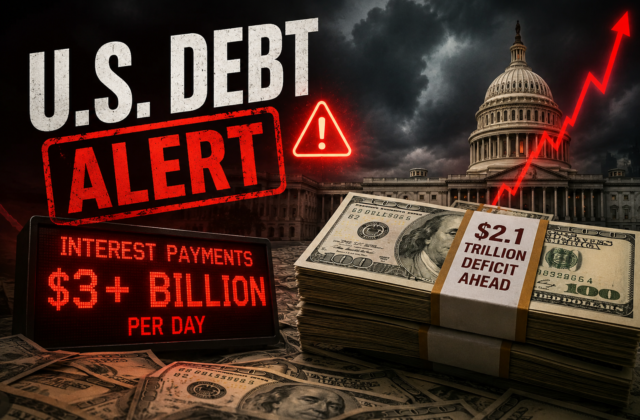
U.S. Debt Alert: Treasury Is Paying More Than $3 Billion a Day in Interest as Deficit Heads Toward $2.1 Trillion
U.S. Debt Alert: Treasury Is Paying More Than $3 Billion a Day in Interest as Deficit Heads Toward $2.1 Trillion America’s fiscal picture is coming under renewed pressure as the federal government faces rapidly rising interest costs and another enormous annual deficit. New Congressional Budget Office figures show that net interest on debt held by...
Linda
Aug 11, 2026 · 3 min Read
Key Highlights
- 🇺🇸 Net interest on U.S. public debt reached about $963 billion through July 2026, according to figures reported from the latest CBO budget update.
- 💰 That works out to approximately $3.18 billion per day over the first 10 months of fiscal 2026.
- 📈 Interest costs were reported to be about $117 billion higher, or roughly 14% above the comparable period a year earlier.
- 🔴 The federal deficit reached approximately $1.8 trillion during the first 10 months of fiscal 2026.
- 📊 The CBO has reportedly raised its full-year deficit projection to approximately $2.1 trillion.
- 🏦 CBO's February baseline projected $1.0 trillion in net interest outlays for 2026 and $2.1 trillion by 2036.
U.S. Debt Alert: Treasury Is Paying More Than $3 Billion a Day in Interest as Deficit Heads Toward $2.1 Trillion
America’s fiscal picture is coming under renewed pressure as the federal government faces rapidly rising interest costs and another enormous annual deficit. New Congressional Budget Office figures show that net interest on debt held by the public reached about $963 billion through the first 10 months of fiscal 2026—an average of roughly $3.2 billion per day. At the same time, the CBO has raised its projected full-year deficit to about $2.1 trillion.
The numbers matter because the United States is not only borrowing to finance existing spending. A growing portion of federal resources is now being directed toward servicing debt accumulated in previous years.
That creates a difficult fiscal cycle: larger deficits require more borrowing, more borrowing increases debt, and higher interest rates can make refinancing that debt increasingly expensive.
The CBO’s February baseline had projected $1.0 trillion in net interest outlays for fiscal 2026, rising to $2.1 trillion by 2036.
The latest reporting indicates the 2026 deficit is now tracking higher than that earlier baseline.
💰 The $3 Billion-a-Day Problem Explained
The headline number is eye-catching:
More than $3 billion a day.
But this is an average, not a literal Treasury payment made at exactly the same amount every 24 hours.
The figure comes from dividing cumulative net interest costs over the fiscal year by the number of days covered.
According to reporting on the latest CBO figures, net interest on debt held by the public reached approximately $963 billion between October 2025 and July 2026.
That translates to roughly:
$96.3 billion per month
or approximately:
$3.18 billion per day.
The important point is not the daily arithmetic.
It is the direction of travel.
Interest costs are becoming one of the largest items in the federal budget.
📈 Why U.S. Debt Interest Is Rising
There are two major forces behind the increase.
1. The government owes more money
When the federal government consistently spends more than it collects in revenue, it must borrow to cover the difference.
That increases the stock of debt on which interest must eventually be paid.
2. Borrowing costs remain significant
Treasury securities are issued at different maturities and interest rates.
When older debt matures, the government has to refinance it.
If new borrowing occurs at higher rates than the debt being replaced, interest costs can increase.
The CBO specifically identifies debt held by the public and the average interest rate on that debt as the main determinants of net interest costs.
🧮 The Deficit Is Heading Toward Another $2 Trillion Year
Interest is only one side of the problem.
The federal government is also running a massive budget deficit.
The latest reporting puts the fiscal 2026 deficit projection at roughly $2.1 trillion, above the CBO’s earlier February estimate.
That means Washington is still expected to borrow heavily even before considering the longer-term debt trajectory.
For perspective, CRFB estimated that the government had accumulated a $1.8 trillion rolling deficit over the 12 months through June 2026.
The July update therefore matters because it provides another indication of whether the fiscal gap is widening or narrowing.
🔥 Spending Is Outpacing Revenue
A deficit exists when government spending exceeds government revenue.
The problem becomes harder to manage when spending grows faster than revenues.
CRFB’s June analysis showed that over the preceding 12 months:
- Federal revenue was approximately $5.4 trillion.
- Federal spending was approximately $7.2 trillion.
- The resulting rolling deficit was about $1.8 trillion.
That gap represents the amount the government needs to finance through borrowing and other financing mechanisms.
The July figures are therefore being closely watched because they provide another snapshot of the government’s fiscal trajectory.
🏦 Why Interest Costs Can Become a Fiscal Feedback Loop
This is perhaps the most important part of the story.
Imagine the government has a large deficit.
It borrows to finance that deficit.
The new borrowing increases the amount of debt outstanding.
That debt generates additional interest expense.
If the government doesn’t generate enough additional revenue or reduce other spending, it may need to borrow again.
That can create a feedback loop:
Deficit → More Borrowing → More Debt → More Interest → Higher Spending → Potentially Larger Deficit
This doesn’t mean the United States is automatically heading toward a fiscal crisis.
But it explains why economists and investors pay close attention to the trajectory.
📊 CBO’s Long-Term Warning Is Even Bigger
The immediate $963 billion figure is only part of the story.
The CBO’s 2026–2036 Budget and Economic Outlook projects that net interest costs will increase at an average annual rate of 7.5%.
Under that baseline, net interest outlays rise from approximately:
$1.0 trillion in 2026
to
$2.1 trillion in 2036.
CBO estimates that interest costs would rise from about 3.3% of GDP in 2026 to 4.6% in 2036.
That is why today’s interest bill is being viewed as more than a one-year budget problem.
📉 What Happens If Interest Rates Stay High?
Higher Treasury yields can eventually feed into the federal government’s interest bill.
The effect is not instantaneous because the government has a large portfolio of existing debt issued at different rates and maturities.
But as securities mature, they must be refinanced.
If refinancing occurs at higher yields, the government’s average borrowing cost can gradually rise.
CBO’s baseline estimates an average interest rate on debt held by the public of approximately 3.4% in 2026, with that rate generally rising later in the projection period.
This is one reason Federal Reserve policy matters to fiscal policy even though the Fed and Treasury have different responsibilities.
🏛️ Why the Federal Reserve Matters
The Federal Reserve does not set the interest rate on every Treasury security.
However, monetary policy strongly influences short-term interest rates and affects financial conditions across the economy.
When inflation remains persistent, the Fed may need to keep policy restrictive for longer.
When inflation falls sufficiently, policymakers may have room to reduce rates.
For the Treasury, lower market rates can eventually reduce the cost of refinancing some debt.
But there is an important time lag.
A Federal Reserve rate cut does not instantly reduce the interest cost on the entire national debt.
📈 What This Could Mean for Treasury Yields
The government’s borrowing requirements are closely watched by bond investors.
When Treasury supply is large, investors consider whether yields adequately compensate them for:
- interest-rate risk;
- inflation risk;
- fiscal risk;
- and the opportunity cost of holding government debt.
The Treasury is currently auctioning substantial amounts of debt, with this week’s schedule including $58 billion of three-year notes, $42 billion of 10-year notes and $25 billion of 30-year bonds, according to Barron’s reporting.
Strong demand can help absorb supply.
Weak demand can put upward pressure on yields.
📉 What Does This Mean for Stocks?
The relationship between federal debt and stocks is not straightforward.
A rising deficit does not automatically mean stocks will fall.
However, persistently high Treasury yields can affect equity valuations.
Why?
Because investors compare the expected return from stocks with the relatively lower-risk return available from government bonds.
If Treasury yields rise substantially, investors may demand higher returns from equities.
That can put pressure on valuations, particularly for companies whose expected profits are far in the future.
🏠 What Does This Mean for Mortgage Rates?
Treasury yields also matter to consumers.
Mortgage rates are not directly set by the federal government or the Federal Reserve.
However, the 10-year Treasury yield is an important market benchmark for longer-term borrowing costs.
If Treasury yields remain elevated, mortgage rates can remain under pressure.
That can affect:
- home affordability;
- refinancing activity;
- housing demand;
- construction;
- and consumer spending.
Therefore, the federal deficit story can eventually reach household finances through financial markets.
🪙 What Could It Mean for Gold?
This is where the fiscal story becomes particularly interesting for investors.
Gold doesn’t pay interest.
Treasuries do.
So when Treasury yields rise significantly, gold can face competition from income-producing assets.
But gold can also benefit from concerns about:
- inflation;
- currency stability;
- geopolitical uncertainty;
- fiscal sustainability;
- and falling real interest rates.
That means the relationship between U.S. debt and gold is not simply:
More debt = higher gold.
Markets consider several variables simultaneously.
🌎 Why Foreign Investors Are Watching
U.S. Treasury securities are held by investors around the world.
Foreign governments, central banks, financial institutions, pension funds and private investors all participate in the Treasury market.
That makes U.S. fiscal policy an international issue.
Changes in Treasury yields can influence global borrowing costs and currency markets.
The United States therefore has a unique position: its government debt is simultaneously a domestic fiscal issue and a major component of the global financial system.
⚠️ Is the U.S. Heading for a Debt Crisis?
Not necessarily.
The current figures demonstrate significant fiscal pressure, but they do not prove that an imminent debt crisis is unavoidable.
The United States has several advantages, including:
- a large economy;
- deep capital markets;
- the dollar’s central role in global finance;
- and a highly liquid Treasury market.
But those advantages do not eliminate the long-term cost of persistent deficits.
The key question is whether policymakers can eventually bring spending and revenue into a more sustainable relationship.
🔮 U.S. Debt Outlook: What Happens Next?
The next several months will be important for the fiscal and bond-market outlook.
Investors will be watching:
Federal deficit data
Monthly Treasury and CBO data will show whether borrowing continues to accelerate.
Treasury auctions
Demand for government debt will provide clues about investor appetite.
Inflation
Higher inflation can push market interest rates higher and complicate monetary policy.
Federal Reserve policy
Changes in the Fed’s interest-rate outlook can influence Treasury yields.
Economic growth
Stronger growth can increase tax revenues, while a weaker economy can reduce revenue and increase pressure on federal programs.
📌 The Bigger Economic Picture
The most important takeaway isn’t that the U.S. government is spending $3 billion every day on interest.
It is that interest is becoming a major structural component of the federal budget.
CBO’s long-term projections show the scale of the challenge: net interest is expected to rise from about $1 trillion in 2026 to $2.1 trillion in 2036 under its baseline.
That means policymakers have less room to ignore the cost of borrowing.
The longer large deficits persist, the more important interest rates become.
And the more important interest rates become, the more fiscal policy, monetary policy and financial markets become interconnected.
🏆 Bottom Line
The U.S. fiscal picture is becoming harder to ignore.
The latest figures indicate that the federal government is spending the equivalent of more than $3 billion a day in net interest costs, while the fiscal-year deficit is on track to reach roughly $2.1 trillion.
The immediate concern is not that the United States suddenly becomes unable to borrow.
The bigger issue is the rising share of federal resources being consumed by debt servicing.
CBO’s longer-term projection makes the warning clearer: interest costs could reach $2.1 trillion annually by 2036 under its baseline.
For investors, the story reaches far beyond Washington.
Treasury yields, the dollar, mortgage rates, stocks, inflation expectations and gold could all be affected by how markets interpret America’s fiscal trajectory.
❓ FAQs
How much does the U.S. pay in national debt interest each day?
Based on the reported CBO figures through July 2026, net interest averaged approximately $3.18 billion per day during the first 10 months of fiscal 2026.
How much is the U.S. deficit expected to be in 2026?
The latest reporting indicates the CBO has raised its fiscal 2026 deficit projection to approximately $2.1 trillion.
Why is U.S. debt interest increasing?
The two major factors are the growing amount of debt held by the public and the interest rates paid on that debt.
Is the U.S. national debt going to cause a financial crisis?
The current numbers show substantial fiscal pressure, but they do not establish that an immediate debt crisis is inevitable.
How does the deficit affect Treasury yields?
Large borrowing requirements can increase the amount of Treasury securities supplied to the market. Investor demand and expectations about inflation, growth and monetary policy determine how yields respond.
Could U.S. debt affect mortgage rates?
Yes. Longer-term Treasury yields influence broader borrowing costs, including mortgage rates, although mortgage rates are determined by several market factors.
Is rising U.S. debt bullish for gold?
Not automatically. Gold responds to a combination of real interest rates, inflation expectations, the dollar, geopolitical risk and investor demand.
What is CBO?
The Congressional Budget Office is the nonpartisan agency of Congress responsible for producing budget and economic analyses.
What is the federal deficit?
The federal deficit is the amount by which federal government spending exceeds federal revenue during a given period.
Is the deficit the same as national debt?
No. The deficit is a flow measured over a period, while the national debt is the accumulated amount the government owes.
🪙 Gold Price Today — Live Market Check
The U.S. fiscal outlook is particularly relevant to gold investors because debt, inflation expectations, Treasury yields and the U.S. dollar can all influence precious-metals markets.
For the latest live domestic gold rates and gold calculator:
GoldPriceNow.in — Live Gold Price & Calculator
Important: I could not reliably retrieve the live GoldPriceNow.in quote during this check, so I have not inserted an unverified ₹/gram figure. Use the live page above for the current rate.
🌐 Key Resources
- Congressional Budget Office — Budget and Economic Outlook 2026–2036 — CBO’s long-term projections for deficits, debt and interest costs.
- CBO — Debt-Service and Deficit Interactive Tool — Official CBO tool for examining how policy changes affect debt-service costs.
- Committee for a Responsible Federal Budget — June 2026 Rolling Deficit — Analysis of the $1.8 trillion rolling deficit through June.
- GoldPriceNow.in — Live Gold Price & Calculator — Current gold rates and calculator.
- Barron’s — Treasury Debt Auctions and Market Outlook — Recent coverage of Treasury issuance and bond-market demand.
Keep reading
Related Articles
 Crypto
₿ Bitcoin Breaks Above $72,000: Why Trump’s Crypto Push Is Sending Crypto Stocks Higher
Bitcoin’s $72,000 Move Is Bigger Than Bitcoin A typical crypto headline would be: Bitcoin jumps above $72,000. But that misses the most important part of today’s move. The interesting part is the simultaneous rally in: Bitcoin ↓ Coinbase ↓ Strategy ↓ Circle ↓ Robinhood ↓ Bitcoin miners ↓ Crypto infrastructure That tells us investors aren’t...
 Markets
U.S. Treasury Doubles Bond Buybacks: Why Markets Are Still Worried About Rising Yields
The Treasury Just Sent Two Messages to Wall Street At first glance, this looks like a straightforward market-support operation. Treasury says: We want to improve liquidity in longer-dated Treasury securities. Investors hear: Washington is increasingly concerned about the rise in long-term borrowing costs. And that second interpretation is what makes this story important. The Treasury...
 Commodities
Oil Nears $95: Could the Iran War Trigger a New U.S. Inflation Shock?
Oil at $95 Is Not the Real Story A crude-oil headline is easy to write: “Oil prices rise as Iran tensions escalate.” Reuters, Bloomberg, CNBC and WSJ can publish that story within minutes. But for TheBusinessNow, that isn’t enough. The bigger question is: What happens to the American economy if oil stays near $95 —...
Comments (0)