
Trump Threatens Oman Over Strait of Hormuz as US-Iran Talks Reach Critical Point
Trump Threatens Oman as Strait of Hormuz Crisis Deepens US President Donald Trump has issued a stark warning to Oman, saying the United States could take military action if Oman interferes with Washington’s efforts to control shipping through the strategically important Strait of Hormuz. The comments, reported on August 17, come at a highly sensitive...
TheBusinessNow
Aug 17, 2026 · 3 min Read
Key Highlights
- 🇺🇸 Trump has threatened military action against Oman if it interferes with US efforts involving Iran and the Strait of Hormuz.
- 🇮🇷 US-Iran negotiations remain uncertain as the 60-day diplomatic deadline passes without a final agreement.
- 🇴🇲 Oman is playing a key diplomatic role between Washington and Tehran.
- 🚢 Strait of Hormuz shipping remains a major concern for global energy markets.
- 🛢️ Any prolonged disruption could push crude oil prices higher and increase global inflation risks.
- 🪙 Gold could benefit from safe-haven demand if geopolitical tensions escalate.
Trump Threatens Oman as Strait of Hormuz Crisis Deepens
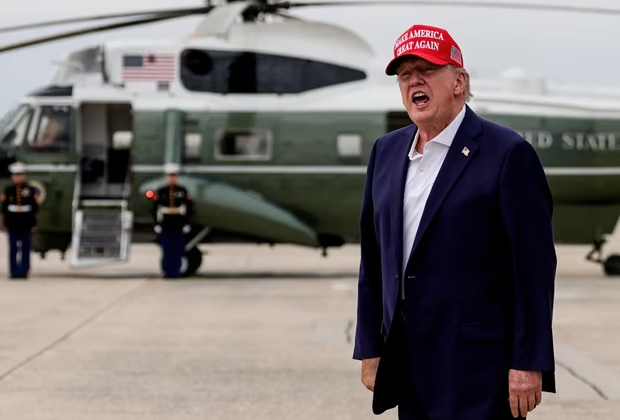
US President Donald Trump has issued a stark warning to Oman, saying the United States could take military action if Oman interferes with Washington’s efforts to control shipping through the strategically important Strait of Hormuz.
The comments, reported on August 17, come at a highly sensitive moment for the US-Iran conflict. A 60-day negotiating period linked to a US-Iran memorandum has expired without a final peace agreement, while Iran and Oman have been working on arrangements that could help restore commercial shipping through the strait.
Trump’s remarks have added another layer of uncertainty to an already fragile diplomatic situation—and financial markets are watching closely.
What Did Trump Say About Oman?
During a Fox News interview, Trump warned that the United States would bomb Oman if it “gets in the way” of Washington’s efforts regarding Iran and the Strait of Hormuz.
Trump also said he was not in a hurry to reach a deal with Iran and demanded that Tehran surrender rather than continue resisting US pressure.
The comments are particularly significant because Oman has historically played a role as a diplomatic intermediary between Washington and Tehran.
Rather than simply being another regional player, Oman has been involved in communication between the two sides, making the threat particularly sensitive from a diplomatic perspective.
Why Is Oman So Important?
The geography of the region explains much of the current tension.
The Strait of Hormuz lies between Iran and Oman, connecting the Persian Gulf with the Gulf of Oman and the wider Arabian Sea.
It is one of the world’s most important energy chokepoints.
A prolonged disruption could affect:
- Crude oil supplies
- LNG shipments
- Global fuel prices
- Shipping costs
- Inflation
- Airline expenses
- Manufacturing costs
- Emerging-market economies
The current crisis has already sharply reduced shipping activity through the waterway. Reuters reported that only five vessels passed through the strait on Saturday and none on Sunday, compared with 31 vessels the previous weekend.
Iran and Oman Are Working on a Shipping Arrangement
One of the most important developments behind Trump’s warning is the separate effort by Iran and Oman to establish arrangements for commercial shipping through the Strait of Hormuz.
Iran said on Monday that it was working with Oman to finalize a joint statement concerning shipping routes through the strait. AP reported that the proposed arrangement involves separate routes for inbound and outbound vessels, with the goal of facilitating maritime traffic.
This creates a complicated diplomatic situation.
Washington wants the waterway reopened and has been applying pressure on Iran. Tehran, meanwhile, has been negotiating with Oman over how shipping could operate.
Trump’s latest comments suggest that the White House does not want a separate arrangement to undermine US objectives.
The 60-Day US-Iran Deadline Has Passed
The latest escalation comes as the deadline connected to a 60-day US-Iran negotiation period expires.
The agreement was intended to reduce hostilities, address the Strait of Hormuz crisis and establish a framework for discussions surrounding Iran’s nuclear program.
However, negotiations remain unresolved, with Washington and Tehran still divided over fundamental issues including the blockade, military presence and control of the waterway.
That uncertainty is now becoming increasingly important for investors.
What Does This Mean for Oil Prices?
Oil is arguably the biggest financial-market story surrounding the Hormuz crisis.
The Strait of Hormuz is critical to international energy trade, meaning any prolonged disruption can create a risk premium in crude markets.
On August 17, Brent crude was trading around the high-$80s per barrel, with prices rising as concerns over the conflict and stalled diplomacy persisted. Reuters reported Brent at around $88.86, while WTI was around $82.44.
The key question for oil traders is no longer simply whether there will be a military escalation.
It is whether shipping through Hormuz remains severely restricted for an extended period.
If shipping remains disrupted:
Oil prices could move higher.
That could eventually translate into:
- Higher gasoline and diesel prices
- More expensive air travel
- Higher freight costs
- Increased manufacturing expenses
- Greater inflationary pressure
What Happens to Gold?
Gold is also likely to remain highly sensitive to the situation.
Geopolitical uncertainty can increase demand for safe-haven assets, while a weaker US dollar can provide an additional boost to bullion.
On Monday, Reuters reported that gold prices were advancing alongside a softer dollar as investors assessed both geopolitical uncertainty and expectations for US monetary policy.
However, the relationship is not always straightforward.
If an oil shock causes inflation to rise sharply, markets could begin expecting tighter monetary policy. Higher interest-rate expectations can create pressure on gold because the opportunity cost of holding a non-yielding asset increases.
Therefore, traders should watch gold, the US dollar and US Treasury yields together rather than assuming geopolitical tension automatically means higher gold prices.
What About the US Dollar?
The US dollar could experience two competing forces.
Geopolitical risk could support the dollar
During periods of extreme uncertainty, investors often seek liquid dollar-denominated assets.
That can create demand for the US currency.
But monetary policy could work in the opposite direction
If US economic data continues to weaken and markets increase expectations of Federal Reserve easing, the dollar could face pressure.
Reuters reported Monday that the dollar had fallen to its lowest level since June amid softer US economic data and reduced expectations for a near-term Fed rate increase.
This creates an important setup for forex traders.
The direction of the dollar may depend on which factor dominates:
geopolitical safe-haven demand vs. Federal Reserve rate expectations.
How Could Global Stock Markets React?
Investors generally dislike uncertainty.
A prolonged Hormuz crisis could put pressure on companies exposed to higher energy and transportation costs.
Potentially vulnerable sectors:
- Airlines
- Logistics
- Manufacturing
- Consumer businesses
- Transportation
- Energy-intensive industries
Potential beneficiaries:
- Oil producers
- Some energy companies
- Defense companies
- Alternative-energy businesses
- Certain shipping and infrastructure companies
However, the market reaction will depend heavily on whether the crisis remains contained or spreads across the wider Gulf region.
Why This Matters for India
India is particularly sensitive to movements in crude oil prices because the country imports a substantial portion of its energy requirements.
A sustained oil-price increase could potentially put pressure on:
Inflation → Import Bill → Rupee → Corporate Costs → Consumer Prices
If crude remains elevated for an extended period, Indian equities could face additional pressure, particularly in sectors that depend heavily on fuel and transportation.
The Indian rupee could also come under pressure if the country’s oil import bill rises significantly.
Could the Strait of Hormuz Crisis Become a Global Inflation Problem?
This is one of the biggest economic risks.
Imagine the following chain reaction:
Hormuz disruption
↓
Higher oil prices
↓
Higher transportation costs
↓
Higher production costs
↓
Higher consumer prices
↓
Central banks face inflation pressure
↓
Interest-rate cuts could be delayed
That scenario could create a difficult environment for global markets because economies would face both slower growth and higher prices.
This is one reason investors are watching the situation beyond the immediate military headlines.
Trump’s IRGC Backchannel Claim
Another significant development from Trump’s interview was his claim that the US has established a direct backchannel with Iran’s Islamic Revolutionary Guard Corps (IRGC).
The disclosure comes as formal diplomatic efforts remain stalled.
However, an IRGC spokesperson subsequently denied Trump’s claim that Washington was communicating through such a backchannel.
That conflicting information highlights the uncertainty surrounding the current diplomatic process.
Three Possible Scenarios From Here
Scenario 1: Diplomacy Makes Progress
If Washington, Tehran and regional mediators reach an arrangement for shipping through Hormuz:
- Oil could retreat
- Gold could lose some geopolitical premium
- Global equities could recover
- Shipping costs could decline
- Risk appetite could improve
This would be the most positive scenario for global markets.
Scenario 2: Current Standoff Continues
If negotiations continue without a major breakthrough:
- Oil could remain elevated
- Gold could remain supported
- Markets could remain volatile
- Shipping disruptions could continue
- Inflation concerns could persist
This may become the market’s base-case scenario if neither side is willing to compromise.
Scenario 3: Military Escalation
The most disruptive scenario would involve a broader military confrontation involving Oman, Iran, US forces or other Gulf countries.
That could result in:
- A significant oil-price spike
- Severe shipping disruption
- Strong safe-haven demand
- Equity-market volatility
- Currency-market stress
- Higher inflation expectations
This scenario would carry the greatest risk for the global economy.
What Traders Should Watch Now
For forex, gold, oil and stock-market traders, the following indicators will be particularly important:
🛢️ Crude Oil
Watch Brent and WTI for signs that markets are pricing in a larger supply disruption.
🪙 Gold
Watch XAU/USD for changes in safe-haven demand.
💵 US Dollar
Monitor DXY alongside Treasury yields and Federal Reserve expectations.
🚢 Shipping
Any major change in commercial traffic through Hormuz could quickly affect energy markets.
🇮🇷 US-Iran Diplomacy
Official statements from Washington and Tehran could trigger sharp market moves.
🇴🇲 Oman
Any military or diplomatic development involving Oman could become a major market catalyst.
Breaking News Could Move Markets Quickly
This is a developing geopolitical story.
Investors should be careful about treating individual statements as confirmation of future military action. Trump’s threat represents a significant escalation in rhetoric, but it does not by itself mean that a US attack on Oman is imminent.
The situation could change rapidly as diplomatic contacts continue.
Final Thoughts
President Trump’s warning to Oman has dramatically raised the stakes surrounding the Strait of Hormuz, just as the US-Iran negotiation deadline reaches a critical point.
The biggest concern for the global economy is not simply the political dispute itself—it is what happens to energy supplies and international shipping if the crisis continues.
For financial markets, the equation is straightforward:
More escalation → greater oil and geopolitical risk.
Diplomatic progress → lower risk premium and potentially lower oil prices.
For investors watching oil, gold, forex, the US dollar, Indian equities and global stock markets, the Strait of Hormuz is likely to remain one of the most important geopolitical market drivers.
The next major development from Washington, Tehran or Muscat could therefore have consequences far beyond the Middle East.
Frequently Asked Questions
Why did Trump threaten Oman?
Trump warned that the United States could take military action if Oman interfered with Washington’s objectives regarding Iran and the Strait of Hormuz. The comments came as Iran and Oman were discussing arrangements for shipping through the waterway.
Why is the Strait of Hormuz so important?
It is a critical global energy shipping route. Disruptions can increase oil prices, shipping costs and inflation risks.
Will oil prices rise if the crisis escalates?
They could. A prolonged disruption to shipping through Hormuz would likely increase the risk premium in crude markets, although the actual price reaction would depend on the scale and duration of the disruption.
Could gold rise?
Gold could benefit from increased safe-haven demand, although interest rates and the US dollar remain important factors in determining its direction.
What could happen to the Indian stock market?
A sustained rise in crude oil prices could increase India’s import costs and inflationary pressure, potentially weighing on sentiment toward Indian equities and the rupee.
Is the US going to attack Oman?
There is currently no confirmation that a US attack on Oman is imminent. Trump’s remarks were a threat tied to Oman’s role in the Hormuz dispute. The situation remains fluid and diplomatic efforts are continuing.
About TheBusinessNow
TheBusinessNow covers global business, finance, technology, markets, geopolitics and economic trends, providing readers with original analysis of the events shaping the world economy.
Disclaimer: This article is for informational purposes only and does not constitute financial, investment or trading advice. Geopolitical events can change rapidly, and market reactions are unpredictable.
Keep reading
Related Articles
 Crypto
₿ Bitcoin Breaks Above $72,000: Why Trump’s Crypto Push Is Sending Crypto Stocks Higher
Bitcoin’s $72,000 Move Is Bigger Than Bitcoin A typical crypto headline would be: Bitcoin jumps above $72,000. But that misses the most important part of today’s move. The interesting part is the simultaneous rally in: Bitcoin ↓ Coinbase ↓ Strategy ↓ Circle ↓ Robinhood ↓ Bitcoin miners ↓ Crypto infrastructure That tells us investors aren’t...
 Markets
U.S. Treasury Doubles Bond Buybacks: Why Markets Are Still Worried About Rising Yields
The Treasury Just Sent Two Messages to Wall Street At first glance, this looks like a straightforward market-support operation. Treasury says: We want to improve liquidity in longer-dated Treasury securities. Investors hear: Washington is increasingly concerned about the rise in long-term borrowing costs. And that second interpretation is what makes this story important. The Treasury...
 Commodities
Oil Nears $95: Could the Iran War Trigger a New U.S. Inflation Shock?
Oil at $95 Is Not the Real Story A crude-oil headline is easy to write: “Oil prices rise as Iran tensions escalate.” Reuters, Bloomberg, CNBC and WSJ can publish that story within minutes. But for TheBusinessNow, that isn’t enough. The bigger question is: What happens to the American economy if oil stays near $95 —...
Comments (0)