
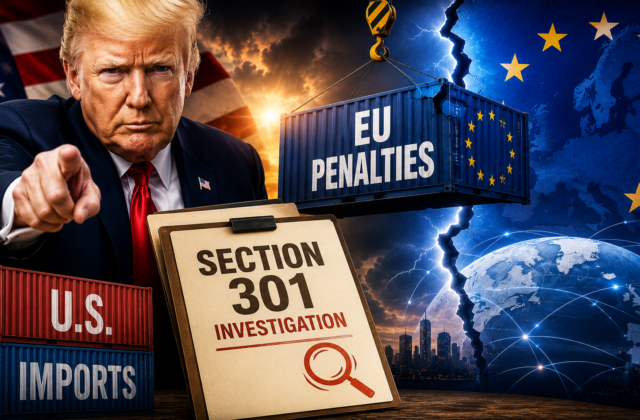
Trump Launches Section 301 Investigation Into EU Penalties: What It Means for Global Business
Trump Launches Section 301 Investigation Into EU Penalties: What It Means for Global Business Global trade tensions may be entering a new phase after President Donald Trump announced plans to launch a Section 301 investigation into penalties imposed by the European Union on U.S. companies. The announcement immediately attracted attention across financial markets because Section...
TheBusinessNow
Jul 24, 2026 · 3 min Read
Key Highlights
- 🇺🇸 Donald Trump has announced a Section 301 investigation into EU penalties imposed on U.S. companies.
- 🌍 The move could increase trade tensions between the United States and the European Union.
- ⚖️ The investigation will examine whether EU actions unfairly discriminate against American businesses.
- 📈 Investors are closely watching because Section 301 investigations have historically preceded major trade actions.
- 🚢 Global supply chains, exporters, and multinational corporations could face renewed uncertainty.
- 🏭 Manufacturing, technology, automotive, and pharmaceutical sectors may be among the most affected.
- 💰 New tariffs, if introduced later, could influence inflation and consumer prices.
Trump Launches Section 301 Investigation Into EU Penalties: What It Means for Global Business
Global trade tensions may be entering a new phase after President Donald Trump announced plans to launch a Section 301 investigation into penalties imposed by the European Union on U.S. companies.
The announcement immediately attracted attention across financial markets because Section 301 investigations have historically preceded major U.S. trade actions, including tariffs and broader economic measures.
Although the investigation has only been announced and no trade action has yet been finalized, economists, multinational corporations, and investors are closely monitoring developments that could affect billions of dollars in transatlantic commerce.
What Is Section 301?
Section 301 refers to a provision of the U.S. Trade Act of 1974.
It gives the U.S. government authority to investigate whether foreign governments have adopted trade practices considered unfair or discriminatory toward American businesses.
If such practices are determined to violate U.S. trade interests, the administration may pursue various responses, including:
- New tariffs
- Trade negotiations
- Import restrictions
- Other enforcement measures
The investigation itself does not automatically result in tariffs, but it can become the legal basis for future trade action.
Why Is Trump Targeting EU Penalties?
According to recent statements, the administration plans to examine fines imposed by the European Union on American companies.
The investigation is expected to determine whether those penalties unfairly disadvantage U.S. businesses operating in Europe.
Supporters argue the review is intended to protect American companies from what they view as discriminatory treatment.
European officials, meanwhile, have generally maintained that enforcement actions are based on EU competition and regulatory laws rather than nationality.
Why This Matters for Global Business
The United States and the European Union represent one of the world’s largest trading relationships.
Together they account for:
- Trillions of dollars in annual trade
- Millions of jobs
- Extensive cross-border investment
- Integrated manufacturing supply chains
Any increase in trade tensions between the two economies could influence businesses worldwide.
Which Industries Could Be Affected?
If the dispute escalates, several sectors may receive increased attention.
Technology
Large U.S. technology companies operating in Europe have frequently faced regulatory scrutiny.
Automotive
Vehicle manufacturers depend heavily on transatlantic supply chains.
Pharmaceuticals
Healthcare and life sciences companies maintain extensive operations across both markets.
Manufacturing
Industrial exporters could face changing tariff structures if trade measures expand.
Agriculture
Agricultural products have historically become bargaining tools during trade disputes.
What Could Happen Next?
A Section 301 investigation generally follows several stages:
- Information gathering.
- Consultation with businesses.
- Legal review.
- Government findings.
- Possible policy recommendations.
Only after completing these steps would policymakers decide whether additional trade measures are appropriate.
Could New Tariffs Follow?
Although tariffs have not been announced, markets often associate Section 301 investigations with potential trade restrictions.
Possible outcomes include:
- New import tariffs.
- Negotiated settlements.
- Regulatory adjustments.
- Suspension of proposed actions following diplomatic discussions.
At this stage, no final decision has been made.
What Investors Are Watching
Financial markets typically respond to major trade developments because they influence:
- Corporate earnings
- Manufacturing costs
- Supply chains
- Inflation
- Global economic growth
Companies with substantial European operations may receive particular attention as the investigation develops.
Lessons From Previous Trade Disputes
Section 301 investigations have previously played a major role in U.S. trade policy.
Past cases demonstrated that:
- Trade disputes can reshape global supply chains.
- Businesses often diversify manufacturing locations.
- Companies increase inventory planning during periods of uncertainty.
- Financial markets closely monitor policy announcements.
Many multinational corporations now incorporate geopolitical risk into long-term strategic planning.
Possible European Response
Should the investigation lead to formal U.S. trade action, the European Union could choose several responses.
These may include:
- Diplomatic negotiations.
- Legal challenges through international trade mechanisms.
- Reciprocal trade measures.
- Regulatory adjustments.
Historically, both sides have generally attempted negotiations before broader trade conflicts escalate.
Why Businesses Should Pay Attention
Even without immediate tariffs, investigations create uncertainty.
Businesses may begin reviewing:
- Supply chains.
- Import costs.
- Manufacturing locations.
- Pricing strategies.
- Investment decisions.
Corporate planning often changes well before official policy takes effect.
What This Means for the Global Economy
The announcement comes during a period already characterized by:
- Higher interest rates.
- AI-driven economic transformation.
- Geopolitical tensions.
- Supply-chain realignment.
- Inflation concerns.
Additional trade uncertainty could become another variable influencing global economic growth.
Final Analysis
Donald Trump’s decision to launch a Section 301 investigation into European Union penalties affecting U.S. companies signals renewed attention toward transatlantic trade policy. While the investigation does not automatically lead to tariffs or retaliatory measures, it represents an important first step that could influence future negotiations between two of the world’s largest economic partners.
For businesses, investors, and policymakers, the coming months will be less about immediate policy changes and more about understanding where the investigation leads. Whether it results in negotiated reforms, additional trade restrictions, or a broader shift in U.S.-EU economic relations, the outcome has the potential to affect global commerce, financial markets, and international business strategies well beyond 2026.
❓ Frequently Asked Questions (FAQs)
1. What is a Section 301 investigation?
A Section 301 investigation is a process under the U.S. Trade Act of 1974 that allows the U.S. government to investigate foreign trade practices it believes are unfair or discriminatory toward American businesses.
2. Why is Donald Trump launching a Section 301 investigation into the EU?
Trump has announced plans to investigate European Union penalties imposed on U.S. companies, arguing that they may unfairly target American businesses and warrant a formal trade review.
3. Does a Section 301 investigation automatically lead to tariffs?
No. An investigation is only the first step. It may lead to negotiations, policy recommendations, or trade actions such as tariffs, but no automatic penalties are imposed.
4. How could this affect global businesses?
Companies with operations in both the United States and Europe could face increased uncertainty regarding supply chains, import costs, regulatory compliance, and future investment decisions.
5. Which industries may be affected the most?
Technology, automotive, manufacturing, pharmaceuticals, agriculture, logistics, and international exporters could be impacted if trade tensions escalate.
6. How might financial markets react?
Markets often monitor trade disputes closely because they can influence inflation, corporate earnings, commodity prices, currency movements, and investor confidence.
7. Could this trigger another U.S.–EU trade dispute?
It is possible, but the investigation itself does not guarantee retaliatory measures. Much will depend on the findings, negotiations, and any future policy decisions by both sides.
🌍 About The Business Now
The Business Now is your destination for premium global business journalism covering:
- 🌎 International Politics & Geopolitics
- 📈 Stock Markets & Investing
- 💼 Business & Corporate Strategy
- 💹 Global Economy & Trade
- 🤖 Artificial Intelligence
- 🛢️ Gold, Oil & Commodities
- 🚀 Technology & Innovation
Our goal is to provide accurate, data-driven analysis that helps investors, professionals, and readers understand the forces shaping the global economy.
The Business Now — Global News. Business Intelligence. Market Insights.
🟡 Gold Price Now
Follow GoldPriceNow.in for:
- 🟡 Live 24K Gold Price
- 🟠 Live 22K Gold Price
- 🟤 Live 18K Gold Price
- ⚪ Live Silver Price
- 🌍 International Spot Gold Rates
- 📊 Gold Price Charts
- 🧮 Gold Investment Calculator

Keep reading
Related Articles
 Crypto
₿ Bitcoin Breaks Above $72,000: Why Trump’s Crypto Push Is Sending Crypto Stocks Higher
Bitcoin’s $72,000 Move Is Bigger Than Bitcoin A typical crypto headline would be: Bitcoin jumps above $72,000. But that misses the most important part of today’s move. The interesting part is the simultaneous rally in: Bitcoin ↓ Coinbase ↓ Strategy ↓ Circle ↓ Robinhood ↓ Bitcoin miners ↓ Crypto infrastructure That tells us investors aren’t...
 Markets
U.S. Treasury Doubles Bond Buybacks: Why Markets Are Still Worried About Rising Yields
The Treasury Just Sent Two Messages to Wall Street At first glance, this looks like a straightforward market-support operation. Treasury says: We want to improve liquidity in longer-dated Treasury securities. Investors hear: Washington is increasingly concerned about the rise in long-term borrowing costs. And that second interpretation is what makes this story important. The Treasury...
 Commodities
Oil Nears $95: Could the Iran War Trigger a New U.S. Inflation Shock?
Oil at $95 Is Not the Real Story A crude-oil headline is easy to write: “Oil prices rise as Iran tensions escalate.” Reuters, Bloomberg, CNBC and WSJ can publish that story within minutes. But for TheBusinessNow, that isn’t enough. The bigger question is: What happens to the American economy if oil stays near $95 —...
Comments (0)