
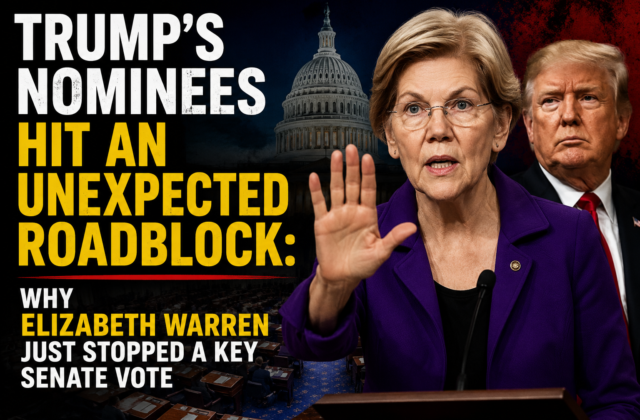
Trump’s Nominees Hit an Unexpected Roadblock: Why Elizabeth Warren Just Stopped a Key Senate Vote
Trump’s Nominees Hit an Unexpected Roadblock: Why Elizabeth Warren Just Stopped a Key Senate Vote A routine Senate confirmation process unexpectedly turned into one of Washington’s latest political flashpoints after Senator Elizabeth Warren objected to moving forward with votes on several Trump administration nominees, citing concerns over background check procedures. The delay has reignited debate...
TheBusinessNow
Jul 23, 2026 · 2 min Read
Key Highlights
- 🏛️ A Senate committee postponed votes on several Trump administration nominees after procedural objections.
- ⚖️ Senator Elizabeth Warren cited concerns about the completeness of background check information before confirmation votes.
- 📄 The delay is procedural and does not mean the nominees have been rejected.
- 🇺🇸 The dispute highlights the Senate's constitutional oversight role in confirming senior executive branch officials.
- 📊 Investors are watching because leadership changes at federal agencies can influence housing, banking, infrastructure, and regulatory policy.
- 📰 The episode reflects the increasingly partisan nature of confirmation battles in Washington.
Trump’s Nominees Hit an Unexpected Roadblock: Why Elizabeth Warren Just Stopped a Key Senate Vote
A routine Senate confirmation process unexpectedly turned into one of Washington’s latest political flashpoints after Senator Elizabeth Warren objected to moving forward with votes on several Trump administration nominees, citing concerns over background check procedures.
The delay has reignited debate over the Senate’s constitutional role in confirming executive branch officials, the standards applied during nominee vetting, and the increasingly partisan nature of confirmation battles.
Although the committee did not permanently reject the nominees, the dispute has temporarily stalled the confirmation process and placed additional scrutiny on how nominees are evaluated before taking office.
What Happened?
According to reports from The Hill, Yahoo News, and Punchbowl News, a Senate committee meeting intended to vote on several Trump nominees was interrupted after Senator Warren questioned whether all required background review procedures had been completed.
Her objections centered on whether committee members had received sufficient information before proceeding with confirmation votes.
As a result, the scheduled committee action was delayed.
Why Warren Objected
Senator Warren argued that senators must have complete background information before voting on nominees entrusted with major government responsibilities.
Her concerns reportedly focused on:
- Background investigation procedures
- Access to committee records
- Vetting transparency
- Senate oversight responsibilities
She maintained that confirmation decisions should be based on complete and properly reviewed documentation.
Which Nominees Were Affected?
Reports indicate the committee was considering multiple Trump administration nominees, including positions connected to federal agencies such as the Department of Housing and Urban Development (HUD).
The procedural dispute delayed committee action but did not constitute a final decision on the nominees themselves.
Why Senate Confirmations Matter
The U.S. Constitution requires Senate confirmation for many senior executive branch appointments.
These include leaders responsible for:
- Housing policy
- National security
- Treasury
- Justice
- Commerce
- Healthcare
- Financial regulation
Before confirmation, nominees typically undergo:
- FBI background investigations
- Ethics reviews
- Financial disclosures
- Committee hearings
- Question-and-answer sessions
Only after these steps can the Senate vote.
A Familiar Political Battleground
Confirmation hearings have become increasingly contentious regardless of which party controls the White House.
Recent administrations from both Republicans and Democrats have faced:
- Delayed confirmations
- Procedural disputes
- Ethics questions
- Committee disagreements
- Extended floor debates
Political polarization has made nominations one of Washington’s most closely watched processes.
Why This Matters Beyond Politics
Leadership vacancies can affect how quickly federal agencies implement policy.
Delays may influence areas such as:
- Housing programs
- Financial regulation
- Infrastructure
- Federal budgeting
- Consumer protection
For businesses and investors, uncertainty over agency leadership can sometimes delay regulatory decisions or policy implementation.
Market Impact
The immediate financial market impact appears limited.
However, investors continue monitoring political developments because leadership changes can affect sectors including:
- Banking
- Real estate
- Construction
- Housing finance
- Infrastructure
- Public spending
If confirmation delays become prolonged, they could contribute to uncertainty surrounding future policy execution.
The Broader Debate
Supporters of Warren’s position argue that rigorous oversight protects the integrity of the confirmation process and ensures qualified individuals are appointed.
Critics contend that procedural delays can unnecessarily slow government operations and become political tools rather than substantive reviews.
The disagreement reflects a broader debate over how the Senate should balance thorough oversight with efficient governance.
What Happens Next?
The committee is expected to revisit the nominations after procedural issues are addressed.
Possible next steps include:
- Additional background review.
- Release of requested documentation.
- Rescheduled committee votes.
- Senate floor consideration if approved by committee.
The timing will depend on committee leadership and whether concerns raised during the hearing are resolved.
Why Investors and Businesses Should Watch
While the story is primarily political, confirmation delays can influence government agencies that oversee:
- Housing markets
- Banking regulation
- Consumer finance
- Infrastructure investment
- Federal grants
- Economic policy implementation
For that reason, businesses, investors, and policy analysts often follow high-profile confirmation battles closely.
Final Analysis
The temporary delay of votes on several Trump administration nominees highlights the increasingly contested nature of the Senate confirmation process. Senator Elizabeth Warren’s objections focused on whether lawmakers had sufficient background information before proceeding—a procedural issue that underscores the Senate’s constitutional oversight role.
At this stage, the nominees have not been rejected. The committee vote was postponed while questions surrounding the review process are addressed. Whether the delay proves brief or develops into a larger political battle will depend on how quickly the committee resolves the concerns and schedules new votes.
More broadly, the episode illustrates how confirmation hearings have become a central arena for political debate in Washington, with potential implications for government operations, regulatory leadership, and public policy beyond the immediate headlines.
❓ Frequently Asked Questions (FAQs)
1. Why was the Senate vote on Trump’s nominees delayed?
The Senate committee vote was postponed after Senator Elizabeth Warren raised concerns about whether lawmakers had received complete background check information before voting on several Trump administration nominees.
2. Were Trump’s nominees rejected?
No. The nominees were not rejected. The committee delayed the vote pending additional review of the background check and vetting process.
3. What concerns did Elizabeth Warren raise?
Warren questioned whether committee members had sufficient access to background investigation materials and whether the confirmation process should proceed before all necessary reviews were complete.
4. Why are Senate confirmation hearings important?
The U.S. Senate confirms many senior government officials who oversee major federal agencies. These confirmations influence public policy, regulation, housing, banking, infrastructure, and national security.
5. Which nominees were affected?
Reports indicate that several Trump administration nominees were affected, including positions related to the Department of Housing and Urban Development (HUD) and other executive branch appointments under consideration by the committee.
6. Could the delay affect financial markets?
The immediate market impact appears limited. However, investors monitor confirmation delays because agency leadership can influence regulation, housing policy, banking oversight, infrastructure spending, and broader economic policy.
7. What happens next?
The committee is expected to revisit the nominations after addressing procedural concerns. If approved in committee, the nominees can move to the full Senate for confirmation votes.
🌐 About The Business Now
The Business Now is a global business and finance publication covering:
- 🌍 World Politics & Geopolitics
- 📈 Stock Markets & Investing
- 🏦 Economy & Federal Reserve
- 🏠 Housing & Real Estate
- 🛢️ Oil, Gold & Commodities
- 🤖 AI & Technology
- 🚀 Business & Corporate News
Our mission is to provide fact-based reporting, market intelligence, and in-depth analysis that helps readers understand how major political and economic developments impact businesses, investors, and global markets.
The Business Now — Breaking News. Deeper Analysis. Smarter Decisions.
🟡 Check Live Gold Prices
Track the latest 24K, 22K, and 18K live gold prices, historical charts, market news, and gold calculators at:

Keep reading
Related Articles
 Crypto
₿ Bitcoin Breaks Above $72,000: Why Trump’s Crypto Push Is Sending Crypto Stocks Higher
Bitcoin’s $72,000 Move Is Bigger Than Bitcoin A typical crypto headline would be: Bitcoin jumps above $72,000. But that misses the most important part of today’s move. The interesting part is the simultaneous rally in: Bitcoin ↓ Coinbase ↓ Strategy ↓ Circle ↓ Robinhood ↓ Bitcoin miners ↓ Crypto infrastructure That tells us investors aren’t...
 Markets
U.S. Treasury Doubles Bond Buybacks: Why Markets Are Still Worried About Rising Yields
The Treasury Just Sent Two Messages to Wall Street At first glance, this looks like a straightforward market-support operation. Treasury says: We want to improve liquidity in longer-dated Treasury securities. Investors hear: Washington is increasingly concerned about the rise in long-term borrowing costs. And that second interpretation is what makes this story important. The Treasury...
 Commodities
Oil Nears $95: Could the Iran War Trigger a New U.S. Inflation Shock?
Oil at $95 Is Not the Real Story A crude-oil headline is easy to write: “Oil prices rise as Iran tensions escalate.” Reuters, Bloomberg, CNBC and WSJ can publish that story within minutes. But for TheBusinessNow, that isn’t enough. The bigger question is: What happens to the American economy if oil stays near $95 —...
Comments (0)