
44 Stocks Are Splitting on Monday, July 13, 2026: The Complete Stock Split Calendar Every Investor Should Watch This Week
Why July 13 Could Be One of the Busiest Stock Split Days of 2026 If you’re an active investor, trader, or simply someone who follows the stock market closely, Monday, July 13, 2026, deserves a place on your watchlist. A remarkable 44 companies are scheduled to undergo stock split-related corporate actions, making it one of...
TheBusinessNow
Jul 11, 2026 · 6 min Read
Key Highlights
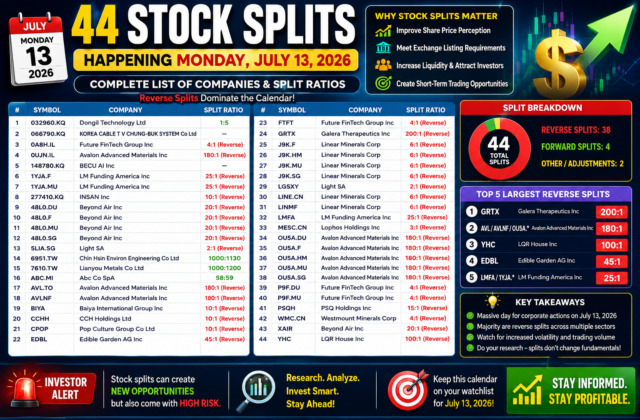
- 44 companies are scheduled for stock split-related corporate actions on Monday, July 13, 2026, making it one of the busiest stock split calendars of the year.
- Reverse stock splits dominate the list, with most companies consolidating shares to meet exchange listing requirements or restructure their capital.
- Galera Therapeutics (GRTX) leads the calendar with the largest 200:1 reverse stock split.
- Avalon Advanced Materials Inc. follows closely with a 180:1 reverse stock split, appearing across multiple exchanges.
Why July 13 Could Be One of the Busiest Stock Split Days of 2026
If you’re an active investor, trader, or simply someone who follows the stock market closely, Monday, July 13, 2026, deserves a place on your watchlist.
A remarkable 44 companies are scheduled to undergo stock split-related corporate actions, making it one of the busiest stock split calendars of the year. While headlines often focus on high-profile companies like Nvidia, Apple, or Tesla, many lesser-known stocks are also making significant moves—and history shows that corporate actions can sometimes trigger sharp price volatility, increased trading volume, and renewed investor attention.
Most importantly, this week’s calendar is dominated by reverse stock splits, a move frequently used by companies seeking to maintain exchange listing requirements, improve share price perception, or restructure their capital.
Whether you’re a long-term investor, swing trader, or penny stock enthusiast, understanding these upcoming stock splits can help you stay ahead of market-moving events.
What Is a Stock Split?
A stock split changes the number of outstanding shares while maintaining the company’s overall market value.
For example:
- 2-for-1 Stock Split: Investors receive two shares for every one share they own, while the share price adjusts proportionally.
- 10-for-1 Reverse Stock Split: Every ten existing shares become one share, increasing the price per share while reducing the number of shares outstanding.
A stock split does not automatically change a company’s valuation, but it often influences liquidity, investor sentiment, and trading activity.
Why Are So Many Companies Announcing Reverse Stock Splits?
One striking trend in this week’s calendar is the overwhelming number of reverse stock splits.
Companies typically pursue reverse splits for several reasons:
- Maintain exchange listing requirements
- Increase share price above minimum thresholds
- Attract institutional investors
- Improve market perception
- Simplify capital structure
- Prepare for future financing
However, reverse stock splits can also signal that a company has experienced prolonged share price weakness. Investors should always examine the company’s financial performance, earnings outlook, and long-term strategy rather than relying solely on the split announcement.
Complete Stock Split Calendar — Monday, July 13, 2026
| Symbol | Company | Split Ratio |
|---|---|---|
| XAIR | Beyond Air Inc | 20:1 Reverse |
| LMFA | LM Funding America Inc | 25:1 Reverse |
| FTFT | Future FinTech Group Inc | 4:1 Reverse |
| AVL | Avalon Advanced Materials Inc | 180:1 Reverse |
| GRTX | Galera Therapeutics Inc | 200:1 Reverse |
| PSQH | PSQ Holdings Inc | 15:1 Reverse |
| BIYA | Baiya International Group Inc | 10:1 Reverse |
| CPOP | Pop Culture Group Co Ltd | 10:1 Reverse |
| CCHH | CCH Holdings Ltd | 10:1 Reverse |
| EDBL | Edible Garden AG Inc | 45:1 Reverse |
| YHC | LQR House Inc | 100:1 Reverse |
| LINE.CN | Linear Minerals Corp | 6:1 Reverse |
| WMC.CN | Westmount Minerals Corp | 4:1 Reverse |
| MESC.CN | Lophos Holdings Inc | 3:1 Reverse |
| LGSXY | Light SA | 2:1 Reverse |
Plus 29 additional international listings and regional exchange tickers completing the total of 44 scheduled corporate actions. – YahooFinance
1. Galera Therapeutics (GRTX) — 200:1 Reverse Split
Galera Therapeutics is implementing the largest reverse split on the list. Such large consolidations often attract increased trader attention due to potential volatility.
2. Avalon Advanced Materials (AVL)
Avalon is completing a massive 180:1 reverse split, one of the most significant corporate actions scheduled this week across multiple exchanges.
3. Beyond Air (XAIR)
Healthcare stocks frequently experience heightened trading activity following reverse stock split announcements. Beyond Air’s 20:1 reverse split will likely remain on many traders’ watchlists.
4. Future FinTech Group (FTFT)
As a fintech-focused company, Future FinTech often attracts speculative investors. Its 4:1 reverse split may generate increased interest as the market evaluates the company’s next strategic steps.
5. LM Funding America (LMFA)
LM Funding America is implementing a 25:1 reverse split, another notable corporate action that could increase short-term trading activity.
Do Reverse Stock Splits Mean a Stock Will Rise?
Not necessarily.
Many investors mistakenly assume reverse stock splits automatically lead to higher stock prices over time.
In reality:
- Some companies recover successfully after restructuring.
- Others continue declining despite the higher share price.
- Long-term performance depends on revenue growth, profitability, balance sheet strength, and business execution—not the split itself.
This is why experienced investors focus on fundamentals first and corporate actions second.
Why Traders Monitor Stock Split Calendars
Professional traders regularly follow stock split calendars because these events can influence:
- Daily trading volume
- Price volatility
- Retail investor interest
- Options activity
- Institutional participation
- Technical chart patterns
Even when a split does not change intrinsic value, it can create short-term trading opportunities.
What Investors Should Look for Before Buying
Before investing in any company undergoing a stock split, consider the following:
- Recent earnings reports
- Revenue growth trends
- Cash flow and debt levels
- Exchange listing status
- Insider buying or selling
- Industry outlook
- Upcoming catalysts
- Management guidance
A stock split should be viewed as one piece of a much larger investment puzzle.
Market Outlook for July 13
With 44 scheduled stock split events, Monday’s trading session could attract above-average attention from retail investors, momentum traders, and market analysts.
Healthcare, fintech, mining, biotechnology, and technology companies are particularly well represented in this week’s calendar.
Although not every split will generate significant market movement, investors should expect increased news flow and trading interest around several of these companies.
Final Thoughts
Stock splits remain one of the most closely watched corporate actions in the financial markets. While they don’t directly change a company’s value, they often influence investor sentiment, liquidity, and trading behavior.
This week’s 44 scheduled stock splits on July 13, 2026, provide investors with an opportunity to monitor companies undergoing significant structural changes. From Galera Therapeutics’ 200:1 reverse split to Avalon Advanced Materials’ 180:1 consolidation, several companies could remain in focus throughout the trading week.
For investors, the key takeaway is simple: don’t chase a stock because of a split—understand the business behind it. Corporate actions can create opportunities, but long-term returns are ultimately driven by strong fundamentals, sound management, and sustainable growth.
Frequently Asked Questions
What is the biggest stock split on July 13, 2026?
Galera Therapeutics (GRTX) is scheduled to complete the largest reverse stock split at 200:1.
How many companies have stock splits on July 13, 2026?
A total of 44 companies are scheduled for stock split-related corporate actions.
Are reverse stock splits good or bad?
A reverse stock split is neither inherently good nor bad. It changes the share structure but does not directly alter a company’s market value. Investors should evaluate the company’s financial health and long-term prospects.
Why do companies perform reverse stock splits?
Common reasons include meeting exchange listing requirements, improving share price perception, attracting institutional investors, and restructuring capital.
Where can investors track upcoming stock splits?
Investors can monitor corporate action calendars provided by major financial data platforms, stock exchanges, and brokerage firms.
About TheBusinessNow
TheBusinessNow delivers global coverage of business, finance, technology, geopolitics, commodities, and economic trends. Our goal is to provide readers with original, fact-based analysis that explains how world events shape markets and investment decisions.
Keep reading
Related Articles
 Crypto
₿ Bitcoin Breaks Above $72,000: Why Trump’s Crypto Push Is Sending Crypto Stocks Higher
Bitcoin’s $72,000 Move Is Bigger Than Bitcoin A typical crypto headline would be: Bitcoin jumps above $72,000. But that misses the most important part of today’s move. The interesting part is the simultaneous rally in: Bitcoin ↓ Coinbase ↓ Strategy ↓ Circle ↓ Robinhood ↓ Bitcoin miners ↓ Crypto infrastructure That tells us investors aren’t...
 Markets
U.S. Treasury Doubles Bond Buybacks: Why Markets Are Still Worried About Rising Yields
The Treasury Just Sent Two Messages to Wall Street At first glance, this looks like a straightforward market-support operation. Treasury says: We want to improve liquidity in longer-dated Treasury securities. Investors hear: Washington is increasingly concerned about the rise in long-term borrowing costs. And that second interpretation is what makes this story important. The Treasury...
 Commodities
Oil Nears $95: Could the Iran War Trigger a New U.S. Inflation Shock?
Oil at $95 Is Not the Real Story A crude-oil headline is easy to write: “Oil prices rise as Iran tensions escalate.” Reuters, Bloomberg, CNBC and WSJ can publish that story within minutes. But for TheBusinessNow, that isn’t enough. The bigger question is: What happens to the American economy if oil stays near $95 —...
Comments (0)