
Stock Market Crash Today: Sensex and Nifty Tumble as Oil Prices Surge, Global Tensions Shake Investor Confidence
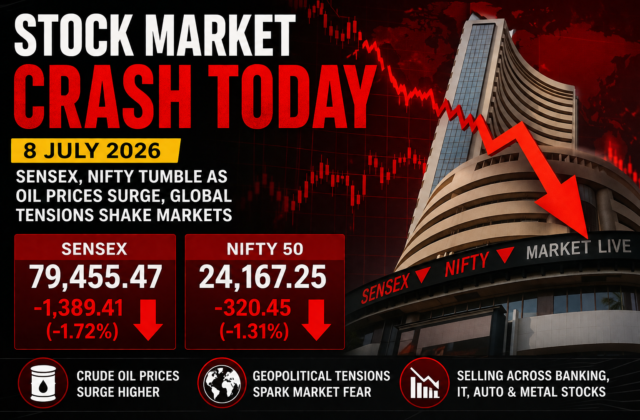
Indian Stock Market Ends Deep in the Red as Global Uncertainty Triggers Heavy Selling Indian equity markets witnessed one of their sharpest declines in recent weeks on Wednesday, July 8, 2026, as investors rushed to reduce risk amid escalating geopolitical tensions and a sharp rise in crude oil prices. Benchmark indices Sensex and Nifty 50...
Elina
Jul 8, 2026 · 9 min Read
Key Highlights
- Stock Market Crash Today: Sensex, Nifty Fall Sharply as Oil Prices Surge Amid Global Tensions
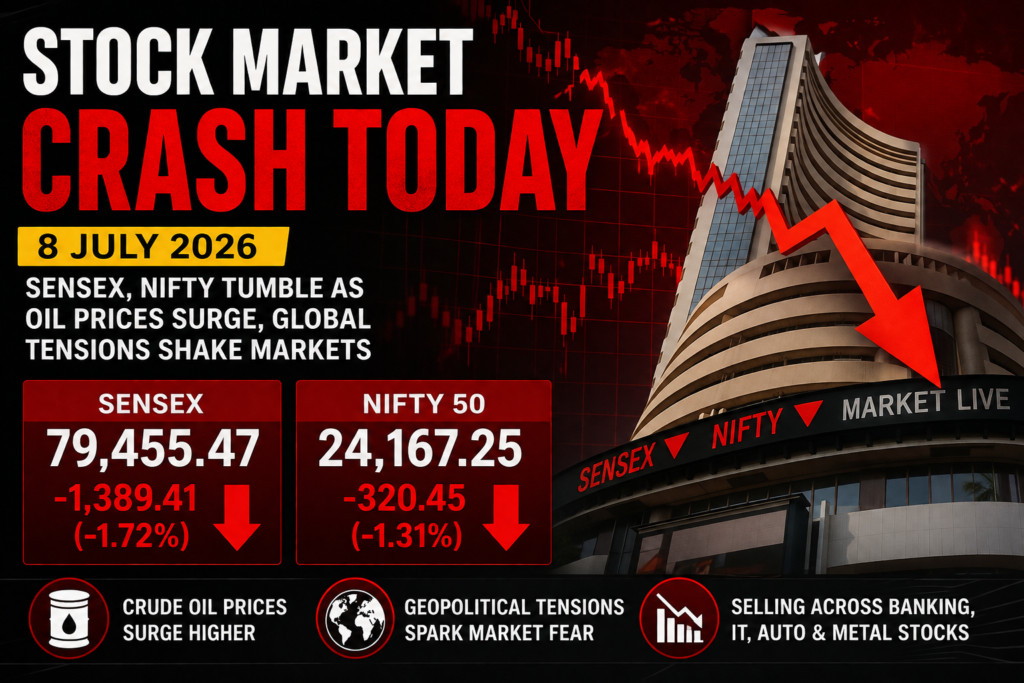
Indian Stock Market Ends Deep in the Red as Global Uncertainty Triggers Heavy Selling
Indian equity markets witnessed one of their sharpest declines in recent weeks on Wednesday, July 8, 2026, as investors rushed to reduce risk amid escalating geopolitical tensions and a sharp rise in crude oil prices. Benchmark indices Sensex and Nifty 50 came under intense selling pressure throughout the trading session, with losses spreading across banking, IT, auto, metals, and energy stocks.
The market weakness followed renewed concerns over the Middle East after fresh developments involving the United States and Iran, which pushed global crude oil prices higher and dampened investor sentiment worldwide. Asian markets also traded lower, adding to the cautious mood on Dalal Street.
Why Did the Stock Market Fall Today?
Several factors combined to trigger the sharp decline:
1. Rising Crude Oil Prices
India imports more than 80% of its crude oil requirements. Any spike in international oil prices raises import costs, widens the trade deficit, increases inflationary pressure, and negatively impacts corporate profitability.
Higher crude prices are particularly challenging for sectors such as aviation, paints, logistics, chemicals, and oil marketing companies.
2. Fresh Geopolitical Tensions
Investor confidence weakened after renewed tensions involving the United States and Iran. Markets typically react negatively during geopolitical uncertainty because investors become concerned about disruptions to global trade, energy supplies, and economic growth.
3. Weak Global Market Sentiment
Asian equity markets traded cautiously while overnight weakness in global markets further weighed on Indian equities. Foreign institutional investors reduced exposure to risk assets, leading to broad-based selling across sectors.
4. Profit Booking After Recent Rally
Indian markets had recently climbed to multi-week highs, encouraging many traders to book profits. The negative global news flow accelerated selling pressure, turning an orderly correction into a broader market decline.
Which Sectors Were Hit the Most?
Nearly every major sector finished lower during the session.
Among the worst performers were:
- Banking Stocks
- Information Technology (IT)
- Auto Stocks
- Metal Companies
- Oil & Gas
- Realty
- Capital Goods
The selling was broad-based, reflecting widespread risk aversion rather than weakness in any single industry.
Why Rising Oil Prices Matter for India
Oil remains one of India’s largest imports.
When crude prices increase:
- Fuel becomes more expensive.
- Transportation costs rise.
- Manufacturing expenses increase.
- Inflation accelerates.
- Consumer spending slows.
- Corporate profit margins come under pressure.
This often leads investors to shift money away from equities until market conditions stabilize.
Impact on Investors
The market decline erased significant investor wealth in a single trading session as large-cap, mid-cap, and small-cap stocks all witnessed selling pressure. Defensive sectors such as FMCG and pharmaceuticals showed comparatively better resilience than cyclical sectors.
Long-term investors, however, generally view such corrections as part of normal market cycles rather than a reason for panic.
Stocks Investors Are Watching
Market participants are closely monitoring:
- Banking leaders
- Large IT companies
- Energy stocks
- Reliance Industries
- Tata Group companies
- HDFC Bank
- ICICI Bank
- Larsen & Toubro
Investors are also awaiting upcoming quarterly earnings, which could determine the next direction of the market.
What Should Retail Investors Do?
During periods of heightened volatility, financial experts generally recommend:
- Avoid panic selling.
- Focus on fundamentally strong companies.
- Continue systematic investment plans (SIPs).
- Maintain adequate diversification.
- Keep cash available for attractive buying opportunities.
- Monitor global developments before making major investment decisions.
Short-term volatility often creates opportunities for disciplined long-term investors.
What Could Move the Market Next?
Investors will closely watch several developments over the coming days:
- International crude oil prices
- Middle East geopolitical situation
- Foreign Institutional Investor (FII) activity
- Quarterly corporate earnings
- Inflation data
- RBI policy expectations
- Global central bank commentary
Any improvement in geopolitical conditions or easing oil prices could help stabilize market sentiment.
Outlook for the Indian Stock Market
Although today’s decline has rattled investors, India’s long-term economic fundamentals remain supported by steady domestic consumption, infrastructure investment, banking sector resilience, and continued participation from retail investors.
However, in the near term, markets are likely to remain volatile as global geopolitical developments continue to influence investor sentiment.
Analysts believe traders should expect sharp swings until there is greater clarity on crude oil prices and international political developments.
Conclusion
The Indian stock market experienced a sharp sell-off on July 8, 2026, driven by rising crude oil prices, renewed geopolitical tensions, and weak global cues. While the correction has increased short-term uncertainty, it also highlights how closely Indian markets remain linked to global events.
Investors should stay informed, focus on quality businesses, and avoid making emotional investment decisions during periods of heightened market volatility.
About TheBusinessNow
TheBusinessNow covers global business, technology, finance, startups, markets, AI, and economic trends, providing fact-based analysis for readers worldwide.
Keep reading
Related Articles
 Crypto
₿ Bitcoin Breaks Above $72,000: Why Trump’s Crypto Push Is Sending Crypto Stocks Higher
Bitcoin’s $72,000 Move Is Bigger Than Bitcoin A typical crypto headline would be: Bitcoin jumps above $72,000. But that misses the most important part of today’s move. The interesting part is the simultaneous rally in: Bitcoin ↓ Coinbase ↓ Strategy ↓ Circle ↓ Robinhood ↓ Bitcoin miners ↓ Crypto infrastructure That tells us investors aren’t...
 Markets
U.S. Treasury Doubles Bond Buybacks: Why Markets Are Still Worried About Rising Yields
The Treasury Just Sent Two Messages to Wall Street At first glance, this looks like a straightforward market-support operation. Treasury says: We want to improve liquidity in longer-dated Treasury securities. Investors hear: Washington is increasingly concerned about the rise in long-term borrowing costs. And that second interpretation is what makes this story important. The Treasury...
 Finance
Walmart Stock Plunges 6%: What Its Weak Outlook Says About the U.S. Consumer
Walmart Stock Plunges 6% — But the Earnings Were Not Actually Bad This is where the headline can be misleading. Walmart did not report a disastrous quarter. Quite the opposite. Revenue rose 5.9%, operating income increased 28.8%, e-commerce remained extremely strong and Walmart raised its full-year sales and profit expectations. Yet investors immediately sold the...
Comments (0)