
SpaceX IPO Losing Steam? Buy the Dip or Stay Away After Starship Launch Failure and Stock Selloff
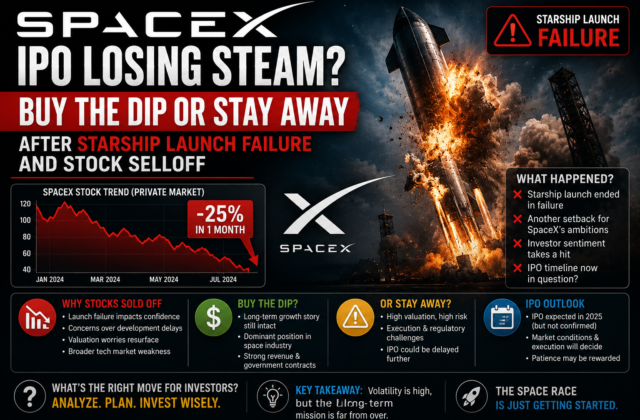
SpaceX IPO Losing Steam? Buy the Dip or Stay Away After the Latest Selloff Only weeks after becoming one of the biggest public listings in financial history, SpaceX is facing a reality check. The company’s stock has come under pressure following its latest Starship V3 launch abort, leaving investors asking a critical question: Is this...
TheBusinessNow
Jul 19, 2026 · 3 min Read
Key Highlights
- 🚀 SpaceX shares remain below their IPO price after recent weakness.
- 📉 The latest Starship V3 launch abort has added fresh pressure on investor sentiment.
- 💰 Billions in market value have been wiped out since the IPO peak.
- 🌍 Starlink remains SpaceX's largest revenue-generating business.
- 🛰️ Future Starship success is critical for Mars ambitions and next-generation satellite deployment.
- 📊 Analysts remain divided on whether the recent decline is a buying opportunity or a sign of deeper risks.
SpaceX IPO Losing Steam? Buy the Dip or Stay Away After the Latest Selloff
Only weeks after becoming one of the biggest public listings in financial history, SpaceX is facing a reality check.
The company’s stock has come under pressure following its latest Starship V3 launch abort, leaving investors asking a critical question:
Is this just a temporary pullback—or the beginning of a much bigger correction?
With billions erased from its market value, increasing technical pressure, and fresh questions surrounding Starship’s development timeline, Wall Street is beginning to debate whether this is the perfect buying opportunity or a warning sign.
For long-term investors, the answer could determine one of the biggest investment decisions of 2026.
What Happened to SpaceX Stock?
SpaceX entered the public markets with extraordinary expectations, quickly becoming one of the most valuable aerospace companies in history.
Investor enthusiasm was driven by:
- Starlink’s rapidly expanding subscriber base
- Strong government and defense contracts
- Commercial launch leadership
- Long-term Mars exploration ambitions
- Artificial intelligence and orbital infrastructure opportunities
However, momentum slowed after the company’s second Starship V3 launch attempt ended in an automatic abort when multiple Raptor engines failed to ignite properly.
While the issue was handled safely, it renewed investor concerns about the pace of Starship development.
Why Investors Are Suddenly Nervous
Several factors are weighing on sentiment.
1. Starship Delays
Starship is central to nearly every major SpaceX growth story.
It supports:
- Mars missions
- Lunar contracts
- Larger Starlink deployments
- Military payload launches
- Future commercial space infrastructure
Any delay increases execution risk.
2. Sky-High Valuation
Following its IPO, SpaceX reached an extraordinary valuation that priced in years of future growth.
That leaves little room for operational setbacks.
Even small disappointments can trigger large share-price swings.
3. Technical Selling
After falling below key support levels, institutional investors and algorithmic trading systems accelerated selling pressure.
Momentum shifted from aggressive buying to cautious profit-taking.
The Bull Case: Why Investors Are Still Optimistic
Despite recent weakness, many analysts continue to see SpaceX as one of the world’s strongest long-term growth companies.
Massive Growth Drivers
✔ Starlink subscriptions continue expanding globally.
✔ Government launch contracts remain strong.
✔ NASA partnerships provide recurring revenue.
✔ Defense spending continues to increase.
✔ Global satellite internet demand remains enormous.
Unlike many aerospace companies, SpaceX operates across multiple high-growth sectors.
The Bear Case
Not everyone believes the current valuation is justified.
Major concerns include:
- Starship execution risk
- Extremely high expectations
- Competition from Blue Origin and international launch providers
- Heavy capital spending
- Regulatory hurdles
If Starship experiences additional delays, investors may continue reducing exposure.
Can Starlink Carry the Company?
Many investors underestimate just how important Starlink has become.
Today, Starlink is widely regarded as the financial engine behind SpaceX.
Revenue comes from:
- Consumer broadband
- Enterprise customers
- Maritime internet
- Aviation connectivity
- Government communications
- Defense contracts
Even if Starship development slows temporarily, Starlink continues generating meaningful cash flow.
SpaceX Financial Strength
Although SpaceX remains a high-growth company, several structural advantages stand out.
| Strength | Impact |
|---|---|
| Starlink Revenue | Strong recurring income |
| Government Contracts | Stable cash flow |
| NASA Partnerships | Long-term credibility |
| Global Launch Leadership | Competitive advantage |
| Defense Business | Growing opportunity |
SpaceX vs Traditional Aerospace Companies
| Company | Growth Potential | Innovation | Risk |
|---|---|---|---|
| SpaceX | ⭐⭐⭐⭐⭐ | ⭐⭐⭐⭐⭐ | High |
| Boeing | ⭐⭐ | ⭐⭐ | Medium |
| Lockheed Martin | ⭐⭐⭐ | ⭐⭐⭐ | Low |
| Northrop Grumman | ⭐⭐⭐ | ⭐⭐⭐ | Low |
SpaceX remains the highest-risk—but also one of the highest-potential—companies in the aerospace sector.
Technical Analysis
Key Support Levels
| Level | Outlook |
|---|---|
| IPO Price | Psychological support |
| Recent Low | Critical buying zone |
| Below Recent Low | Bearish |
Resistance Levels
| Level | Outlook |
|---|---|
| IPO Price Recovery | First bullish signal |
| Previous High | Strong resistance |
| New All-Time High | Long-term bullish confirmation |
Should You Buy the Dip?
Long-Term Investors
For investors with a long investment horizon, the current pullback may present an opportunity if they believe in SpaceX’s long-term execution and growth story.
Short-Term Traders
Expect continued volatility. Starship updates, launch schedules, and company announcements are likely to drive short-term price movements.
Risk-Averse Investors
Those uncomfortable with high volatility may prefer to wait for greater clarity on Starship’s development before making investment decisions.
Biggest Catalysts to Watch
Over the coming months, investors should monitor:
- 🚀 Next Starship launch attempt
- 🛰️ Starlink subscriber growth
- 📈 Quarterly financial updates
- 🤝 New NASA and defense contracts
- 🌍 International expansion
- 💵 Cash flow trends
- 🧠 AI and orbital infrastructure initiatives
Positive progress in these areas could improve investor confidence.
Why This Story Is Trending
Searches for “SpaceX IPO Losing Steam,” “Should You Buy SpaceX Stock?” and “SpaceX Stock Prediction 2026” have surged after the Starship launch abort and subsequent share-price weakness.
Investors are trying to determine whether the decline represents a temporary correction or a shift in the company’s long-term investment narrative.
The Bottom Line
SpaceX remains one of the most ambitious companies in the world, operating at the intersection of aerospace, satellite communications, defense, and advanced technology.
The recent stock weakness reflects concerns about execution and valuation rather than a collapse in the company’s core business.
For investors who believe in SpaceX’s long-term vision, the current pullback may warrant closer attention. However, as with any high-growth company, elevated expectations and operational risks mean volatility is likely to remain part of the investment story.
Frequently Asked Questions (FAQs)
Why is SpaceX stock falling?
Recent weakness followed the Starship V3 launch abort and increased concerns about execution timelines, contributing to negative investor sentiment.
Is SpaceX still a good long-term investment?
Opinions differ. Supporters point to Starlink, government contracts, and long-term growth potential, while skeptics focus on valuation and execution risks.
Should investors buy the dip?
That depends on individual investment goals, risk tolerance, and confidence in the company’s long-term prospects. Investors should conduct their own research before making decisions.
What is SpaceX’s biggest growth business?
Starlink is widely viewed as the company’s largest revenue-generating business and a major driver of future growth.
What should investors watch next?
Key developments include Starship test flights, Starlink expansion, financial performance, and new commercial or government contracts.
About TheBusinessNow
TheBusinessNow delivers global coverage of business, finance, technology, geopolitics, commodities, and economic trends. Our goal is to provide readers with original, fact-based analysis that explains how world events shape markets and investment decisions.
Keep reading
Related Articles
 Crypto
₿ Bitcoin Breaks Above $72,000: Why Trump’s Crypto Push Is Sending Crypto Stocks Higher
Bitcoin’s $72,000 Move Is Bigger Than Bitcoin A typical crypto headline would be: Bitcoin jumps above $72,000. But that misses the most important part of today’s move. The interesting part is the simultaneous rally in: Bitcoin ↓ Coinbase ↓ Strategy ↓ Circle ↓ Robinhood ↓ Bitcoin miners ↓ Crypto infrastructure That tells us investors aren’t...
 Markets
U.S. Treasury Doubles Bond Buybacks: Why Markets Are Still Worried About Rising Yields
The Treasury Just Sent Two Messages to Wall Street At first glance, this looks like a straightforward market-support operation. Treasury says: We want to improve liquidity in longer-dated Treasury securities. Investors hear: Washington is increasingly concerned about the rise in long-term borrowing costs. And that second interpretation is what makes this story important. The Treasury...
 Commodities
Oil Nears $95: Could the Iran War Trigger a New U.S. Inflation Shock?
Oil at $95 Is Not the Real Story A crude-oil headline is easy to write: “Oil prices rise as Iran tensions escalate.” Reuters, Bloomberg, CNBC and WSJ can publish that story within minutes. But for TheBusinessNow, that isn’t enough. The bigger question is: What happens to the American economy if oil stays near $95 —...
Comments (0)