
Oil Drops Near $80 as Strait of Hormuz Reopening Sparks Major Market Shift
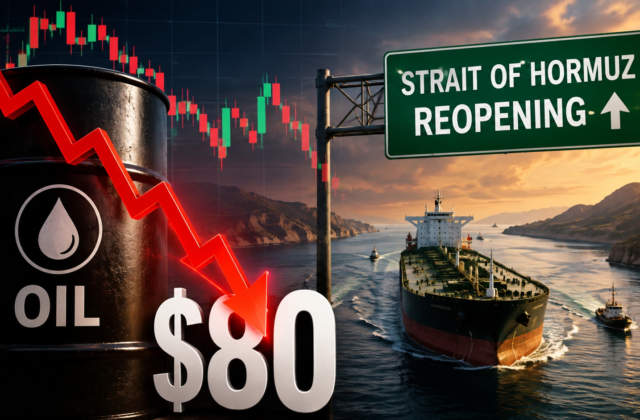
Oil Drops Near $80 as Strait of Hormuz Reopening Sparks Major Market Shift Oil prices are sliding sharply as hopes for a U.S.-Iran agreement and a possible reopening of the Strait of Hormuz ease fears of prolonged supply disruption, sending a fresh shock through global energy markets. Brent crude fell about 4% on Tuesday, reaching...
Kelly Brown
Aug 4, 2026 · 3 min Read
Key Highlights
- 🛢️ Brent crude fell to around $80.66 a barrel, according to Reuters.
- 📉 WTI crude dropped to about $76.76, extending the market sell-off.
- 🚢 Hopes for a reopening of the Strait of Hormuz are helping reduce the oil-market risk premium.
- 🇺🇸🇮🇷 U.S.-Iran diplomatic efforts are becoming a major driver of crude prices.
- 🌍 A sustained reopening could gradually restore disrupted Gulf oil flows.
- ⚠️ The situation remains uncertain, with maritime risks and Iran's conditions still creating potential for renewed volatility.
Oil Drops Near $80 as Strait of Hormuz Reopening Sparks Major Market Shift
Oil prices are sliding sharply as hopes for a U.S.-Iran agreement and a possible reopening of the Strait of Hormuz ease fears of prolonged supply disruption, sending a fresh shock through global energy markets.
Brent crude fell about 4% on Tuesday, reaching $80.66 a barrel, while U.S. West Texas Intermediate dropped to $76.76. The move came after renewed diplomatic signals suggested a potential agreement could allow the crucial Strait of Hormuz shipping route to reopen.
The decline represents a dramatic change in market sentiment. Oil prices had been supported by fears that disruptions around the Strait could restrict the movement of crude from the Persian Gulf. Now, traders are increasingly pricing in the possibility that those supply constraints could ease.
Why Is Oil Falling?
The immediate catalyst is a change in expectations surrounding the Strait of Hormuz.
The waterway is one of the world’s most important energy chokepoints, connecting the Persian Gulf with global shipping routes.
When traders believe the Strait will remain disrupted, they typically price in the possibility of tighter oil supplies.
But when the probability of normal shipping increases, that risk premium can disappear quickly.
That’s what markets are now beginning to price.
Reuters reported that U.S. Treasury Secretary Scott Bessent suggested an agreement to reopen the Strait could potentially be reached within days, while Qatari officials indicated that a resolution draft was circulating.
Brent Crude Falls Back Toward $80
Brent crude, the international benchmark, dropped $3.11 to $80.66 per barrel during Tuesday trading.
WTI crude fell even more sharply, declining $3.58 to $76.76.
The move puts Brent close to the psychologically important $80 level.
For energy traders, that level matters because it represents a significant shift from the elevated prices seen during periods of intense Middle East supply fears.
Goldman Sachs has reportedly projected Brent remaining within roughly the $80-$90 range unless there is either a major diplomatic breakthrough or renewed escalation.
Strait of Hormuz Is at the Center of the Oil Market
The Strait of Hormuz has become the single biggest geopolitical variable for oil prices.
Any sustained disruption could restrict shipments from major Gulf producers.
Conversely, a reliable reopening could allow shipping activity to normalize and reduce fears of a prolonged supply shortage.
That is why even expectations of reopening can move oil prices dramatically before physical flows have completely returned to normal.
This distinction is important.
Oil prices are falling because traders expect conditions to improve — not because the global oil supply chain has instantly returned to normal.
Reuters reported that transit activity has improved somewhat, but flows remain constrained and maritime threats continue.
What Happens If Hormuz Fully Reopens?
A sustained reopening could have major consequences for global energy markets.
More Oil Can Reach Global Markets
As shipping restrictions ease, crude stranded or delayed because of the disruption could gradually reach international buyers.
Lower Supply Risk Premium
Oil prices often include a premium for geopolitical risk. A stable reopening could remove part of that premium.
Potential Relief for Fuel Prices
Lower crude prices can eventually reduce wholesale fuel costs, although retail gasoline and diesel prices don’t necessarily move immediately.
Inflation Pressure Could Ease
Energy is an important component of inflation. A sustained decline in crude prices could reduce pressure on transportation and production costs.
Oil Producers Could Face Lower Revenue
The same decline that benefits consumers and importers can hurt oil-producing companies and countries if prices remain lower for an extended period.
But the Oil Sell-Off Is Not Risk-Free
Despite the sharp decline, traders aren’t treating the situation as completely resolved.
The Strait remains vulnerable to geopolitical developments.
Reuters reported that Gulf shipping traffic remains significantly affected, while Iran’s position and continuing maritime risks are preventing a full return to normal conditions.
That means oil could remain extremely sensitive to headlines.
A successful diplomatic agreement could push prices lower.
A breakdown in negotiations could produce the opposite reaction.
This makes the crude market particularly vulnerable to sudden price swings.
Why Traders Are Watching U.S.-Iran Talks
The oil market is effectively trading the probability of a diplomatic breakthrough.
If negotiations succeed, three major changes could follow:
Hormuz reopening → shipping improves → supply fears decline
That chain could put additional downward pressure on crude.
But if talks collapse, traders could quickly rebuild the geopolitical premium.
That could send Brent and WTI higher again.
For this reason, statements from Washington, Tehran and regional mediators are becoming almost as important to oil traders as traditional inventory and production data.
What Lower Oil Prices Mean for the Global Economy
A sustained decline in crude prices could have consequences well beyond energy markets.
Consumers
Lower oil prices can eventually translate into cheaper gasoline, diesel and transportation costs.
Airlines
Fuel is a major expense for airlines, meaning lower jet-fuel costs can potentially improve margins.
Manufacturers
Lower energy and transportation costs can reduce operating expenses.
Central Banks
Lower energy prices could help reduce inflation pressures, potentially giving central banks greater flexibility on interest-rate policy.
Oil Companies
Producers may face lower revenue and potentially tighter profit margins if crude remains depressed.
Could Oil Fall Below $80?
The answer will depend heavily on what happens next with the Strait of Hormuz and U.S.-Iran negotiations.
There has already been precedent for Brent falling below $80 when traders became confident that Hormuz flows would normalize.
In June, Brent dropped below $80 amid optimism over a U.S.-Iran agreement and expectations of restored supply.
Citi also previously lowered its Brent forecasts after expectations that Hormuz trade flows would normalize, highlighting how strongly the market responds to the possibility of restored supply.
A sustained move below $80 would therefore represent another major shift in the market’s assessment of geopolitical risk.
What Oil Traders Will Watch Next
The next major catalysts include:
- U.S.-Iran negotiations
- Strait of Hormuz shipping activity
- Iranian crude exports
- Gulf oil production
- OPEC+ output decisions
- U.S. crude inventories
- Tanker insurance and freight rates
- Any renewed military escalation
- Global economic growth
Among these, Hormuz traffic and diplomatic negotiations are likely to remain the immediate geopolitical drivers.
Oil Price Outlook
The short-term outlook remains highly dependent on geopolitics.
Bullish for Oil
A breakdown in negotiations, renewed attacks or continued restrictions on Hormuz shipping could push crude higher.
Bearish for Oil
A durable agreement, reliable reopening of the Strait and normalization of oil shipments could push prices lower.
The Biggest Question
The market is now asking whether the current decline is the beginning of a sustained normalization — or simply another temporary reaction to diplomatic headlines.
For now, traders appear increasingly optimistic about the first scenario.
The Bigger Market Shift
The latest oil decline demonstrates just how quickly geopolitical risk can move financial markets.
Only a change in expectations around one strategically important shipping route has been enough to push crude sharply lower.
That matters because oil prices influence:
Inflation → interest rates → currencies → transportation costs → corporate profits → stock markets.
If oil remains near or below $80 for an extended period, the consequences could spread across the global economy.
But if negotiations fail and Hormuz disruptions intensify again, the market could quickly reverse.
Final Thoughts
Oil’s latest drop toward $80 a barrel is more than a routine commodity-market move.
It reflects a major change in how traders are assessing the risk surrounding the Strait of Hormuz and the U.S.-Iran conflict.
Brent recently fell to around $80.66, while WTI dropped to approximately $76.76, as diplomatic signals raised expectations that the strategic waterway could reopen.
The key word, however, is expectations.
The Strait has not simply returned to normal overnight, and significant risks remain.
For oil traders, investors, businesses and consumers, the next few days could be crucial.
If Hormuz reopening becomes reality, oil could face further downward pressure. If diplomacy breaks down, the recent sell-off could reverse just as quickly.
❓ FAQs
Why is oil falling toward $80?
Oil is falling as expectations of a U.S.-Iran agreement and a potential reopening of the Strait of Hormuz reduce fears of prolonged supply disruption.
What is the current Brent oil price?
Reuters reported Brent crude at around $80.66 per barrel during Tuesday’s trading. Prices are constantly changing during market hours.
What happened to WTI crude?
WTI crude fell to approximately $76.76 per barrel, according to Reuters.
Why is the Strait of Hormuz important for oil?
The Strait is a critical shipping route for energy supplies from the Persian Gulf. Disruptions can create concerns about global oil availability and push prices higher.
Will oil prices fall below $80?
They could, particularly if shipping through Hormuz normalizes and supply fears continue to decline. However, renewed geopolitical tensions could quickly push prices higher.
Will lower oil prices reduce inflation?
Potentially. Sustained lower crude prices can reduce energy and transportation costs, which can ease some inflationary pressure. The overall effect depends on the broader economy.
Is the Strait of Hormuz fully reopened?
Current reporting indicates that conditions remain constrained and maritime risks persist. The market is reacting primarily to expectations of a potential reopening rather than assuming that normal shipping has already been fully restored.
📰 About The Business Now
The Business Now delivers coverage of business, finance, commodities, energy, markets, geopolitics and major global developments with fact-based reporting and analysis.
🪙 Check Live Gold Prices
Track Gold, Silver, Platinum and Palladium prices, historical charts, calculators and daily market updates at:
🌐 External Resources
Keep reading
Related Articles
 Crypto
₿ Bitcoin Breaks Above $72,000: Why Trump’s Crypto Push Is Sending Crypto Stocks Higher
Bitcoin’s $72,000 Move Is Bigger Than Bitcoin A typical crypto headline would be: Bitcoin jumps above $72,000. But that misses the most important part of today’s move. The interesting part is the simultaneous rally in: Bitcoin ↓ Coinbase ↓ Strategy ↓ Circle ↓ Robinhood ↓ Bitcoin miners ↓ Crypto infrastructure That tells us investors aren’t...
 Markets
U.S. Treasury Doubles Bond Buybacks: Why Markets Are Still Worried About Rising Yields
The Treasury Just Sent Two Messages to Wall Street At first glance, this looks like a straightforward market-support operation. Treasury says: We want to improve liquidity in longer-dated Treasury securities. Investors hear: Washington is increasingly concerned about the rise in long-term borrowing costs. And that second interpretation is what makes this story important. The Treasury...
 Commodities
Oil Nears $95: Could the Iran War Trigger a New U.S. Inflation Shock?
Oil at $95 Is Not the Real Story A crude-oil headline is easy to write: “Oil prices rise as Iran tensions escalate.” Reuters, Bloomberg, CNBC and WSJ can publish that story within minutes. But for TheBusinessNow, that isn’t enough. The bigger question is: What happens to the American economy if oil stays near $95 —...
Comments (0)