
Marco Rubio Says No Final Decision on Strait of Hormuz Yet — What It Means for Global Oil Markets
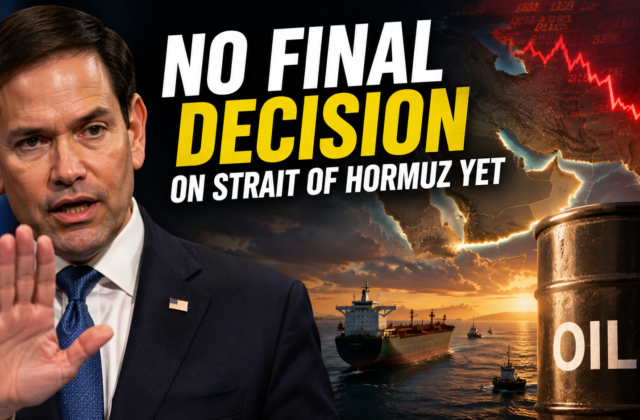
Marco Rubio Says No Final Decision on Strait of Hormuz Yet — What It Means for Global Oil Markets U.S. Secretary of State Marco Rubio says negotiations over the Strait of Hormuz are making progress, but no final agreement has been reached yet. The uncertainty is keeping global oil markets on edge, even as crude...
Jaames Land
Aug 4, 2026 · 3 min Read
Key Highlights
- 🛢️ Brent crude recently fell to around $80.47 a barrel.
- 📉 WTI dropped to approximately $76.67, as traders priced in greater hopes of diplomatic progress.
- 🇺🇸 Marco Rubio says negotiations have made progress, but there is still no final agreement to reopen the Strait.
- 🚢 A recent strike involving a commercial vessel has highlighted continuing risks to shipping.
- 🌍 The Strait of Hormuz remains one of the world's most important energy chokepoints.
- ⚠️ A breakdown in negotiations could quickly reverse the recent decline in oil prices.
- 📈 A durable reopening could reduce the geopolitical risk premium embedded in crude prices.
Marco Rubio Says No Final Decision on Strait of Hormuz Yet — What It Means for Global Oil Markets
U.S. Secretary of State Marco Rubio says negotiations over the Strait of Hormuz are making progress, but no final agreement has been reached yet. The uncertainty is keeping global oil markets on edge, even as crude prices have fallen sharply on hopes that the crucial shipping route could reopen.
The latest developments are creating a complicated picture for energy traders. On one hand, diplomatic progress has raised expectations that shipping through the Strait could eventually normalize. On the other, a new strike on a commercial vessel and unresolved disagreements between the United States and Iran are reminding markets that a deal is far from guaranteed.
What Did Marco Rubio Say About Hormuz?
The latest comments from Rubio come as Washington and regional mediators work toward a possible arrangement that could restore shipping through the Strait of Hormuz.
Reuters reported that Rubio and Treasury Secretary Scott Bessent indicated negotiations were progressing and that restored shipping could potentially be achieved soon. However, the discussions have not produced a finalized agreement.
That distinction is crucial for financial markets.
Investors are currently reacting to the possibility of a reopening rather than a confirmed return to normal shipping.
And oil markets are particularly sensitive to that difference.
Why Is the Strait of Hormuz So Important?
The Strait of Hormuz connects the Persian Gulf with the Gulf of Oman and the wider global shipping network.
Major energy exporters in the Gulf depend heavily on the waterway to move crude and other petroleum products to international customers.
When shipping through the Strait is threatened, traders immediately begin calculating the possibility of tighter global supply.
That can push crude prices higher.
When the probability of reopening increases, the opposite can happen.
That’s why the latest diplomatic developments have had such a visible impact on oil prices.
Oil Prices Are Already Responding
Oil markets have reacted strongly to signs that diplomacy could reduce the disruption.
Brent crude recently fell 3.9% to $80.47 per barrel, while U.S. West Texas Intermediate dropped 4.6% to $76.67, according to Reuters.
The decline pushed oil to around a three-week low.
The market’s message is relatively straightforward:
More confidence in a Hormuz reopening = lower supply-risk premium.
But that doesn’t mean the oil crisis is over.
The market remains vulnerable to sudden changes in the diplomatic and military situation.
No Final Deal Means Oil Could Reverse Quickly
The biggest risk for oil traders is that expectations become detached from reality.
A diplomatic proposal may be circulating, and officials may be optimistic, but the agreement still needs to be finalized and implemented.
The Wall Street Journal reported that negotiations remain complicated by disagreements over issues including fees, sanctions relief, security arrangements and control of the waterway. A recent strike on a cargo vessel has also raised fresh concerns about shipping safety.
This means oil prices could remain highly volatile.
If a deal is finalized:
Hormuz reopening → shipping improves → supply fears ease → oil prices potentially fall further
If negotiations collapse:
Hormuz remains restricted → supply concerns return → oil prices potentially rebound
What Happens If Hormuz Reopens?
A durable reopening could have significant consequences for the global energy market.
1. Oil Supply Risks Could Decline
More tankers would potentially be able to transport crude from Gulf producers to international markets.
2. The Geopolitical Premium Could Shrink
Oil prices often incorporate an additional premium when traders fear war or supply disruption.
A stable reopening could remove some of that premium.
3. Global Fuel Costs Could Eventually Ease
Lower crude prices can eventually feed through to gasoline, diesel, aviation fuel and other energy costs.
4. Inflation Pressure Could Decline
Cheaper energy can reduce costs across transportation, manufacturing and logistics.
5. Oil Producers Could Face Pressure
A prolonged decline in crude prices can reduce revenue for energy producers and oil-dependent economies.
What If Hormuz Remains Closed or Restricted?
The opposite scenario could create another sharp move higher.
If tanker traffic remains restricted, crude supplies from the Gulf could face continuing disruptions.
That would create several potential consequences:
- Higher oil prices
- More expensive gasoline
- Higher transportation costs
- Increased inflation pressure
- Greater pressure on central banks
- Potentially weaker consumer spending
- Increased volatility in global stock markets
The longer the disruption lasts, the more significant these effects could become.
The Market Is Trading Expectations, Not Certainty
This is perhaps the most important point for investors.
Oil has already fallen substantially because markets are becoming more optimistic about diplomacy.
But oil prices can move before physical supply flows actually normalize.
A tanker route doesn’t return to normal simply because officials announce progress.
Shipping companies, insurers, traders and energy producers also need confidence that vessels can travel safely.
The recent vessel strike demonstrates why that confidence remains fragile.
Why the $80 Oil Level Matters
Brent crude moving toward $80 is significant for financial markets.
A sustained move below that level could suggest that traders increasingly believe the worst supply-disruption scenarios are fading.
But a rebound above $80 — especially if accompanied by renewed geopolitical escalation — could indicate that the market is rebuilding its risk premium.
That’s why traders will be watching the $80 level closely.
The question isn’t simply whether Brent touches $80.
It’s whether it can remain below that threshold as the geopolitical situation develops.
What It Means for Inflation
Oil prices have a direct and indirect influence on inflation.
Higher crude prices can increase:
Gasoline → transportation → shipping → production costs → consumer prices
A sustained decline in oil could therefore provide some relief to inflation.
That would be particularly important for central banks already trying to balance price stability against economic growth.
But the inflation impact depends on how long the oil-price move lasts.
A temporary drop caused by diplomatic headlines may have a much smaller effect than a sustained decline resulting from normalized supply.
What It Means for the Federal Reserve
The oil market can complicate Federal Reserve policy.
If crude prices rise sharply because of geopolitical disruptions, inflation could become more difficult to control.
That could make policymakers more cautious about cutting interest rates.
If oil prices instead decline and remain lower, inflation pressures could ease.
That could potentially give the Fed more flexibility.
However, the Federal Reserve does not set interest rates based on oil prices alone.
Core inflation, employment, consumer spending and broader economic conditions remain critical.
What It Means for Stocks
Oil prices can affect different parts of the stock market in very different ways.
Potential Winners From Lower Oil
- Airlines
- Transportation companies
- Consumer businesses
- Manufacturing companies
- Oil-importing economies
Lower energy costs can improve margins for businesses that consume large amounts of fuel.
Potential Losers
- Oil producers
- Oil-service companies
- Some energy exporters
A sustained crude-price decline can reduce expected earnings for energy companies.
Broader Market
If lower oil prices help reduce inflation without signaling a major economic slowdown, stocks could benefit from expectations of easier monetary policy.
But if oil falls because global demand is collapsing, the market could interpret the move very differently.
Why Shipping Safety Is Now Critical
Even if diplomats reach an agreement, shipping companies will want evidence that the route is genuinely safe.
The latest reports indicate that Gulf shipping traffic has improved somewhat, but disruptions remain.
That creates a potential gap between:
Political agreement
and
Actual normalization of shipping.
Oil markets will likely pay close attention to tanker movements, insurance costs and evidence of sustained commercial traffic through the Strait.
Three Possible Oil Market Scenarios
🟢 Bullish for Global Energy Stability
A final agreement is reached, shipping resumes reliably and geopolitical tensions decline.
Potential result: Brent could face additional downward pressure.
🟡 Prolonged Uncertainty
Negotiations continue without a final agreement while some shipping activity resumes.
Potential result: Oil remains volatile around current levels.
🔴 Renewed Escalation
Talks collapse or attacks on shipping increase.
Potential result: Supply fears return and crude prices could surge again.
What Traders Should Watch Next
The most important market catalysts include:
- Final U.S.-Iran diplomatic agreement
- Strait of Hormuz shipping activity
- Commercial vessel security
- Iranian oil exports
- Gulf production
- OPEC+ policy
- U.S. crude inventories
- Tanker insurance rates
- Brent crude’s reaction around $80
- Federal Reserve inflation expectations
Among these, the actual reopening and sustained safe passage of tankers may ultimately matter more than political statements.
Global Oil Market Outlook
The near-term outlook remains extremely sensitive to headlines.
Oil prices have already moved lower because traders see a greater possibility of a diplomatic solution.
But the lack of a final agreement means the market cannot completely remove the geopolitical risk premium.
Reuters reported that Goldman Sachs expects Brent to remain roughly in the $80-$90 range, depending on whether diplomatic or military developments dominate the market.
That range highlights the uncertainty facing energy traders.
A successful agreement could push prices lower.
A breakdown could send them sharply higher.
Final Thoughts
Marco Rubio’s latest comments underline the biggest issue facing global oil markets right now: progress does not necessarily mean a deal.
Negotiations over the Strait of Hormuz appear to be moving forward, but there is still no finalized agreement. At the same time, shipping risks remain, including a recent vessel strike that has complicated hopes for a rapid return to normal.
Oil prices have responded by falling sharply, with Brent recently around $80.47 and WTI near $76.67.
The next major move could depend on whether diplomatic progress becomes an actual agreement.
If Hormuz reopens safely and consistently, global oil markets could enter a period of normalization. If negotiations fail, the recent oil-price decline could reverse quickly.
For investors, the message is simple:
Watch the Strait — not just the headlines.
❓ FAQs
What did Marco Rubio say about the Strait of Hormuz?
Rubio indicated that progress was being made in efforts to reopen the Strait, but reporting on August 4 indicates that no final agreement had been reached.
Why is the Strait of Hormuz important for oil?
It is a critical maritime route for energy shipments from the Persian Gulf. Restrictions can create concerns about global supply and push crude prices higher.
Why did oil prices fall?
Oil prices declined as traders became more optimistic that diplomatic efforts could eventually restore shipping through the Strait of Hormuz.
Could oil prices rise again?
Yes. A collapse in negotiations, renewed attacks or continued restrictions on shipping could restore the geopolitical risk premium and push crude prices higher.
What is Brent crude trading around?
Brent recently traded around $80.47 per barrel, according to Reuters. Market prices can change continuously.
What happens if Hormuz fully reopens?
A sustained reopening could increase confidence in global energy supplies, reduce the geopolitical risk premium and potentially put downward pressure on crude prices.
Does a lower oil price mean lower inflation?
Potentially, if lower crude prices persist. Cheaper energy can reduce transportation and production costs, although the overall inflation effect depends on broader economic conditions.
📰 About The Business Now
The Business Now delivers coverage of business, finance, commodities, energy, geopolitics, stocks and global markets with fact-based reporting and analysis.
🪙 Check Live Gold Prices
Track Gold, Silver, Platinum and Palladium prices, historical charts, calculators and daily market updates at:
🌐 External Resources
Keep reading
Related Articles
 Crypto
₿ Bitcoin Breaks Above $72,000: Why Trump’s Crypto Push Is Sending Crypto Stocks Higher
Bitcoin’s $72,000 Move Is Bigger Than Bitcoin A typical crypto headline would be: Bitcoin jumps above $72,000. But that misses the most important part of today’s move. The interesting part is the simultaneous rally in: Bitcoin ↓ Coinbase ↓ Strategy ↓ Circle ↓ Robinhood ↓ Bitcoin miners ↓ Crypto infrastructure That tells us investors aren’t...
 Markets
U.S. Treasury Doubles Bond Buybacks: Why Markets Are Still Worried About Rising Yields
The Treasury Just Sent Two Messages to Wall Street At first glance, this looks like a straightforward market-support operation. Treasury says: We want to improve liquidity in longer-dated Treasury securities. Investors hear: Washington is increasingly concerned about the rise in long-term borrowing costs. And that second interpretation is what makes this story important. The Treasury...
 Commodities
Oil Nears $95: Could the Iran War Trigger a New U.S. Inflation Shock?
Oil at $95 Is Not the Real Story A crude-oil headline is easy to write: “Oil prices rise as Iran tensions escalate.” Reuters, Bloomberg, CNBC and WSJ can publish that story within minutes. But for TheBusinessNow, that isn’t enough. The bigger question is: What happens to the American economy if oil stays near $95 —...
Comments (0)