
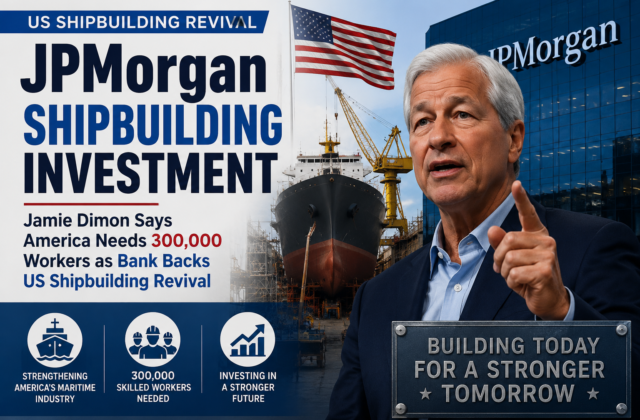
JPMorgan Shipbuilding Investment: Jamie Dimon Says America Needs 300,000 Workers as Bank Backs US Shipbuilding Revival
JPMorgan Shipbuilding Investment: Why Wall Street Is Betting on America’s Maritime Comeback The JPMorgan Shipbuilding Investment is emerging as one of the biggest industrial stories of 2026 after JPMorgan Chase announced a major push to support America’s shipbuilding sector. CEO Jamie Dimon said the United States needs around 300,000 skilled workers to rebuild its shipbuilding...
TheBusinessNow
Jul 17, 2026 · 3 min Read
Key Highlights
- 🚢 JPMorgan announces a $24 million shipbuilding investment.
- 👷 Jamie Dimon says the US needs 300,000 shipbuilding workers.
- 💰 Many shipbuilding jobs could pay up to $100,000 without a college degree.
- 🇺🇸 Investment supports America's manufacturing and defense industries.
- ⚓ Shipbuilding demand is rising due to defense modernization and global trade.
- 📈 Investors are watching shipbuilding companies and defense suppliers closely.
JPMorgan Shipbuilding Investment: Why Wall Street Is Betting on America’s Maritime Comeback
The JPMorgan Shipbuilding Investment is emerging as one of the biggest industrial stories of 2026 after JPMorgan Chase announced a major push to support America’s shipbuilding sector. CEO Jamie Dimon said the United States needs around 300,000 skilled workers to rebuild its shipbuilding industry, adding that many of these jobs could pay up to $100,000 annually without requiring a college degree.
Alongside those remarks, JPMorgan announced a $24 million investment initiative aimed at strengthening the country’s maritime manufacturing workforce and supporting companies involved in naval and commercial ship production.
The move highlights growing confidence that shipbuilding could become one of America’s next major industrial growth sectors as geopolitical tensions, supply-chain security, and defense spending continue to rise.
Why JPMorgan Shipbuilding Investment Is Making Headlines
The JPMorgan Shipbuilding Investment reflects a broader effort to rebuild critical American industries that have declined over recent decades.
According to JPMorgan, expanding domestic shipbuilding capacity is becoming increasingly important because of:
- Growing naval modernization
- Supply chain resilience
- National security concerns
- Rising commercial shipping demand
- Manufacturing job creation
Rather than focusing only on financial returns, the investment also seeks to address America’s shortage of skilled industrial workers.
Jamie Dimon Says America Needs 300,000 Shipbuilding Workers
One of the biggest talking points from the announcement came from Jamie Dimon, who emphasized the urgent need for a larger skilled workforce.
He stated that approximately 300,000 workers will be required to rebuild the country’s shipbuilding capabilities.
Dimon also highlighted that many careers in the industry offer:
- Annual salaries approaching $100,000
- Apprenticeship opportunities
- Technical training
- Long-term career stability
- No requirement for a traditional four-year college degree
His comments have reignited discussions about vocational education and workforce development across the United States.
How the $24 Million JPMorgan Shipbuilding Investment Will Be Used
The investment is expected to support initiatives including:
Workforce Training
Programs designed to prepare welders, electricians, engineers, machinists, and technicians for shipbuilding careers.
Manufacturing Expansion
Helping suppliers expand production capacity for naval and commercial ship components.
Regional Economic Development
Supporting communities with strong maritime manufacturing traditions, including Philadelphia and other major shipbuilding hubs.
Defense Supply Chain
Strengthening suppliers that contribute to US naval modernization and national security.
Why Shipbuilding Is Becoming a Strategic Industry Again
The global shipbuilding landscape is changing rapidly.
Governments around the world are investing heavily in:
- Naval defense
- Commercial shipping fleets
- Maritime logistics
- Offshore energy infrastructure
- Port modernization
For the United States, rebuilding domestic shipbuilding capacity is increasingly viewed as both an economic and strategic priority.
What This Means for Investors
The JPMorgan Shipbuilding Investment could increase investor attention on several industries.
Potential beneficiaries include:
- Shipbuilding companies
- Defense contractors
- Steel manufacturers
- Industrial equipment suppliers
- Engineering firms
- Workforce training organizations
While the investment itself is relatively modest compared with JPMorgan’s overall business, analysts say it signals growing institutional confidence in America’s industrial revival.
Could Shipbuilding Become America’s Next Manufacturing Boom?
Many economists believe shipbuilding could experience significant long-term growth if government support and private investment continue expanding.
Key growth drivers include:
- Increased defense budgets
- Rising global trade
- Infrastructure modernization
- Skilled labor investment
- Domestic manufacturing incentives
Jamie Dimon’s comments suggest Wall Street increasingly sees shipbuilding as more than just a defense industry—it may become a major source of future economic growth.
Challenges Facing the Industry
Despite growing optimism, several obstacles remain.
These include:
- Skilled labor shortages
- Rising material costs
- Long construction timelines
- Global competition
- Supply-chain constraints
- Workforce training requirements
Successfully rebuilding the industry will require collaboration between government, financial institutions, manufacturers, and educational organizations.
Final Thoughts
The JPMorgan Shipbuilding Investment represents more than a financial commitment—it signals renewed confidence in American manufacturing, skilled labor, and industrial competitiveness.
Jamie Dimon’s call for 300,000 new shipbuilding workers underscores the scale of the opportunity facing the United States. If investments continue and workforce development accelerates, shipbuilding could become one of the country’s fastest-growing industrial sectors over the next decade.
For investors, policymakers, and job seekers alike, this is a trend worth watching closely.
Frequently Asked Questions (FAQs)
What is the JPMorgan Shipbuilding Investment?
JPMorgan announced a $24 million investment to support America’s shipbuilding industry through workforce development and manufacturing initiatives.
Why did Jamie Dimon say 300,000 workers are needed?
Jamie Dimon believes the US requires around 300,000 skilled workers to rebuild domestic shipbuilding capacity and strengthen manufacturing.
How much can shipbuilding workers earn?
According to Jamie Dimon, many skilled shipbuilding jobs can pay around $100,000 per year, often without requiring a college degree.
Why is shipbuilding important for the US economy?
Shipbuilding supports national defense, commercial shipping, manufacturing jobs, and supply-chain resilience while strengthening domestic industrial capabilities.
Which industries could benefit from JPMorgan’s investment?
Defense contractors, shipbuilders, steel producers, engineering firms, equipment manufacturers,
About TheBusinessNow
TheBusinessNow delivers global coverage of business, finance, technology, geopolitics, commodities, and economic trends. Our goal is to provide readers with original, fact-based analysis that explains how world events shape markets and investment decisions.
Read More – Brenda Fricker Dies at 81: Oscar-Winning Actress and ‘Home Alone 2’ Star Leaves Behind a Legendary Legacy
You May also Read – Stop E20 Petrol Petition Crosses 1.21 Lakh Signatures , Sonam Wangchuk Hunger Strike: Congress Leader Sandeep Dikshit Urges Careful Consideration Before Protest
Gold Calculator – Gold Price Calculator
Watch S&P Futures, Dow Futures, Nasdaq, Russel Live
Keep reading
Related Articles
 Crypto
₿ Bitcoin Breaks Above $72,000: Why Trump’s Crypto Push Is Sending Crypto Stocks Higher
Bitcoin’s $72,000 Move Is Bigger Than Bitcoin A typical crypto headline would be: Bitcoin jumps above $72,000. But that misses the most important part of today’s move. The interesting part is the simultaneous rally in: Bitcoin ↓ Coinbase ↓ Strategy ↓ Circle ↓ Robinhood ↓ Bitcoin miners ↓ Crypto infrastructure That tells us investors aren’t...
 Markets
U.S. Treasury Doubles Bond Buybacks: Why Markets Are Still Worried About Rising Yields
The Treasury Just Sent Two Messages to Wall Street At first glance, this looks like a straightforward market-support operation. Treasury says: We want to improve liquidity in longer-dated Treasury securities. Investors hear: Washington is increasingly concerned about the rise in long-term borrowing costs. And that second interpretation is what makes this story important. The Treasury...
 Commodities
Oil Nears $95: Could the Iran War Trigger a New U.S. Inflation Shock?
Oil at $95 Is Not the Real Story A crude-oil headline is easy to write: “Oil prices rise as Iran tensions escalate.” Reuters, Bloomberg, CNBC and WSJ can publish that story within minutes. But for TheBusinessNow, that isn’t enough. The bigger question is: What happens to the American economy if oil stays near $95 —...
Comments (0)