
Google’s Next AI Leap Begins: Gemini Spark Is Rolling Out—Could This Be the End of Traditional AI Chatbots?
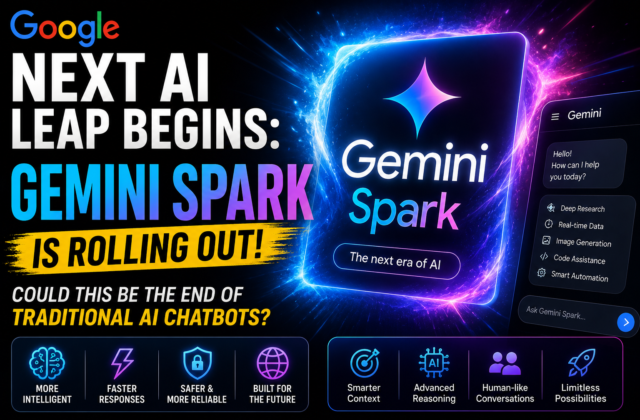
Google’s Next AI Leap Begins: Gemini Spark Is Rolling Out—Could This Be the End of Traditional AI Chatbots? The artificial intelligence race has entered a new chapter. Google is expanding access to Gemini Spark, its latest agentic AI assistant, allowing more Google AI Pro users in the United States to try technology that moves beyond...
TheBusinessNow
Jul 24, 2026 · 3 min Read
Key Highlights
- 🚀 Google has expanded access to Gemini Spark for more Google AI Pro users.
- 🤖 Gemini Spark introduces agentic AI, capable of planning and executing multi-step tasks.
- 💼 Google is shifting beyond traditional chatbots toward AI-powered digital assistants.
- ⚔️ The rollout intensifies competition with ChatGPT, Microsoft Copilot, and Anthropic Claude.
- 📈 Businesses may benefit from greater AI-powered productivity and workflow automation.
- 🌐 Gemini Spark signals the next stage of AI, where assistants do more than generate text—they help complete work.
Google’s Next AI Leap Begins: Gemini Spark Is Rolling Out—Could This Be the End of Traditional AI Chatbots?
The artificial intelligence race has entered a new chapter.
Google is expanding access to Gemini Spark, its latest agentic AI assistant, allowing more Google AI Pro users in the United States to try technology that moves beyond simple conversations.
Unlike traditional AI chatbots that primarily answer questions, Gemini Spark is designed to plan, reason, and complete tasks with limited user intervention.
This shift represents one of Google’s clearest signals yet that the future of AI isn’t just about generating text—it’s about getting work done.
What Is Gemini Spark?
Gemini Spark is an experimental AI feature built on Google’s Gemini ecosystem.
Instead of waiting for users to provide every instruction step by step, Spark can help organize multi-step workflows by:
- Planning tasks
- Breaking projects into stages
- Researching information
- Coordinating actions
- Completing complex requests
Google describes this approach as agentic AI—software capable of carrying out tasks rather than simply responding to prompts.
What Makes Agentic AI Different?
Traditional AI chatbots typically operate like digital search engines.
You ask a question.
They answer.
Agentic AI changes that model.
Instead of asking:
“How do I plan a business trip?”
You might simply say:
“Plan my business trip.”
The AI could potentially:
- Research flights
- Compare hotels
- Build an itinerary
- Organize documents
- Suggest schedules
Rather than generating information alone, agentic AI is designed to take initiative within defined limits.
Why Google Is Betting Big on Agentic AI
The AI industry is evolving rapidly.
Over the past two years, competition has intensified among:
- OpenAI
- Microsoft
- Anthropic
- Meta
- Amazon
Each company is now trying to build AI systems capable of functioning as digital assistants rather than text generators.
Google believes the next major opportunity lies in AI that helps users complete real-world work more efficiently.
Gemini Spark Expands to More Users
Google has started expanding Gemini Spark access to Google AI Pro subscribers in the United States.
The rollout allows more users to experiment with:
- Advanced reasoning
- Task planning
- Workflow assistance
- Agentic AI capabilities
Because the feature remains experimental, availability may continue expanding gradually over time.
Why This Matters for Businesses
Businesses may benefit significantly from agentic AI.
Potential applications include:
Productivity
Automating repetitive administrative work.
Research
Gathering information from multiple sources.
Project Management
Breaking large projects into manageable tasks.
Customer Service
Handling more sophisticated customer interactions.
Content Creation
Supporting writing, editing, planning, and publishing workflows.
If successful, these capabilities could reduce manual effort across many industries.
Could This Change Everyday Internet Use?
Possibly.
Instead of opening multiple apps to complete one task, future AI assistants may coordinate activities across different services.
Imagine asking an AI to:
- Plan a vacation
- Create a presentation
- Organize a meeting
- Compare products
- Build financial reports
without manually switching between numerous websites and applications.
That vision is driving much of today’s AI development.
Google’s Challenge
Despite the excitement, several challenges remain.
Agentic AI requires:
- Reliable reasoning
- Accurate information
- Strong privacy protections
- User trust
- Clear permission systems
Google must also ensure the AI performs actions safely and transparently before broader adoption.
Competition Is Intensifying
Google is not alone.
OpenAI continues expanding ChatGPT’s capabilities.
Microsoft integrates AI deeply into Windows and Microsoft 365.
Anthropic focuses on enterprise AI.
Meta continues investing in open AI models.
The competition is no longer just about which chatbot answers questions best.
It is about which AI becomes the most useful digital assistant.
Will Traditional Chatbots Disappear?
Probably not immediately.
Traditional conversational AI will still remain useful for:
- Quick questions
- Brainstorming
- Learning
- Writing assistance
- Coding help
However, agentic AI may gradually become the preferred option for users who want AI to actively help complete tasks instead of simply providing information.
The two approaches are likely to coexist for several years.
Privacy and Security Questions
As AI gains greater ability to perform actions, concerns about privacy become increasingly important.
Users will likely expect:
- Greater transparency
- Clear permissions
- Secure handling of personal data
- Strong human oversight
Building trust may prove just as important as improving AI capabilities.
What Investors Are Watching
Artificial intelligence remains one of the fastest-growing technology sectors.
Investors are monitoring:
- AI subscription growth
- Enterprise adoption
- Productivity gains
- Cloud computing demand
- Semiconductor demand
- AI infrastructure spending
Products like Gemini Spark could influence future revenue opportunities across Google’s software, cloud, and AI businesses.
Final Analysis
Gemini Spark represents more than another chatbot update—it reflects Google’s broader vision for the next generation of artificial intelligence. By introducing agentic capabilities that can help plan, organize, and execute tasks, Google is moving AI beyond conversation toward practical digital assistance.
The technology is still in its early stages, and questions remain around reliability, privacy, and real-world performance. Even so, the direction is clear: the AI industry is shifting from systems that simply answer questions to systems designed to work alongside users.
Whether Gemini Spark ultimately becomes the defining AI assistant or one of many competing platforms, its rollout signals that the future of artificial intelligence may be measured not only by what it knows—but by what it can accomplish.
❓ Frequently Asked Questions (FAQs)
1. What is Google Gemini Spark?
Google Gemini Spark is an experimental agentic AI assistant built on the Gemini platform. Unlike traditional chatbots, it is designed to help users plan, organize, and complete multi-step tasks instead of simply answering questions.
2. What does “agentic AI” mean?
Agentic AI refers to artificial intelligence that can reason, plan, and perform tasks with limited user intervention. It goes beyond conversation by helping users accomplish real-world objectives.
3. Who can use Gemini Spark?
Google is rolling out Gemini Spark to Google AI Pro users in the United States. Availability is expanding gradually as Google continues testing the feature.
4. How is Gemini Spark different from traditional AI chatbots?
Traditional chatbots mainly generate responses to prompts. Gemini Spark aims to manage workflows, organize projects, conduct research, and assist with complex multi-step tasks.
5. Will Gemini Spark compete with ChatGPT?
Yes. Gemini Spark is part of Google’s broader strategy to compete in the rapidly evolving AI assistant market alongside ChatGPT, Microsoft Copilot, Anthropic Claude, and other advanced AI platforms.
6. Is Gemini Spark available worldwide?
Currently, Google is expanding access primarily to eligible users in the United States. A broader international rollout may occur in future phases.
7. Why is Gemini Spark important?
Gemini Spark represents Google’s move toward the next generation of AI assistants that focus on productivity, automation, and task execution rather than only conversation.
🌍 About The Business Now
The Business Now delivers trusted reporting and expert analysis on:
- 🤖 Artificial Intelligence & Technology
- 📈 Global Markets & Investing
- 🌍 Geopolitics & International Affairs
- 🏦 Business & Economy
- 💼 Corporate Strategy & Innovation
- 🛢️ Gold, Oil & Commodities
- 🚀 Startups & Emerging Technologies
We simplify complex global developments with fact-based journalism, helping readers understand how innovation, business, and world events shape the future.
The Business Now — Global News. Business Intelligence. Market Insights.
🟡 Check Live Gold Prices
Stay updated with:
- 🟡 Live 24K Gold Price
- 🟠 Live 22K Gold Price
- 🟤 Live 18K Gold Price
- ⚪ Live Silver Price
- 🌍 International Spot Gold Rates
- 📈 Gold Price Charts
- 🧮 Gold Investment Calculator
Visit GoldPriceNow.in for the latest precious metals prices and market updates.

Keep reading
Related Articles
 Crypto
₿ Bitcoin Breaks Above $72,000: Why Trump’s Crypto Push Is Sending Crypto Stocks Higher
Bitcoin’s $72,000 Move Is Bigger Than Bitcoin A typical crypto headline would be: Bitcoin jumps above $72,000. But that misses the most important part of today’s move. The interesting part is the simultaneous rally in: Bitcoin ↓ Coinbase ↓ Strategy ↓ Circle ↓ Robinhood ↓ Bitcoin miners ↓ Crypto infrastructure That tells us investors aren’t...
 Business
Japan’s Bond Market Is Sending a Warning: 10-Year Yields Near 3% Put the BOJ and Government Under Pressure
Japan’s Bond Market Is Sending a Warning: 10-Year Yields Near 3% Put the BOJ and Government Under Pressure Japan’s once-unthinkably low borrowing costs are disappearing. As the 10-year Japanese government bond yield approaches 3%, investors are reassessing inflation, government spending, the yen and the next move from the Bank of Japan. Japan’s bond market is...
 Business
$23.8 Million Judgment Pushes Ice Cream Maker Into Bankruptcy: What Rebel Creamery’s Collapse Means for U.S. Consumer Brands
Rebel Creamery Files for Bankruptcy After $23.8 Million Judgment: The Business Story Behind the Ice Cream Collapse A U.S. ice cream company whose products are sold through major grocery retailers including Walmart, Kroger and Safeway has filed for Chapter 11 bankruptcy protection while appealing a nearly $23.8 million court judgment. Rebel Creamery LLC filed for...
Comments (0)