
Global Stock Market Crash Today: Asian Markets Sink as Sensex, Nifty, Nikkei and Shanghai Extend Worldwide Sell-Off
Global financial markets witnessed a broad-based sell-off on Wednesday as investors reacted to rising economic uncertainty, geopolitical tensions, and cautious expectations surrounding central bank policies. Major Asian benchmark indices closed sharply lower, adding to concerns that volatility may continue across global equity markets. Investors worldwide shifted toward safer assets as risk appetite weakened. India’s benchmark...
Ruman Paul
Jul 8, 2026 · 4 Min Read
Key Highlights
- Global Markets Turn Red as Investors Flee Risk Assets
Global financial markets witnessed a broad-based sell-off on Wednesday as investors reacted to rising economic uncertainty, geopolitical tensions, and cautious expectations surrounding central bank policies.
Major Asian benchmark indices closed sharply lower, adding to concerns that volatility may continue across global equity markets. Investors worldwide shifted toward safer assets as risk appetite weakened.
India’s benchmark indices suffered one of their steepest declines in recent weeks, while Japan and China also ended the session in negative territory.
Global Market Performance
| Index | Closing Level | Change | % Change |
|---|---|---|---|
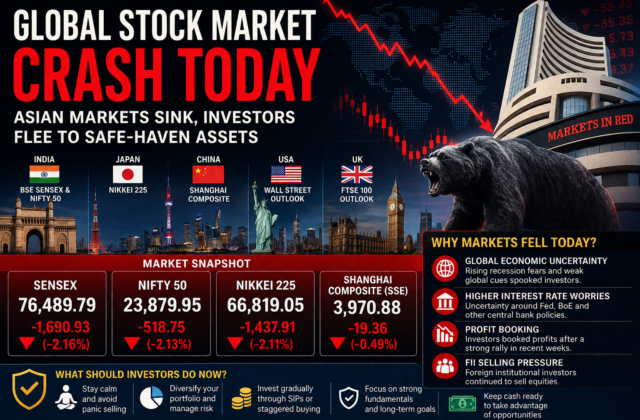
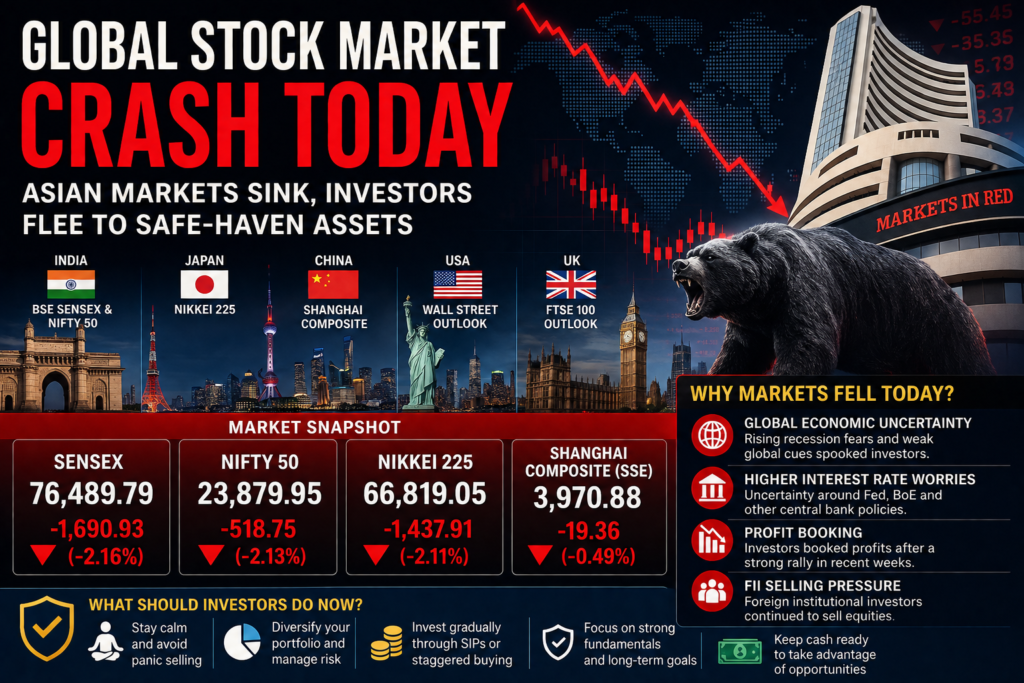
| BSE Sensex (India) | 76,489.79 | -1,690.93 | -2.16% |
| Nifty 50 (India) | 23,879.95 | -518.75 | -2.13% |
| Nikkei 225 (Japan) | 66,819.05 | -1,437.91 | -2.11% |
| Shanghai Composite (China) | 3,970.88 | -19.36 | -0.49% |
The widespread declines underline growing investor concerns about the health of the global economy and the possibility of prolonged market volatility.
Why Are Global Stock Markets Falling?
Several interconnected global factors are driving today’s market decline.
1. Risk-Off Sentiment Returns
Investors across Asia reduced exposure to equities amid growing concerns over slowing economic growth, geopolitical uncertainty, and tighter financial conditions.
When uncertainty rises, institutional investors often rotate capital away from stocks into traditionally safer investments such as government bonds, gold, and cash.
2. Central Bank Uncertainty
Markets remain highly sensitive to signals from major central banks, including the U.S. Federal Reserve, the Bank of England, the European Central Bank, and the Bank of Japan.
Higher-for-longer interest rates continue to pressure corporate earnings, borrowing costs, and consumer spending, making equity valuations more vulnerable.
3. Global Investors Book Profits
Following months of strong gains across several equity markets, portfolio managers and hedge funds appear to be locking in profits.
Large-cap technology companies, banks, financial institutions, industrial stocks, and export-oriented businesses experienced broad selling pressure.
4. Geopolitical Risks Continue to Rise
Ongoing geopolitical tensions in several regions continue to influence investor sentiment.
Financial markets historically become more volatile whenever uncertainty surrounding global trade, energy supplies, or international conflicts increases.
India Experiences One of the Sharpest Declines
Indian equities mirrored the weakness seen across Asia.
The BSE Sensex fell 1,690.93 points (-2.16%), while the Nifty 50 dropped 518.75 points (-2.13%), slipping below the psychologically important 24,000 level.
The decline was broad-based, with banking, information technology, financial services, automobiles, metals, and real estate stocks leading losses.
Foreign institutional investors remained cautious as global funds adjusted portfolios amid changing macroeconomic conditions.
Japan’s Nikkei Extends Global Weakness
Japan’s Nikkei 225 also declined more than 2%, highlighting concerns about global demand, international trade, and slowing economic momentum.
Technology manufacturers and export-focused companies faced increased selling pressure as investors reassessed global growth expectations.
China Shows Relative Resilience
China’s Shanghai Composite Index ended lower but outperformed several regional peers.
Although losses remained relatively limited, investors continue monitoring China’s economic recovery, property sector developments, domestic consumption, and government stimulus measures.
What Does This Mean for US and UK Investors?
Although U.S. and European markets were not part of today’s Asian trading session, declines across major Asian indices often influence investor sentiment before Wall Street and London markets open.
Global investors will closely monitor:
- U.S. stock futures
- Treasury bond yields
- Inflation expectations
- Corporate earnings
- Federal Reserve policy outlook
- Bank of England guidance
- European Central Bank commentary
- Currency market movements
- Oil and commodity prices
If risk aversion continues, major indices such as the S&P 500, Nasdaq, Dow Jones Industrial Average, FTSE 100, DAX, and CAC 40 could also experience heightened volatility.
Global Sectors Under Pressure
Selling was widespread across multiple industries:
- Banking
- Financial Services
- Technology
- Manufacturing
- Automobiles
- Metals & Mining
- Real Estate
- Consumer Discretionary
Meanwhile, defensive sectors including healthcare, utilities, and consumer staples generally outperformed the broader market.
Where Are Investors Moving Their Money?
Periods of elevated uncertainty often trigger capital flows toward traditional safe-haven assets.
Investors are increasingly watching:
- Gold
- U.S. Treasury Bonds
- Government Securities
- Investment Grade Bonds
- Defensive Dividend Stocks
- Cash Holdings
Commodity markets and foreign exchange markets are also expected to remain volatile as investors rebalance portfolios.
What Should Long-Term Investors Do?
Market corrections are a normal part of investing.
Rather than reacting emotionally, many professional investors focus on:
- Maintaining diversified portfolios
- Investing gradually through dollar-cost averaging or SIPs
- Reviewing asset allocation
- Avoiding panic selling
- Monitoring company fundamentals instead of daily price movements
Historically, periods of market volatility have often created opportunities for disciplined long-term investors.
Outlook for Global Markets
Investors worldwide will closely watch upcoming economic data releases, inflation reports, central bank speeches, employment numbers, corporate earnings, and geopolitical developments.
Market direction over the coming sessions is likely to depend on whether global economic data eases recession fears or reinforces concerns about slowing growth and elevated interest rates.
Until greater clarity emerges, analysts expect volatility across equities, commodities, currencies, and bond markets to remain elevated.
Final Thoughts
Wednesday’s market sell-off highlights how interconnected today’s financial markets have become. Sharp declines in India, Japan, and China underscore the growing influence of global macroeconomic forces on investor sentiment.
Whether you’re investing from New York, London, Mumbai, Singapore, Sydney, or Dubai, the current environment reinforces the importance of diversification, disciplined investing, and focusing on long-term financial goals rather than short-term market swings.
As investors await fresh economic data and central bank guidance, global markets are likely to remain highly sensitive to every major development.
About TheBusinessNow :
TheBusinessNow covers global business, technology, finance, startups, markets, AI, and economic trends, providing fact-based analysis for readers worldwide.
Keep reading
Related Articles
 Crypto
₿ Bitcoin Breaks Above $72,000: Why Trump’s Crypto Push Is Sending Crypto Stocks Higher
Bitcoin’s $72,000 Move Is Bigger Than Bitcoin A typical crypto headline would be: Bitcoin jumps above $72,000. But that misses the most important part of today’s move. The interesting part is the simultaneous rally in: Bitcoin ↓ Coinbase ↓ Strategy ↓ Circle ↓ Robinhood ↓ Bitcoin miners ↓ Crypto infrastructure That tells us investors aren’t...
 Markets
U.S. Treasury Doubles Bond Buybacks: Why Markets Are Still Worried About Rising Yields
The Treasury Just Sent Two Messages to Wall Street At first glance, this looks like a straightforward market-support operation. Treasury says: We want to improve liquidity in longer-dated Treasury securities. Investors hear: Washington is increasingly concerned about the rise in long-term borrowing costs. And that second interpretation is what makes this story important. The Treasury...
 Commodities
Oil Nears $95: Could the Iran War Trigger a New U.S. Inflation Shock?
Oil at $95 Is Not the Real Story A crude-oil headline is easy to write: “Oil prices rise as Iran tensions escalate.” Reuters, Bloomberg, CNBC and WSJ can publish that story within minutes. But for TheBusinessNow, that isn’t enough. The bigger question is: What happens to the American economy if oil stays near $95 —...
Comments (0)