
Short Sellers vs. Elon Musk: Is Wall Street Underestimating SpaceX Again?
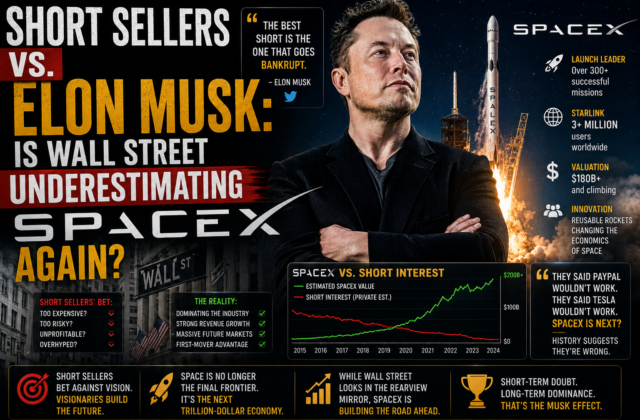
Short Sellers vs. Elon Musk: Is Wall Street Underestimating SpaceX Again? For years, betting against Elon Musk has become one of Wall Street’s most controversial trades. Skeptics have questioned his ambitious timelines, aggressive investments, and sky-high valuations. Yet time and again, Musk’s companies have reshaped industries ranging from electric vehicles to reusable rockets. Now, attention...
TheBusinessNow
Jul 22, 2026 · 3 min Read
Key Highlights
- 🚀 SpaceX has become one of the world's most valuable private companies, fueling debate over whether traditional valuation models can keep pace with disruptive innovation.
- 📉 Wall Street skeptics continue to question Elon Musk's long-term strategy, while supporters point to his history of turning ambitious ideas into commercially successful businesses.
- 🛰️ Starlink, reusable rockets, and government space contracts are expanding SpaceX beyond aerospace into communications, defense, and global infrastructure.
- 💰 Institutional investors are increasingly watching private-market technology leaders, with SpaceX often viewed as a benchmark for the future of the commercial space economy.
- ⚖️ The debate is no longer simply about rockets—it is about how investors should value companies creating entirely new industries.
Short Sellers vs. Elon Musk: Is Wall Street Underestimating SpaceX Again?
For years, betting against Elon Musk has become one of Wall Street’s most controversial trades.
Skeptics have questioned his ambitious timelines, aggressive investments, and sky-high valuations. Yet time and again, Musk’s companies have reshaped industries ranging from electric vehicles to reusable rockets.
Now, attention is turning once again to SpaceX, as growing discussions around short-selling, private-market valuations, and Musk’s expanding influence raise a bigger question:
Is Wall Street once again underestimating Elon Musk?
The debate extends beyond one entrepreneur. It reflects a broader challenge for investors: how do you value companies that redefine entire industries before traditional financial models can fully capture their potential?
Why SpaceX Has Become the Center of Attention
Unlike many publicly traded companies, SpaceX remains privately held, making it unavailable for direct public investment.
However, its influence reaches far beyond private markets.
The company has become a leader in:
- Reusable rocket technology.
- Commercial satellite launches.
- Government space contracts.
- Global broadband through Starlink.
- Emerging space infrastructure.
As SpaceX continues to secure high-profile contracts and expand its launch cadence, many investors view it as one of the world’s most valuable private technology companies.
Why Short Sellers Keep Watching Musk
Short selling is an investment strategy in which investors profit if an asset’s price declines.
While SpaceX itself is private, Musk’s broader business ecosystem often attracts intense debate.
Critics commonly point to:
- High valuations.
- Execution risks.
- Capital-intensive projects.
- Regulatory uncertainty.
- Competition.
Supporters argue that traditional valuation methods may underestimate companies building entirely new markets.
Musk’s Track Record: Why Opinions Stay Divided
Elon Musk has repeatedly pursued projects that initially faced skepticism.
Examples include:
- Scaling electric vehicles.
- Reusable rocket landings.
- Satellite internet.
- Large-scale battery deployment.
Many of these initiatives were once viewed as highly uncertain before achieving broader commercial success.
That history explains why investors often disagree sharply on Musk-related businesses.
SpaceX Is More Than a Rocket Company
Today, SpaceX operates across several strategic sectors.
🚀 Launch Services
SpaceX conducts frequent commercial and government launches using reusable rockets, helping reduce launch costs.
🛰️ Starlink
The company’s satellite internet network serves customers across numerous countries and continues expanding.
🛡️ National Security
Government agencies increasingly rely on commercial launch providers for space missions.
🌍 Future Exploration
SpaceX continues developing technologies intended for long-duration space missions and future exploration goals.
These multiple business lines contribute to investor interest beyond traditional aerospace comparisons.
Why Investors Are Watching Closely
Several factors explain the growing attention.
AI Needs Space Infrastructure
Artificial intelligence depends on data connectivity, cloud infrastructure, and communications.
Satellite networks may play an increasingly important role in global connectivity.
Government Spending
Space remains a strategic priority for many governments.
Commercial partnerships continue expanding across launch services and communications.
Private Market Interest
Large institutional investors continue showing interest in high-growth private technology companies.
SpaceX frequently appears in discussions about the future of private market investing.
Can Traditional Valuation Models Keep Up?
This is where opinions diverge.
Traditional valuation often emphasizes:
- Current revenue.
- Earnings.
- Cash flow.
- Comparable companies.
Supporters argue that companies pioneering entirely new industries may require different frameworks that also consider:
- Technology leadership.
- Network effects.
- Long-term market creation.
- Strategic positioning.
Neither approach guarantees future success, but the debate illustrates why investors can reach very different conclusions.
The Broader Market Question
The discussion surrounding SpaceX reflects a larger trend.
Investors increasingly ask:
- How should transformative technology companies be valued?
- How much uncertainty should markets accept?
- When does optimism become excessive?
- When does skepticism overlook long-term potential?
These questions extend well beyond one company.
Risks Investors Should Remember
Despite optimism, important risks remain.
They include:
- Execution challenges.
- Regulatory changes.
- Competition.
- Geopolitical uncertainty.
- Capital requirements.
- Technological setbacks.
Long-term investing always involves uncertainty, particularly in industries driven by rapid innovation.
What Wall Street Is Watching
Several developments may shape future investor sentiment.
| Indicator | Why It Matters |
|---|---|
| Launch frequency | Operational execution |
| Starlink expansion | Subscriber growth |
| Government contracts | Revenue visibility |
| Technology development | Long-term competitiveness |
| Global space economy | Market opportunities |
| Investor demand | Private market valuation |
The Future of the Space Economy
The commercial space industry is expanding beyond rocket launches.
Future growth areas include:
- Satellite communications.
- Earth observation.
- Navigation services.
- Space manufacturing.
- Commercial lunar missions.
- Data infrastructure.
Many analysts believe these sectors could grow substantially over the coming decades, although the pace and scale remain uncertain.
Final Analysis
History has shown that Elon Musk often divides opinion.
Supporters see a founder willing to pursue ambitious goals that reshape industries.
Critics emphasize the financial, operational, and execution risks that accompany such projects.
Whether Wall Street is underestimating SpaceX—or appropriately accounting for uncertainty—remains an open question.
What is clear is that SpaceX has become one of the most closely watched private technology companies in the world.
As commercial space, satellite communications, and advanced technology continue evolving, investors will likely keep debating how to value businesses operating at the frontier of innovation.
The next chapter in that debate may not be decided by headlines alone, but by the company’s ability to execute on its long-term vision.
📊 Quick Facts
| Metric | Insight |
|---|---|
| Company | SpaceX (Private) |
| Founder | Elon Musk |
| Key Businesses | Launch services, Starlink, satellite communications |
| Industry | Aerospace & Space Technology |
| Major Customers | Commercial, government, and defense organizations |
| Investor Focus | Growth, innovation, execution, long-term market potential |
❓FAQs
Why are investors discussing SpaceX?
SpaceX is a leading private aerospace company with growing influence in satellite communications, launch services, and commercial space technology.
Can investors buy SpaceX stock?
SpaceX is privately held, so its shares are generally not available to public stock market investors.
What are short sellers concerned about?
Critics often point to valuation, execution risk, competition, regulatory developments, and the challenges of capital-intensive industries.
Why is SpaceX considered important?
Its work in reusable rockets, satellite internet, and commercial launch services has significantly influenced the modern space industry.
Is SpaceX guaranteed to succeed?
No. Like any innovative company, it faces opportunities as well as meaningful risks, and future outcomes remain uncertain.
About TheBusinessNow
TheBusinessNow delivers analysis of business, economics, public policy, governance, geopolitics, commodities, and markets. Our reporting focuses on verified information, multiple perspectives, and evidence-based analysis that helps readers understand the forces shaping India and the global economy.
Keep reading
Related Articles
 Markets
U.S. Treasury Doubles Bond Buybacks: Why Markets Are Still Worried About Rising Yields
The Treasury Just Sent Two Messages to Wall Street At first glance, this looks like a straightforward market-support operation. Treasury says: We want to improve liquidity in longer-dated Treasury securities. Investors hear: Washington is increasingly concerned about the rise in long-term borrowing costs. And that second interpretation is what makes this story important. The Treasury...
 Business
Nike Stock Down 35%: China Crisis Deepens — Is NKE a Bargain or a Dangerous Value Trap?
Nike Stock Is Falling — But Is This Finally the Buying Opportunity Investors Have Been Waiting For? Nike (NYSE: NKE) is facing a problem that goes far beyond a weak quarter. The world’s most recognizable sportswear brand is trying to rebuild growth while dealing with declining sales in China, weaker direct-to-consumer revenue, intense competition and...
 Business
Jamie Dimon Warns UK Against Bank Tax Hike: Could Higher Taxes Push Finance Jobs and Investment Abroad?
Jamie Dimon Warns UK Chancellor Against Higher Bank Taxes JPMorgan Chase CEO Jamie Dimon has issued a fresh warning to the UK’s new Chancellor, John Healey, over proposals to increase taxes on banks, arguing that a less competitive tax environment could ultimately push financial jobs and investment away from Britain. Dimon’s intervention comes ahead of...
Comments (0)