
The 7 Economic Indicators Smart Investors Never Ignore—Most People Notice Them Too Late
The 7 Economic Indicators Smart Investors Never Ignore—Most People Notice Them Too Late Every major market rally and every major stock market crash leaves clues long before the headlines appear. While many retail investors react after markets move, professional investors closely monitor a handful of economic indicators that often reveal where the economy—and markets—could be...
TheBusinessNow
Jul 20, 2026 · 3 min Read
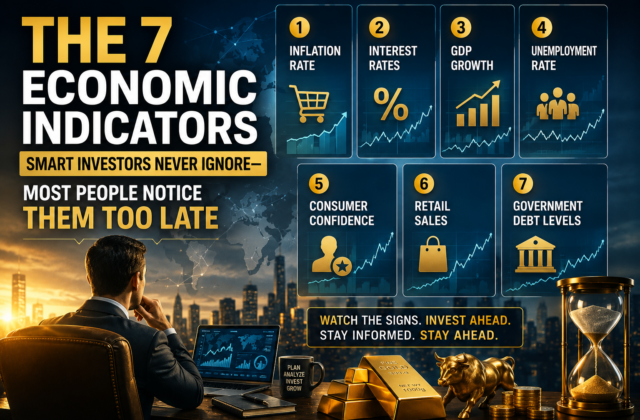
Key Highlights
- 📊 Inflation, interest rates, and GDP remain the three most closely watched economic indicators for global investors.
- 📈 Professional investors monitor economic trends before reacting to market headlines.
- 🏦 Central bank decisions can influence stocks, gold, bonds, and currencies within minutes.
- 🪙 Gold often attracts investors during periods of economic uncertainty and persistent inflation.
- 💵 The US Dollar generally strengthens when interest rates remain elevated.
- ⚠️ Consumer confidence and manufacturing activity often provide early signals about economic momentum.
- 🌍 Understanding these seven indicators can help investors make more informed long-term decisions.
The 7 Economic Indicators Smart Investors Never Ignore—Most People Notice Them Too Late
Every major market rally and every major stock market crash leaves clues long before the headlines appear.
While many retail investors react after markets move, professional investors closely monitor a handful of economic indicators that often reveal where the economy—and markets—could be heading next.
Whether you’re investing in stocks, gold, ETFs, cryptocurrencies, or real estate, understanding these indicators can help you make more informed decisions.
Here’s a closer look at the seven indicators experienced investors rarely ignore.
Why Economic Indicators Matter
Economic indicators are statistics that help measure the health of an economy.
They influence:
- 📈 Stock Markets
- 🪙 Gold Prices
- 💵 US Dollar
- 🏦 Interest Rates
- 🛢️ Oil Prices
- 🏠 Real Estate
- ₿ Cryptocurrency Markets
Markets often react to expectations before official announcements, making these indicators especially important.
1. Inflation (CPI)
Inflation measures how quickly prices for goods and services are rising.
Why Investors Watch It
High inflation reduces purchasing power and often prompts central banks to raise interest rates.
Market Impact
| Inflation Trend | Possible Market Impact |
|---|---|
| Rising | Pressure on stocks, support for gold |
| Falling | Positive for growth stocks |
| Stable | Healthy market environment |
2. Interest Rates
Interest rates are among the most powerful forces influencing financial markets.
Higher rates increase borrowing costs for consumers and businesses.
Why It Matters
Higher rates often:
- Slow economic growth
- Reduce corporate profits
- Strengthen the US Dollar
- Pressure technology stocks
Lower rates generally encourage borrowing, spending, and investment.
3. GDP Growth
Gross Domestic Product (GDP) measures the total value of goods and services produced within an economy.
Positive GDP
- Strong business activity
- Higher consumer spending
- Better corporate earnings
Weak GDP
- Slower growth
- Lower business investment
- Increased recession concerns
GDP remains one of the clearest indicators of economic momentum.
4. Unemployment Rate
Employment reflects the strength of the economy.
Low unemployment usually indicates healthy consumer demand.
However, an extremely tight labor market may also contribute to inflation.
Investors Watch For
✅ Job creation
✅ Wage growth
✅ Labor participation
Strong employment often supports consumer-focused companies.
5. Consumer Confidence
Consumers drive a significant share of economic activity.
When confidence is high, households tend to spend more.
When confidence falls:
- Retail sales weaken
- Travel slows
- Housing demand softens
- Business investment may decline
Investor sentiment often follows consumer sentiment.
6. Manufacturing PMI
The Purchasing Managers’ Index (PMI) provides an early snapshot of business activity.
PMI Above 50
Expansion
PMI Below 50
Contraction
Because it is released monthly, PMI often gives investors an early indication of economic direction before GDP data.
7. Yield Curve
Many economists closely monitor the relationship between short-term and long-term government bond yields.
Normally:
Long-term yields remain above short-term yields.
When short-term yields rise above long-term yields, it may signal growing concerns about future economic growth.
Although not a guarantee of recession, investors often pay close attention when this occurs because it has historically preceded several economic slowdowns.
How Different Assets React
| Indicator | Stocks | Gold | Dollar |
|---|---|---|---|
| Higher Inflation | 📉 | 📈 | Mixed |
| Higher Rates | 📉 | 📉 | 📈 |
| Strong GDP | 📈 | 📉 | 📈 |
| Rising Unemployment | 📉 | 📈 | Mixed |
| Weak Consumer Confidence | 📉 | 📈 | Safe Haven Demand |
| PMI Expansion | 📈 | 📉 | 📈 |
| Yield Curve Stress | 📉 | 📈 | Mixed |
The Biggest Mistake Retail Investors Make
Many investors only react after major headlines appear.
Professional investors often monitor economic data weeks or months before markets fully price in changing conditions.
Instead of relying solely on social media or daily news, experienced investors watch trends across multiple indicators to understand the broader economic picture.
What Investors Should Watch in the Coming Months
Several developments could shape global markets:
- Federal Reserve policy decisions
- Inflation reports
- Employment data
- GDP releases
- Consumer spending trends
- Manufacturing activity
- Geopolitical developments
Together, these factors influence investment decisions across stocks, bonds, commodities, and currencies.
Conclusion
Economic indicators are more than just government statistics—they provide valuable insight into the direction of the economy and financial markets.
No single indicator can predict the future on its own, but monitoring inflation, interest rates, GDP, unemployment, consumer confidence, manufacturing activity, and the yield curve can help investors better understand changing market conditions.
Rather than reacting to headlines after prices move, smart investors use these indicators as part of a broader decision-making process.
Frequently Asked Questions
What are economic indicators?
Economic indicators are statistics that measure the health of an economy, including inflation, GDP, unemployment, and interest rates.
Which economic indicator affects the stock market the most?
Interest rate decisions and inflation data are often among the most influential because they affect borrowing costs, corporate profits, and investor sentiment.
Why do investors monitor GDP?
GDP provides insight into economic growth and business activity, helping investors assess overall economic strength.
Does high inflation always hurt stocks?
Not always. The impact depends on inflation levels, company earnings, interest rates, and investor expectations.
About TheBusinessNow
TheBusinessNow delivers global coverage of business, finance, technology, geopolitics, commodities, and economic trends. Our goal is to provide readers with original, fact-based analysis that explains how world events shape markets and investment decisions.
Watch Gold Price Live – GoldPriceNow.in
Keep reading
Related Articles
 Crypto
₿ Bitcoin Breaks Above $72,000: Why Trump’s Crypto Push Is Sending Crypto Stocks Higher
Bitcoin’s $72,000 Move Is Bigger Than Bitcoin A typical crypto headline would be: Bitcoin jumps above $72,000. But that misses the most important part of today’s move. The interesting part is the simultaneous rally in: Bitcoin ↓ Coinbase ↓ Strategy ↓ Circle ↓ Robinhood ↓ Bitcoin miners ↓ Crypto infrastructure That tells us investors aren’t...
 Markets
U.S. Treasury Doubles Bond Buybacks: Why Markets Are Still Worried About Rising Yields
The Treasury Just Sent Two Messages to Wall Street At first glance, this looks like a straightforward market-support operation. Treasury says: We want to improve liquidity in longer-dated Treasury securities. Investors hear: Washington is increasingly concerned about the rise in long-term borrowing costs. And that second interpretation is what makes this story important. The Treasury...
 Commodities
Oil Nears $95: Could the Iran War Trigger a New U.S. Inflation Shock?
Oil at $95 Is Not the Real Story A crude-oil headline is easy to write: “Oil prices rise as Iran tensions escalate.” Reuters, Bloomberg, CNBC and WSJ can publish that story within minutes. But for TheBusinessNow, that isn’t enough. The bigger question is: What happens to the American economy if oil stays near $95 —...
Comments (0)