
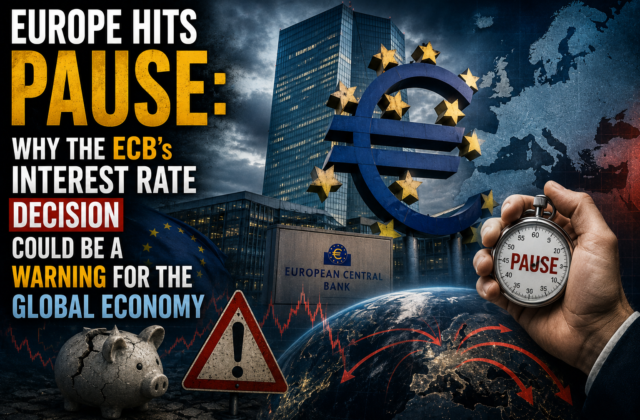
Europe Hits Pause: Why the ECB’s Interest Rate Decision Could Be a Warning for the Global Economy
Europe Hits Pause: Why the ECB’s Interest Rate Decision Could Be a Warning for the Global Economy The European Central Bank (ECB) has chosen caution over action. In its latest monetary policy announcement, the ECB left its key interest rate unchanged at 2.40%, while the Deposit Facility Rate remained at 2.25%, matching economists’ expectations. At...
TheBusinessNow
Jul 23, 2026 · 3 min Read
Key Highlights
- 🇪🇺 The European Central Bank (ECB) kept its main refinancing rate at 2.40% in July, in line with market expectations.
- 🏦 The Deposit Facility Rate remained unchanged at 2.25%, signaling a cautious policy approach.
- 📊 The ECB continues to monitor inflation, economic growth, and labor market trends before making further policy moves.
- 🌍 The decision could influence global bond yields, currency markets, stock markets, and investor sentiment.
- 💶 Businesses and households across Europe continue to face relatively high borrowing costs.
- 📈 Investors are now focused on future ECB guidance and incoming inflation and growth data.
Europe Hits Pause: Why the ECB’s Interest Rate Decision Could Be a Warning for the Global Economy
The European Central Bank (ECB) has chosen caution over action.
In its latest monetary policy announcement, the ECB left its key interest rate unchanged at 2.40%, while the Deposit Facility Rate remained at 2.25%, matching economists’ expectations. At first glance, the decision appeared uneventful. But for investors, economists, and businesses, the move may signal that Europe’s central bank is still navigating a difficult balance between inflation control and economic growth.
While markets widely anticipated the pause, the reasons behind it—and what comes next—could shape financial markets far beyond Europe.
ECB July Decision: The Key Numbers
| Indicator | Latest |
|---|---|
| Main Refinancing Rate | 2.40% |
| Deposit Facility Rate | 2.25% |
| Previous Rate | 2.40% |
| Market Expectation | 2.40% (No Change) |
The ECB’s decision maintains its current policy stance while policymakers continue to assess incoming economic data before making further adjustments.
Why Did the ECB Hold Interest Rates Steady?
Central banks typically adjust interest rates to manage inflation while supporting economic stability.
The ECB’s latest decision reflects several factors:
Inflation Is Moderating but Not Fully Defeated
Inflation across the euro area has eased from previous highs, but policymakers remain focused on ensuring price pressures return sustainably toward the ECB’s medium-term target.
Premature policy easing could risk reigniting inflation.
Economic Growth Remains Uneven
Europe continues to face mixed economic conditions.
Some sectors are showing resilience, while others continue to struggle with weaker demand, higher financing costs, and geopolitical uncertainty.
Holding rates steady gives policymakers more time to evaluate whether economic growth stabilizes without undermining progress on inflation.
Why This Decision Matters Globally
The European Union represents one of the world’s largest economic blocs.
ECB policy influences:
- Global bond markets
- Currency markets
- International investment flows
- Commodity prices
- Banking conditions
- Corporate borrowing costs
Because Europe is deeply integrated into global trade and finance, ECB decisions often affect investors worldwide.
What It Means for Inflation
Higher interest rates generally reduce demand by making borrowing more expensive.
By keeping rates unchanged, the ECB signals that it still believes restrictive monetary policy remains necessary.
Future inflation data will likely determine whether policymakers eventually begin easing monetary policy or maintain the current stance for longer.
What It Means for Businesses
Businesses across Europe continue to operate in an environment of relatively high financing costs.
That affects:
- Business expansion
- Capital investment
- Commercial lending
- Real estate development
- Startup funding
Companies dependent on borrowing may continue facing pressure if rates remain elevated.
Impact on Consumers
European households are also affected by interest-rate policy.
Higher rates can influence:
- Mortgage payments
- Consumer loans
- Credit card borrowing
- Housing affordability
- Household spending
While savers may benefit from higher deposit returns, borrowers often experience increased financing costs.
What Investors Are Watching Next
Markets are now focusing less on today’s decision and more on future guidance.
Key questions include:
- When will the ECB begin reducing rates?
- Is inflation slowing fast enough?
- Will economic growth weaken further?
- How will geopolitical tensions affect energy prices?
- What happens if global trade slows?
These questions will shape expectations for future ECB meetings.
Could This Affect the Euro?
Interest-rate expectations are one of the biggest drivers of currency markets.
If investors expect European rates to remain relatively high, the euro could receive support.
However, exchange rates also depend on:
- Federal Reserve policy
- US economic data
- Global risk sentiment
- Capital flows
- Trade balances
The Global Central Bank Puzzle
The ECB’s decision comes as major central banks continue balancing two competing objectives:
- Keeping inflation under control.
- Avoiding unnecessary economic slowdown.
The U.S. Federal Reserve, the Bank of England, and other major central banks face similar challenges.
This means monetary policy decisions are increasingly interconnected, with changes in one major economy influencing global financial conditions.
Risks Still Facing Europe
Although inflation has moderated, several risks remain:
- Persistent services inflation
- Slower manufacturing activity
- Weak external demand
- Geopolitical tensions affecting energy markets
- Global trade uncertainty
- Elevated government debt in some euro-area economies
These factors help explain why policymakers are proceeding cautiously.
What Could Happen Next?
Several scenarios remain possible:
Scenario 1: Inflation Continues to Ease
If price pressures keep declining while economic growth remains stable, the ECB could eventually begin lowering interest rates.
Scenario 2: Inflation Stays Elevated
If inflation proves more persistent than expected, policymakers may keep rates higher for longer.
Scenario 3: Growth Weakens Sharply
Should economic conditions deteriorate significantly, the ECB could consider monetary easing to support activity, depending on inflation dynamics.
The timing of any future move will depend on incoming economic data rather than a predetermined schedule.
Why Investors Should Pay Attention
Even though the ECB made no policy change, its decisions influence:
- European stock markets
- Global bond yields
- Banking shares
- Real estate
- International trade
- Currency markets
- Commodity prices
- Investor confidence
In modern financial markets, sometimes what central banks choose not to do can be just as important as what they do.
Final Analysis
The European Central Bank’s decision to keep its main interest rate at 2.40% and the Deposit Facility Rate at 2.25% reflects a cautious approach as policymakers assess the path of inflation and economic growth.
While the move was widely expected, it underscores that the ECB is not yet ready to declare victory over inflation or commit to a new easing cycle. Businesses, consumers, and investors across Europe will continue operating in an environment of relatively high borrowing costs while awaiting clearer signals from future economic data.
For global markets, the decision reinforces an important message: major central banks remain data-dependent, and the next phase of monetary policy will likely be shaped by inflation trends, labor markets, energy prices, and geopolitical developments.
Europe may have paused—but the debate over where interest rates go next is far from over.
❓ Frequently Asked Questions (FAQs)
1. What did the ECB decide in July?
The European Central Bank left its main refinancing rate unchanged at 2.40% and its Deposit Facility Rate at 2.25%.
2. Why did the ECB keep interest rates unchanged?
The ECB is balancing slowing inflation with ongoing economic uncertainty and wants more data before changing monetary policy.
3. How does the ECB’s decision affect global markets?
ECB policy can influence the euro, bond yields, stock markets, borrowing costs, and investor confidence across global financial markets.
4. Does this mean rate cuts are coming soon?
Not necessarily. Future decisions will depend on inflation, economic growth, employment data, and financial conditions.
5. Who is most affected by the ECB’s decision?
European households, businesses, banks, investors, exporters, and global financial markets are all affected by ECB interest-rate policy.
6. What should investors watch next?
Upcoming eurozone inflation reports, GDP data, labor market figures, and future ECB policy meetings.
🌐 About The Business Now
The Business Now delivers trusted coverage of global business, finance, markets, technology, geopolitics, AI, energy, and the world economy. Our mission is to explain not just what happened, but why it matters through data-driven analysis, expert insights, and timely reporting that helps readers stay ahead of market-moving events.
Keep reading
Related Articles
 Crypto
₿ Bitcoin Breaks Above $72,000: Why Trump’s Crypto Push Is Sending Crypto Stocks Higher
Bitcoin’s $72,000 Move Is Bigger Than Bitcoin A typical crypto headline would be: Bitcoin jumps above $72,000. But that misses the most important part of today’s move. The interesting part is the simultaneous rally in: Bitcoin ↓ Coinbase ↓ Strategy ↓ Circle ↓ Robinhood ↓ Bitcoin miners ↓ Crypto infrastructure That tells us investors aren’t...
 Markets
U.S. Treasury Doubles Bond Buybacks: Why Markets Are Still Worried About Rising Yields
The Treasury Just Sent Two Messages to Wall Street At first glance, this looks like a straightforward market-support operation. Treasury says: We want to improve liquidity in longer-dated Treasury securities. Investors hear: Washington is increasingly concerned about the rise in long-term borrowing costs. And that second interpretation is what makes this story important. The Treasury...
 Commodities
Oil Nears $95: Could the Iran War Trigger a New U.S. Inflation Shock?
Oil at $95 Is Not the Real Story A crude-oil headline is easy to write: “Oil prices rise as Iran tensions escalate.” Reuters, Bloomberg, CNBC and WSJ can publish that story within minutes. But for TheBusinessNow, that isn’t enough. The bigger question is: What happens to the American economy if oil stays near $95 —...
Comments (0)