
Why Chinese Investors Are Quietly Returning to Wall Street: Is a New U.S. Stock Rally Just Beginning?
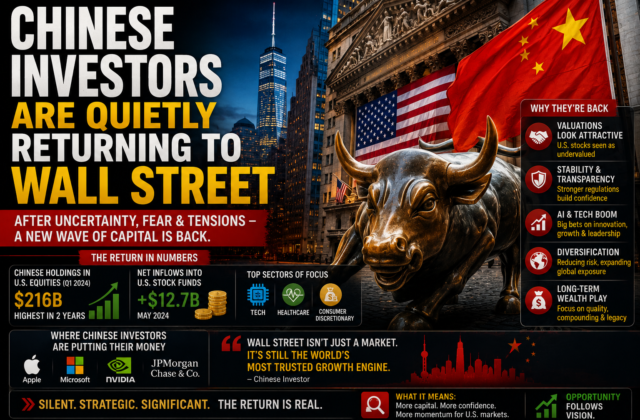
Why Chinese Investors Are Quietly Returning to Wall Street: Is a New U.S. Stock Rally Just Beginning? While most investors are watching inflation, interest rates, and AI stocks, another trend is quietly developing behind the scenes. Chinese capital is gradually finding its way back into U.S. financial markets. It is not happening through dramatic headlines...
TheBusinessNow
Jul 19, 2026 · 4 min Read
Key Highlights
- 📈 Chinese investors are showing renewed interest in selected U.S. equities.
- 💻 Technology and artificial intelligence remain major attractions.
- 💰 Global funds continue to diversify across international markets.
- 🌎 Cross-border capital flows are becoming increasingly important for Wall Street.
- 🏦 Institutional investors are focusing on companies with strong earnings and global exposure.
- 📊 Analysts say foreign investment trends could influence market liquidity and sentiment.
Why Chinese Investors Are Quietly Returning to Wall Street: Is a New U.S. Stock Rally Just Beginning?
While most investors are watching inflation, interest rates, and AI stocks, another trend is quietly developing behind the scenes.
Chinese capital is gradually finding its way back into U.S. financial markets.
It is not happening through dramatic headlines or billion-dollar announcements. Instead, the shift is taking place through institutional allocations, selective equity investments, global funds, technology exposure, and renewed interest in some of America’s largest publicly traded companies.
For Wall Street, this matters.
Foreign capital has historically played an important role in supporting liquidity, valuations, and investor confidence. If Chinese investors continue rebuilding exposure to U.S. markets, the next phase of Wall Street’s rally may have another powerful tailwind.
The key question now is simple:
Is this the beginning of a larger trend—or just a temporary move driven by market conditions?
Why Wall Street Cares About Foreign Capital
The U.S. stock market is not driven only by American investors.
Institutional money from pension funds, sovereign wealth funds, insurance companies, mutual funds, hedge funds, and international asset managers helps shape market performance.
When global investors increase allocations to U.S. equities, several things can happen:
- Improved market liquidity.
- Stronger demand for large-cap companies.
- Higher institutional participation.
- Greater confidence in long-term growth sectors.
This is why Wall Street closely monitors international investment flows.
Why Chinese Investors Are Looking Again
Several factors are contributing to renewed interest.
1. AI Leadership
The United States continues to dominate the artificial intelligence industry.
Companies involved in:
- AI chips
- Cloud computing
- Software
- Robotics
- Semiconductor equipment
remain attractive to investors seeking long-term technological growth.
2. Strong Corporate Earnings
Despite market volatility, many U.S. companies continue to report healthy revenue and earnings growth.
Businesses with global operations remain attractive because they generate income from multiple regions rather than relying on one economy.
3. Market Liquidity
No stock market offers the same combination of size, transparency, and liquidity as Wall Street.
Large institutional investors value the ability to deploy substantial amounts of capital efficiently.
4. Diversification
Global investors often diversify across different regions and sectors to reduce portfolio concentration.
Selective exposure to U.S. equities can be part of that broader strategy.
Which Sectors Could Benefit Most?
If international capital continues to flow into U.S. markets, several industries may attract increased attention.
| Sector | Why Investors Like It |
|---|---|
| Artificial Intelligence | Long-term innovation and growth potential |
| Semiconductors | Critical to AI infrastructure |
| Cloud Computing | Enterprise digital transformation |
| Financial Services | Market activity and investment flows |
| Healthcare | Innovation and demographic demand |
| Cybersecurity | Rising digital security spending |
The AI Connection
Artificial intelligence remains one of the strongest investment themes in global markets.
International investors continue watching companies involved in:
- Advanced chips.
- AI infrastructure.
- Enterprise software.
- Data centers.
- Cloud services.
- Automation.
These businesses are often viewed as long-term beneficiaries of structural technological change.
Could This Strengthen the Dollar?
Large capital inflows into U.S. assets can influence financial markets in several ways.
Potential effects may include:
- Increased demand for U.S. equities.
- Higher trading activity.
- Stronger investor sentiment.
- Greater participation in large-cap companies.
Currency movements, however, depend on many factors beyond equity investment alone.
What Risks Still Exist?
Even if investment flows improve, uncertainty remains.
Major Risks
- Geopolitical tensions.
- Regulatory changes.
- Trade policy developments.
- Currency volatility.
- Slower global economic growth.
- Changes in interest rates.
These factors can influence investor behavior and capital allocation decisions.
Wall Street Is Looking Beyond Headlines
Professional investors rarely make decisions based solely on news events.
Instead, they evaluate:
- Corporate earnings.
- Valuation.
- Economic growth.
- Monetary policy.
- Capital flows.
- Long-term structural trends.
The renewed attention to international investment reflects a broader focus on where global capital is moving.
How This Could Affect U.S. Stocks
If foreign participation continues to increase, sectors with strong earnings, innovation, and global competitiveness could benefit from improved demand.
Potential beneficiaries include:
| Industry | Outlook |
|---|---|
| Technology | Positive |
| AI Infrastructure | Positive |
| Semiconductors | Positive |
| Financial Markets | Stable |
| Cloud Computing | Positive |
| Healthcare Innovation | Positive |
Market performance will ultimately depend on corporate results, economic conditions, and investor sentiment.
Why This Story Is Trending
Searches for “Chinese Investors Returning to Wall Street,” “Foreign Investment in U.S. Stocks,” and “Global Capital Flows 2026” have increased as investors evaluate whether international money is once again supporting U.S. markets.
The discussion reflects broader interest in how global investment trends could influence the next phase of the stock market.
Final Analysis
Global markets are increasingly interconnected.
When international investors adjust their portfolios, the effects can be felt across sectors, industries, and financial markets.
Whether renewed Chinese participation develops into a sustained trend will depend on economic conditions, corporate earnings, regulatory developments, and investor confidence.
For market participants, the more important story may not be where capital came from—but where it chooses to go next.
Frequently Asked Questions (FAQs)
Why are Chinese investors interested in U.S. stocks?
Factors may include diversification, exposure to global technology leaders, market liquidity, and long-term growth opportunities.
Which sectors could benefit most?
Technology, artificial intelligence, semiconductors, financial services, cybersecurity, and healthcare are among the sectors investors often monitor.
Does foreign investment always push stocks higher?
Not necessarily. Market performance depends on earnings, valuations, economic conditions, and investor sentiment.
Why is Wall Street watching international capital?
Global investment flows influence liquidity, market participation, and demand for publicly traded companies.
Is this a long-term trend?
That remains uncertain. Future developments will depend on economic conditions, regulation, and geopolitical factors.
Keep reading
Related Articles
 Markets
U.S. Treasury Doubles Bond Buybacks: Why Markets Are Still Worried About Rising Yields
The Treasury Just Sent Two Messages to Wall Street At first glance, this looks like a straightforward market-support operation. Treasury says: We want to improve liquidity in longer-dated Treasury securities. Investors hear: Washington is increasingly concerned about the rise in long-term borrowing costs. And that second interpretation is what makes this story important. The Treasury...
 Business
Nike Stock Down 35%: China Crisis Deepens — Is NKE a Bargain or a Dangerous Value Trap?
Nike Stock Is Falling — But Is This Finally the Buying Opportunity Investors Have Been Waiting For? Nike (NYSE: NKE) is facing a problem that goes far beyond a weak quarter. The world’s most recognizable sportswear brand is trying to rebuild growth while dealing with declining sales in China, weaker direct-to-consumer revenue, intense competition and...
 Business
Jamie Dimon Warns UK Against Bank Tax Hike: Could Higher Taxes Push Finance Jobs and Investment Abroad?
Jamie Dimon Warns UK Chancellor Against Higher Bank Taxes JPMorgan Chase CEO Jamie Dimon has issued a fresh warning to the UK’s new Chancellor, John Healey, over proposals to increase taxes on banks, arguing that a less competitive tax environment could ultimately push financial jobs and investment away from Britain. Dimon’s intervention comes ahead of...
Comments (0)