
Canada Jobs Report Shocks Markets: Employment Beats Expectations While Unemployment Falls to 6.5% — What It Means for the Bank of Canada, USD/CAD and Global Markets
Canada’s Labour Market Just Delivered a Surprise—and Global Markets Are Paying Attention One of today’s most closely watched economic releases has delivered a stronger-than-expected signal from the Canadian economy. According to the latest labour market data released on July 10, 2026, Canada added 18.2K new jobs, comfortably beating the market expectation of 11.2K. At the...
TheBusinessNow
Jul 10, 2026 · 7 min Read
Key Highlights
- 📈 Canada added 18.2K jobs, beating the forecast of 11.2K.
- 💼 The unemployment rate fell to 6.5%, below expectations.
- 💵 Strong labour data could influence expectations for future Bank of Canada policy.
- 🏗️ Building permits declined 1.7%, signaling continued weakness in parts of the housing sector.
- 🌍 The report may affect the Canadian dollar, bond markets, and broader investor sentiment.
Canada’s Labour Market Just Delivered a Surprise—and Global Markets Are Paying Attention
One of today’s most closely watched economic releases has delivered a stronger-than-expected signal from the Canadian economy.
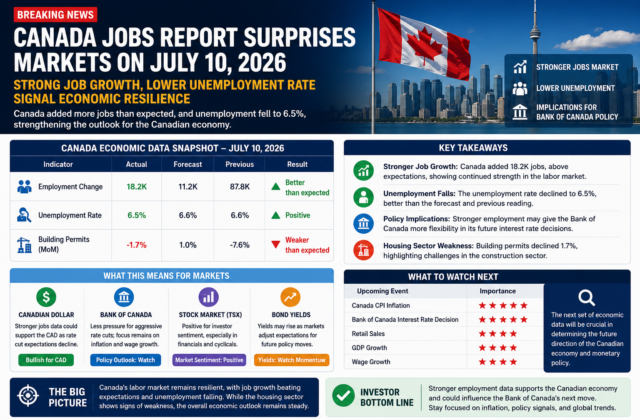
According to the latest labour market data released on July 10, 2026, Canada added 18.2K new jobs, comfortably beating the market expectation of 11.2K. At the same time, the country’s unemployment rate fell to 6.5%, improving from both the forecast of 6.6% and the previous reading of 6.6%.
The only weak point in the report came from Building Permits, which declined 1.7% month-over-month, compared with expectations for +1.0%.
While the housing sector showed softness, the labour market remained resilient—an outcome that could influence expectations for the Bank of Canada’s future interest-rate decisions.
Canada Economic Data Snapshot (July 10, 2026)
| Economic Indicator | Actual | Forecast | Previous | Result |
|---|---|---|---|---|
| Employment Change | 18.2K | 11.2K | 87.8K | ✅ Better than expected |
| Unemployment Rate | 6.5% | 6.6% | 6.6% | ✅ Positive |
| Building Permits (MoM) | -1.7% | +1.0% | -7.6% | ❌ Weaker than expected |
Why This Jobs Report Matters
Employment data is one of the most influential economic indicators for financial markets.
A stronger labour market generally suggests:
- Businesses continue hiring.
- Consumer spending may remain resilient.
- Wage growth could stay firm.
- Economic activity remains stable.
For policymakers, employment trends are closely tied to inflation and future interest-rate decisions.
Today’s figures suggest Canada’s economy remains more resilient than many analysts had expected.
What Could This Mean for the Canadian Dollar?
A stronger-than-expected employment report is often viewed as supportive for the Canadian dollar (CAD) because it may reduce expectations for aggressive interest-rate cuts.
Currency traders will now watch whether today’s data changes market expectations surrounding the Bank of Canada’s next policy meeting.
If investors believe the central bank has more room to keep rates elevated, the Canadian dollar could receive additional support.
Bank of Canada Faces a New Question
The latest employment figures complicate the outlook for monetary policy.
While inflation remains an important consideration, today’s labour market data suggests economic activity has not weakened as much as some had anticipated.
The central bank will likely continue monitoring:
| Economic Factor | Why It Matters |
|---|---|
| Employment Growth | Indicates labour market strength |
| Inflation | Guides interest-rate policy |
| Wage Growth | Influences inflation pressures |
| Consumer Spending | Reflects economic resilience |
| Housing Market | Sensitive to borrowing costs |
Future policy decisions will depend on how these indicators evolve over the coming months.
Market Reaction to Watch
The employment report has implications beyond Canada.
Investors across global markets may monitor:
- USD/CAD for currency volatility.
- Canadian government bond yields.
- TSX equity performance.
- Commodity-linked currencies.
- Broader risk sentiment in North American markets.
A stronger labour market can influence expectations across multiple asset classes.
Why the Building Permits Data Shouldn’t Be Ignored
Although the employment numbers were encouraging, the decline in building permits highlights ongoing challenges in the construction and housing sectors.
This softer reading may indicate caution among developers or continued pressure from financing costs.
Markets will assess whether this weakness remains isolated or develops into a broader trend.
What Investors Should Watch Next
The strength of today’s jobs report does not guarantee a sustained economic acceleration.
Upcoming releases that could shape market expectations include:
| Upcoming Event | Market Importance |
|---|---|
| Canada CPI Inflation | ⭐⭐⭐⭐⭐ |
| Bank of Canada Meeting | ⭐⭐⭐⭐⭐ |
| Retail Sales | ⭐⭐⭐⭐ |
| GDP Growth | ⭐⭐⭐⭐ |
| Wage Growth | ⭐⭐⭐⭐ |
| Manufacturing Data | ⭐⭐⭐ |
Together, these indicators will help determine whether today’s employment surprise marks the beginning of a stronger trend or a single-month improvement.
Final Thoughts
Canada’s latest employment report delivered a clear upside surprise.
Job creation exceeded expectations, unemployment edged lower, and the labour market once again demonstrated resilience despite broader economic uncertainty.
While the housing sector continues to show signs of weakness, today’s report strengthens the case that Canada’s economy remains on relatively solid footing.
For investors, traders, and policymakers, the data offers a fresh perspective on where the Canadian economy may be heading in the second half of 2026.
About TheBusinessNow
TheBusinessNow delivers global coverage of business, finance, technology, geopolitics, commodities, and economic trends. Our goal is to provide readers with original, fact-based analysis that explains how world events shape markets and investment decisions.
Keep reading
Related Articles
 Crypto
₿ Bitcoin Breaks Above $72,000: Why Trump’s Crypto Push Is Sending Crypto Stocks Higher
Bitcoin’s $72,000 Move Is Bigger Than Bitcoin A typical crypto headline would be: Bitcoin jumps above $72,000. But that misses the most important part of today’s move. The interesting part is the simultaneous rally in: Bitcoin ↓ Coinbase ↓ Strategy ↓ Circle ↓ Robinhood ↓ Bitcoin miners ↓ Crypto infrastructure That tells us investors aren’t...
 Markets
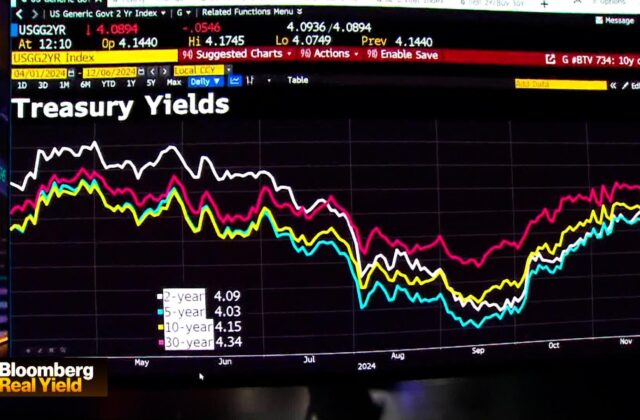
U.S. Treasury Doubles Bond Buybacks: Why Markets Are Still Worried About Rising Yields
The Treasury Just Sent Two Messages to Wall Street At first glance, this looks like a straightforward market-support operation. Treasury says: We want to improve liquidity in longer-dated Treasury securities. Investors hear: Washington is increasingly concerned about the rise in long-term borrowing costs. And that second interpretation is what makes this story important. The Treasury...
 Commodities
Oil Nears $95: Could the Iran War Trigger a New U.S. Inflation Shock?
Oil at $95 Is Not the Real Story A crude-oil headline is easy to write: “Oil prices rise as Iran tensions escalate.” Reuters, Bloomberg, CNBC and WSJ can publish that story within minutes. But for TheBusinessNow, that isn’t enough. The bigger question is: What happens to the American economy if oil stays near $95 —...
Comments (0)